
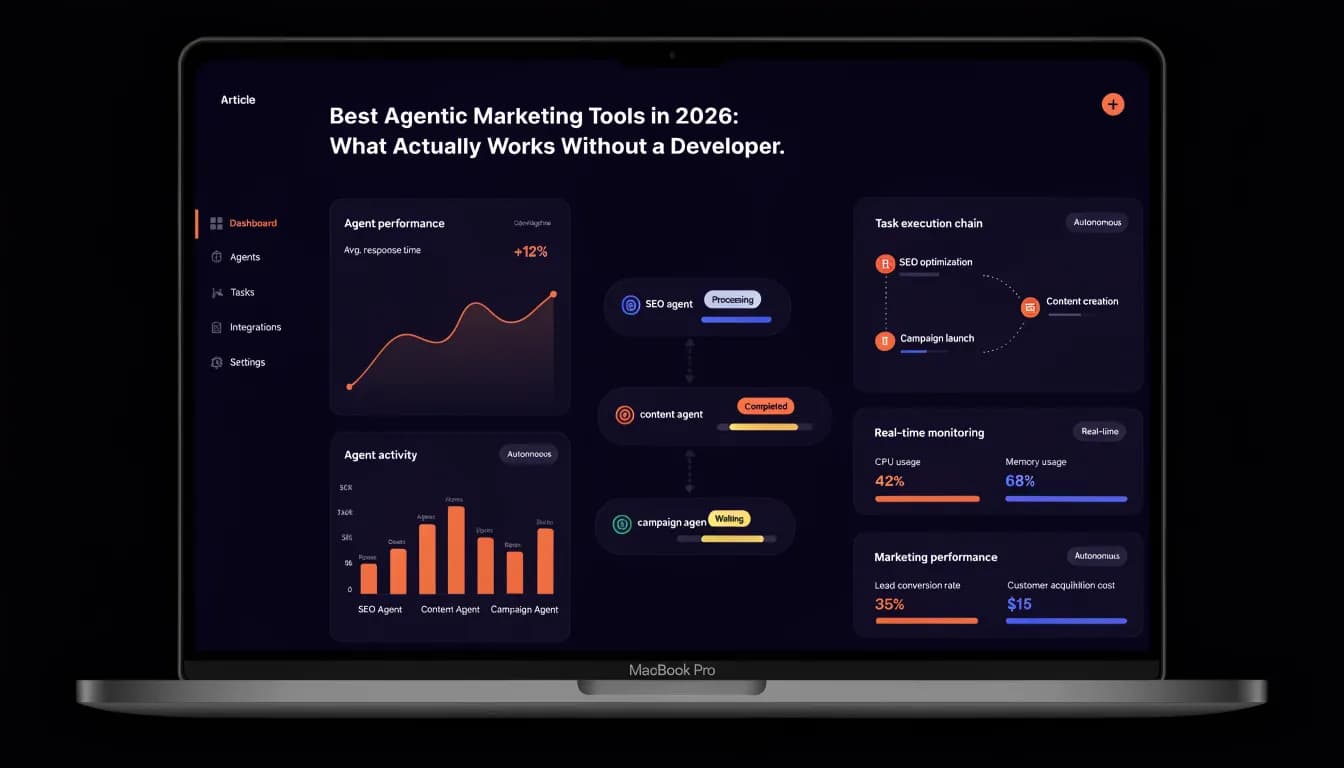
You spent six hours last Tuesday configuring a Zapier workflow that was supposed to run itself. It does run — if you remember to check that the Google Sheet is formatted correctly, that the webhook hasn't timed out again, and that someone manually approved the content before the scheduler fires. You built an automation. You did not build an agent. There is a difference, and it is the difference that determines whether your stack saves you time or just moves the manual work to a different screen. Most tools marketed as "agentic AI" are actually very smart autocomplete. Does yours plan, execute, and adapt — or does it wait for you to tell it what to do next?
Your marketing stack is almost certainly doing less than the vendor promised. Not because the tools are bad — but because "AI-powered" has come to mean anything from a GPT wrapper on a text field to a genuinely autonomous workflow that monitors conditions, makes decisions, and executes across multiple systems without you babysitting it. The gap between those two things is enormous. And the marketers who are actually pulling away from the field right now are the ones who figured out which side of that gap they are on.
The catch: most tools that are genuinely agentic were built by engineers, for engineers. If you have ever opened n8n or Dify and thought "I can see why a developer loves this" — and then closed the tab — you are not alone. A 2025 Salesforce survey found that 47% of marketing leaders cite "complexity of setup and maintenance" as the primary barrier to adopting AI agents. The second most common answer was not cost. It was "we don't have a developer available to configure it."
That framing is about to shift. The market for marketing-native agentic AI is exactly where the market for SaaS was in 2010 — a handful of tools are trying to make developer-level power accessible to people who just need results. Some are further along than others.
This is a comparison of seven platforms that genuinely qualify — or are trying to qualify — as agentic marketing tools in 2026. For each one, you will get a direct assessment of what "agentic" actually means in practice on that platform, who it is built for, and what it costs.
What Actually Makes a Marketing Tool "Agentic"
The word is being stretched. Before getting into the list, here is the framework used to evaluate every platform here.
Understanding agentic marketing as a practice helps, but what you actually need to know is which tools implement it. A genuinely agentic marketing tool does three things that a standard AI tool does not:
Plans independently. It takes a goal ("grow organic traffic for this product cluster by 20% this quarter") and breaks it into a sequence of actions without you mapping out each step. Standard AI waits for instructions. An agent decides what to do first.
Executes across systems. It does not just generate a recommendation — it acts. It creates content, schedules it, monitors performance, and adjusts the next step based on what happened. This requires real integrations, not just API documentation.
Adapts based on results. When a campaign underperforms, an agent recalibrates the approach without you filing a support ticket or writing a new prompt from scratch. This is the hardest part to build, and the part most vendors are quietly skipping.
Tools that only generate content, or that require manual human steps between every action, are not agentic in any meaningful sense. They are good tools. They are not agents.
With that established — here are seven platforms, ranked by how close they actually come to that definition for marketing teams.

1. Allable.ai — Best Agentic Platform Built for Marketers
Price: Free forever | Pro: €31/month | Business: €91/month
Allable.ai is the only platform on this list built from the ground up for marketing teams — not for developers who want to automate marketing tasks. That distinction sounds minor. In practice, it determines whether you spend your first day writing workflows or doing actual marketing work.

The agentic architecture in Allable works through a network of specialized agents — one for SEO analysis, one for content creation, one for competitive intelligence, one for campaign planning — that share a persistent memory of your business context. You do not configure pipelines. You describe a goal ("I want to rank for this cluster of keywords within 90 days") and the system figures out the sequence: SERP analysis, content gap identification, brief generation, draft creation, internal linking, and publish scheduling.
What separates this from a chatbot with a task list: the agents read signals from your connected accounts (Google Search Console, Google Analytics, Meta Ads) and adjust strategy based on what is actually happening. If a piece of content drops in rankings, the system surfaces it as a refresh candidate, generates an updated brief based on current SERP data, and queues it — without a human triggering the process.
The setup time is measured in minutes, not days. There is no developer required. If you know how to use Notion or Semrush, you can configure Allable.ai.
What it does well: Full marketing workflow coverage in one platform — SEO, content, social, campaigns, analytics, local, competitive intelligence. The agents are actually connected to each other, not siloed.
Honest limitation: The platform is newer than the legacy tools on this list. Some enterprise-grade customization that Writer.com or Jasper offer (custom model fine-tuning, granular permission layers) is still in development.
Who it is for: Marketing teams of 2–25 who want agentic automation without hiring a developer or paying for a five-tool stack.
2. Writer.com — Best for Enterprise Teams With Dedicated IT Support
Price: Team: $18/user/month | Enterprise: custom pricing (typically $50,000+/year for full agentic features)
Writer.com has made the most credible enterprise-grade bet on agentic AI among the established content platforms. Its Knowledge Graph — a structured representation of your company's voice, terminology, facts, and guidelines — feeds directly into agents that can execute tasks like drafting on-brand campaign copy, generating product descriptions at scale, or running compliance checks across content before publish.

The agentic workflow builder (called "Palmyra Workflows" internally) is genuinely sophisticated. You can build multi-step sequences that span content creation, review routing, and CMS publishing. The agents access your data sources, reason over them, and produce outputs that require minimal human editing.
The reality check: accessing the full agentic suite requires an Enterprise contract. The Team plan gives you a strong AI writing assistant. It does not give you agents that plan and execute autonomously. The gap between those two tiers is significant — and the pricing gap between them is even more significant. If you are a team of five, the math rarely works out.
What it does well: Brand consistency at scale, enterprise compliance, genuinely sophisticated Knowledge Graph that improves output quality over time.
Honest limitation: The full agentic feature set is enterprise-gated. Small and mid-market teams get a well-branded AI writing tool, not an autonomous agent.
Who it is for: Enterprise marketing and content teams with $50K+ annual software budgets and a dedicated AI/IT implementation resource.
3. Copy.ai — Best for Sales-Led Growth Teams Focused on Pipeline
Price: Free plan (limited) | Starter: $36/month | Advanced: $186/month | Enterprise: custom
Copy.ai rebranded itself as a "GTM AI Platform" in 2024 — a positioning that accurately describes what it does well and where it falls short for pure marketing use cases. For a detailed breakdown of features and pricing, see our Copy.ai review. The platform is strongest at the intersection of sales and marketing: prospecting workflows, outbound sequences, account research, and persona-driven content at scale.

The agentic elements are real but narrowly scoped. Copy.ai's workflows automate sequences of AI-powered steps — research a company, generate personalized outreach, draft a follow-up, update a CRM field. Within that GTM lane, it works. The agents are reliable, the output quality is high, and the integrations with HubSpot and Salesforce are genuinely useful.
Where it struggles as an agentic marketing platform: SEO is an afterthought, there is no native analytics integration that feeds back into content strategy, and the "agent" model is more "task automation" than genuine planning and adaptation. You define the workflow; it executes it. That is automation, not agency.
What it does well: Sales and marketing alignment, personalized outbound at scale, account-based marketing content workflows.
Honest limitation: Not built for SEO-led content marketing, organic growth, or multi-channel campaign management. If your primary growth channel is organic search, this is not the right tool.
Who it is for: Revenue-focused marketing teams running outbound or ABM programs where the primary KPI is pipeline, not traffic.
4. Jasper — Best for Brand Governance Across Large Creative Teams
Price: Creator: $49/month | Pro: $69/month | Business: custom
Jasper has evolved considerably from its early days as an AI writing assistant, and the 2025 "Jasper Everywhere" launch represents its most serious attempt at agentic positioning. The geo-targeted AI agent (which Jasper calls its "marketing agent") can create campaigns, adapt content for different markets, and distribute across channels from a single brief.

For a deeper look at how this plays out in practice, see our full Jasper AI review.
The brand voice features are the strongest on this list. Jasper's Brand IQ system ingests your brand guidelines, past content, and style preferences to build a persistent voice model that improves over time. For large creative teams managing content across multiple markets, channels, and formats simultaneously, that brand consistency layer is genuinely valuable.
The honest limitation: Jasper's "agentic" features are better described as structured campaign automation than true autonomous planning. The system executes well-defined workflows — it does not originate strategy based on performance signals. You still need to tell it what to do. And at $69/month per seat for a team of ten, the cost accumulates quickly relative to platforms that cover a broader marketing workflow.
What it does well: Brand-consistent content at scale, multi-market adaptation, strong template library for campaign formats.
Honest limitation: Requires clear human-defined campaign briefs. Does not read analytics, does not adapt strategy based on what is or is not working.
Who it is for: Brand-led marketing teams — especially agencies and enterprise creative teams — where consistency across content is more important than autonomous optimization.
5. n8n — Best for Developers Who Want Maximum Flexibility
Price: Free (self-hosted) | Cloud Starter: $20/month | Pro: $50/month | Enterprise: custom
n8n is not a marketing tool. It is a developer-grade workflow automation platform that happens to be very powerful for marketing use cases — if you have a developer. That distinction matters enormously for the majority of marketing teams.

The AI agent capabilities in n8n are technically impressive. You can build multi-agent workflows with memory, tool access, and conditional logic that rivals what dedicated AI agent platforms charge enterprise pricing for. The open-source architecture means you can connect anything — your CRM, your custom data warehouse, your niche analytics platform — without waiting for a vendor to build an official integration.
For a deeper look, see our full n8n for marketing review.
The cost of that flexibility is the setup reality. A meaningful n8n marketing automation workflow requires understanding of HTTP requests, JSON data structures, and at minimum a working knowledge of how APIs authenticate. The learning curve that an experienced developer clears in a few hours can take a marketing manager weeks — and some workflows are effectively inaccessible without technical help.
If you have a developer on the team or the budget to hire one for setup: n8n is extraordinarily capable and the value-for-money at the Cloud tier is exceptional. If you do not: this tool will cost you more in time than it saves.
What it does well: Unlimited flexibility, deep integrations, AI agent nodes with real memory and planning capability, exceptional value if you have technical resources.
Honest limitation: Requires developer expertise. Not a marketing-native tool. Setup time and maintenance overhead are significant.
Who it is for: Technical marketing teams, growth engineers, and companies with in-house developers willing to invest in building custom automation infrastructure.
6. Make.com — Best Visual Workflow Builder (With Caveats)
Price: Free (1,000 operations/month) | Core: $9/month | Pro: $16/month | Teams: $29/month | Enterprise: custom
Make.com occupies a middle ground between the no-code approachability of Zapier and the power of n8n. The visual scenario builder is genuinely one of the best in the automation space — dragging modules together to create multi-step workflows is intuitive, and the library of 1,500+ integrations covers nearly every marketing tool you are likely to be using.

The honest truth about its "agentic" credentials: Make.com is not an agentic AI platform. It is a powerful automation platform that can call AI APIs (including OpenAI, Claude, and others) as steps within a workflow. You can build something that looks agentic — trigger → AI analysis → conditional logic → action — but the intelligence lives in the API you are calling, not in Make itself.
That is not a criticism. For rule-based marketing automation (when lead score exceeds X, do Y; when article is published, distribute via Z channels), Make.com is excellent. For autonomous AI agents that plan, adapt, and learn from performance data — it is not the right tool.
What it does well: Visual workflow building, broad integration library, approachable for non-developers, cost-effective for high-volume automation.
Honest limitation: Not genuinely agentic. Requires you to design the logic; the AI tools it calls are external. No native marketing intelligence layer.
Who it is for: Marketing operations teams who need reliable trigger-based automation and want more flexibility than Zapier without the complexity of n8n.
7. Dify — Best Open-Source LLM Orchestration for Technical Teams
Price: Free (self-hosted) | Cloud Sandbox: free | Cloud Professional: $59/month | Enterprise: custom
Dify is to LLM-based agents what n8n is to workflow automation: extraordinarily powerful, built for technical users, and not a marketing tool in any traditional sense. We covered the details of how Dify fits marketing workflows in a dedicated guide. The platform lets you build custom AI applications and agent pipelines using any major LLM, with a visual workflow builder that is meaningfully more accessible than raw API coding.
For a marketing team with a developer who wants to build truly custom agentic workflows — competitor monitoring agents, content scoring systems, real-time campaign adjustment agents — Dify provides a level of control that no SaaS marketing platform can match. You own the models, the data, and the logic.
The tradeoff is the same as n8n: significant technical investment for setup, ongoing maintenance overhead, and a learning curve that requires actual engineering capability. The "marketing native" experience does not exist here. You are building infrastructure that could support marketing automation, not using a tool designed to do marketing work.
What it does well: Custom AI agent architecture, full data ownership, supports local models (Ollama, etc.) for sensitive data use cases, strong community and documentation.
Honest limitation: Requires developer expertise. Building a functional marketing agent on Dify is a project measured in weeks, not hours. Not appropriate for marketing teams without technical resources.
Who it is for: Companies with strong technical teams who want full control over their AI stack and are willing to invest in building proprietary marketing automation infrastructure.
AI Marketing Automation Tools: How to Choose the Right One
After reviewing all seven platforms, the decision matrix comes down to two variables: your technical resources and your primary marketing objective.

Platform | Technical requirement | Best for | Starting price |
|---|---|---|---|
Allable.ai | None — marketing-native | Full-stack marketing automation | Free / €31/mo Pro |
Writer.com | Low (Team) / Medium (Enterprise) | Enterprise brand consistency | $18/user/mo |
Copy.ai | Low | Sales-led GTM and outbound | $36/month |
Jasper | Low | Brand governance, campaign automation | $49/month |
n8n | High (developer required) | Custom technical workflows | Free / $20/mo cloud |
Make.com | Low–Medium | Rule-based marketing automation | Free / $9/month |
Dify | High (developer required) | Custom AI agent infrastructure | Free / $59/mo cloud |
If you want agentic AI with zero development overhead: Allable.ai is the only platform on this list that delivers genuinely autonomous marketing workflows — SEO monitoring, content creation, competitive intelligence, and campaign management — without requiring a developer to configure or maintain the system.
If you are an enterprise team with IT support and a large budget: Writer.com delivers the most sophisticated brand AI for large organizations that can afford the implementation investment.
If your primary channel is outbound and pipeline: Copy.ai's GTM automation is the strongest in its lane.
If brand consistency across a large creative team is the priority: Jasper's brand governance features are unmatched among the content-specific platforms.
If you have a developer and want maximum control: n8n or Dify will give you capabilities no SaaS platform can match — at the cost of significant setup time.
The Best AI Tools for Marketing Know the Difference Between Automation and Agency
The most important question to ask any platform that claims to be "agentic": does it read your performance data and change what it does next, or does it execute the workflow you designed and stop?
Most tools on this list — including several that market themselves heavily on the "agentic AI" positioning — execute. They do not adapt. The workflow is as smart as you were when you designed it.
Genuine agentic behavior requires that the system monitor outcomes, compare them to goals, and recalibrate the plan autonomously. That is a significantly harder technical problem than generating good content or automating a sequence of tasks. As of mid-2026, only a small number of platforms are actually solving it.
The good news: you do not need to solve the developer problem to get there. Marketing-native agentic platforms exist now. The question is whether your current stack is keeping pace.
The shift from AI writing tools to genuinely agentic marketing platforms is happening faster than most marketing teams are moving. The gap between teams that have autonomous AI systems running their content and campaign operations and teams that are still manually orchestrating between six different tools is going to be measurable in traffic and pipeline by the end of this year. The question is not whether to adopt agentic marketing tools. It is whether your current stack is actually agentic — or just well-branded automation waiting for your next instruction.
Frequently Asked Questions
- What Is Agentic Marketing?
- Agentic marketing is a marketing operations approach where AI systems plan and execute marketing tasks autonomously — without requiring a human to manually trigger or supervise each step. In practice, this means software that monitors your performance data, identifies gaps or opportunities, generates and publishes content, adjusts targeting parameters, and reports results without waiting for manual input between each action. The term "agentic" comes from AI research, where an agent is defined as a system that perceives its environment, makes decisions, and takes actions to achieve a goal. Applied to marketing, it means replacing a significant portion of the campaign management and content operations workflow with AI systems that genuinely run themselves.
- What Are Agentic AI Tools and How Do They Differ From Standard AI?
- Standard AI tools respond to prompts. You ask, they generate, you review and act. Agentic AI tools do the asking themselves. They are given a goal and figure out the steps — which might include web research, content creation, data analysis, CMS publishing, and performance monitoring — without you mapping out the workflow. The practical difference: a standard AI tool saves you the time of writing a draft. An agentic AI tool saves you the time of managing the entire content lifecycle. The best agentic AI tools also learn from results: if a piece of content is underperforming, the agent surfaces it, generates a refresh brief based on current SERP data, and queues the update — without you noticing a problem first.
- Can AI Agents Replace a Marketing Automation Platform?
- For many mid-market teams, yes — agentic AI is replacing the combination of a marketing automation platform, a content tool, and an SEO platform. Where traditional marketing automation (HubSpot, Marketo, ActiveCampaign) excels at rule-based email sequences and lead scoring, agentic AI goes further: it creates the content, identifies the opportunities, adapts the strategy, and handles cross-channel execution from a single system. The platforms that cannot be replaced by agentic AI are those handling complex CRM workflows, advanced lead scoring models tied to sales processes, or high-volume transactional email. For content-led growth, SEO, and campaign management, agentic AI is increasingly the more capable and cost-effective choice.
- What Is the Difference Between Marketing Automation and AI Marketing?
- Marketing automation is rule-based: when condition X is true, take action Y. It is deterministic, reliable, and incapable of handling situations outside the rules you defined. AI marketing is intelligence-based: the system understands context, generates new outputs, and can handle novel situations. Agentic AI marketing combines both — it applies AI intelligence to decide what to do next, then executes those decisions automatically. The practical implication: marketing automation requires you to anticipate every scenario in advance. Agentic AI handles scenarios you did not think to plan for, because it is reasoning about the goal rather than following a script.
Stop Juggling 5 AI Marketing Tools
Allable replaces n8n, Dify, Jasper, and your SEO stack in one agentic marketing platform. No dev setup. Built for marketing teams who want automation power without the technical overhead.