Google Ads vs SEO: Which Channel Should You Invest In First?
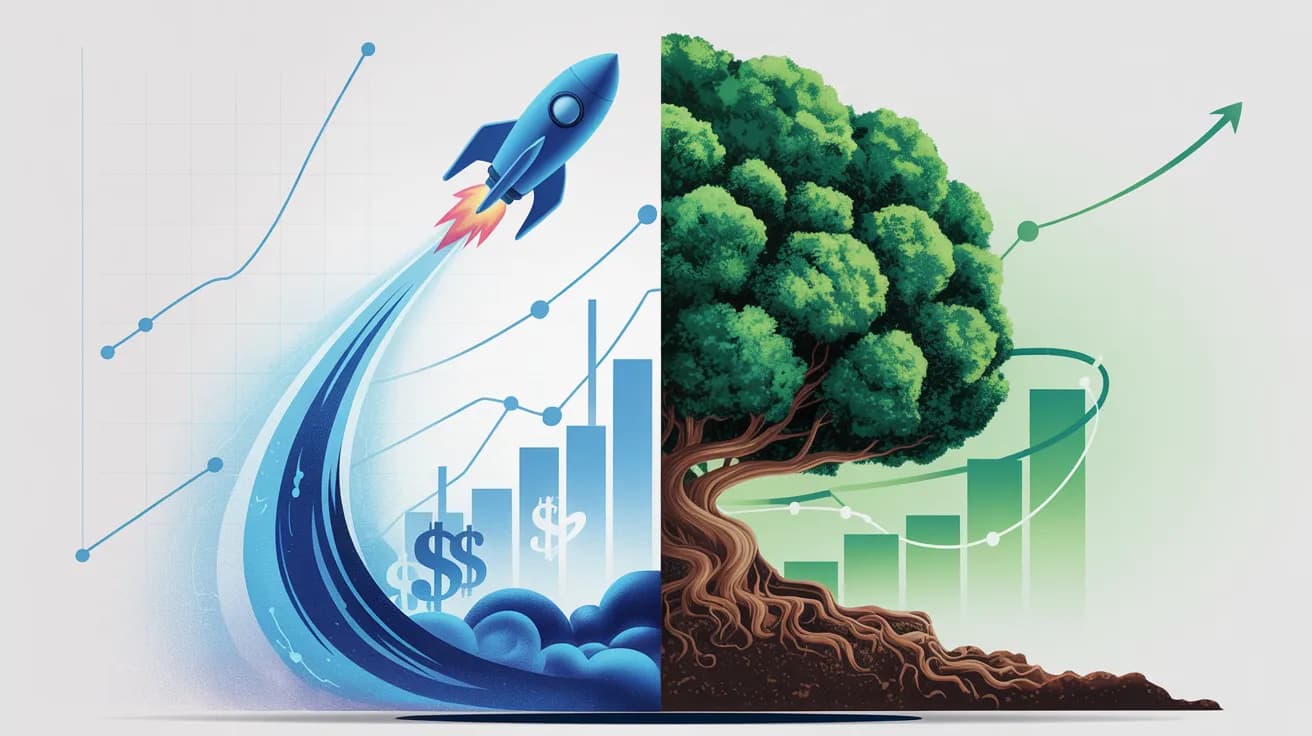
Google Ads gives you traffic by tomorrow. SEO builds traffic that compounds for years. Here is how to decide which channel to invest in first — based on your budget, timeline, and growth stage.
The question everyone gets wrong
Most comparisons between Google Ads and SEO frame it as a battle. That is the wrong lens.
The real question is not which channel is better. It is which channel is right for you, right now, given your budget, your timeline, and where your business actually is.
A brand-new startup with six months of runway needs a different answer than an established business playing the long game. This guide gives you both — grounded in real data, not marketing slogans.
What you are actually comparing
Google Ads (also called paid search or PPC) is an auction-based advertising system. You bid on keywords, your ads appear at the top of search results, and you pay each time someone clicks. The moment you stop funding the account, the traffic stops.
SEO (Search Engine Optimization) is the process of earning organic rankings in Google by producing relevant content and building authority over time. You do not pay per click — but you do invest time and money into content, technical optimization, and links. The returns accumulate long after the work is done.
Both channels compete for the same real estate: Google's search results page. But they do so through completely different mechanics, timelines, and economic models.
How Google Ads works — speed, costs, and the instant-off switch
Google Ads can put your business in front of buyers the same day you launch a campaign. After Google approves your ads (typically within one business day), traffic starts immediately. That speed is the channel's defining advantage.
But the economics deserve a hard look before you commit.
The real costs
The average cost-per-click across all industries is $5.26 in 2025 — up 12.88% year-over-year, according to WordStream's analysis of 16,000+ campaigns. That average masks enormous variation:
- Legal / Attorneys: $8.58 average CPC (personal injury keywords can exceed $137/click)
- Health and Fitness: around $5.00
- Travel: $2.12
- Restaurants: $2.05
- Arts and Entertainment: $1.60
The average cost-per-acquisition across all industries is $70.11, with a conversion rate of 7.52%. High-converting industries like automotive repair hit 14.67% CVR; finance and insurance sit at 2.55%.
For meaningful data in a new campaign, most practitioners recommend budgets of at least $3,000–$5,000/month during the learning phase. Below that threshold, Google's Smart Bidding algorithm does not accumulate enough conversion data to optimize effectively.
The timeline that surprises most advertisers
Yes, traffic starts on day one. But profitable traffic is a different story:
- Days 1–3: Ad approval and initial setup
- Days 7–14: Smart Bidding enters the learning phase — performance is volatile and inconsistent
- Day 30: Enough data to make meaningful optimization decisions
- 60–120 days: Stable, predictable ROI
Most advertisers who fail with Google Ads quit between days 7–21 — exactly when the algorithm is at its least reliable. The channel rewards patience just as much as SEO does, just on a shorter timeline.
What happens when you stop
When you stop paying, traffic stops instantly. There is no decay curve, no residual benefit. Competitors immediately access cheaper clicks in your absence, and when you restart, Smart Bidding has to re-learn from scratch — often performing worse than before the pause for the first 1–2 weeks.
Google Ads builds you a rental. The moment you stop writing cheques, you are back to zero.
The upside: high commercial intent
None of this means Google Ads is a bad channel. The median ROAS for search campaigns is 5.17x (Cassandra Media Mix Modelling study, 253 models), and 65% of people click paid ads when they are ready to purchase. For commercial and transactional queries, paid search is genuinely powerful.
How SEO works — the slow build that compounds
If Google Ads is a tap you can turn on and off, SEO is a reservoir you fill over time. The economics look painful at the start and increasingly attractive the longer you persist.
The timeline
Ahrefs polled 3,680 SEO professionals: the consensus timeline is 3–6 months to see meaningful results. Google's own guidance (from former Search Quality Strategist Maile Ohye) cites 4 months to a year. John Mueller has noted it can take up to a year for Google to fully establish a new site's position.
Only 5.7% of all web pages rank on page 1 within their first year. And 60% of the pages sitting in Google's top 3 results are at least three years old (Ahrefs). Organic rankings are a durable competitive moat — but one that takes years to build.
A realistic phased view:
- Months 1–3: Technical foundation, early quick-win rankings
- Months 3–6: Content starts generating traffic
- Months 6–12: Positive ROI becomes likely
- Year 2–3: Compounding authority — your best content keeps generating traffic without additional spend
The click-through reality
The number 1 organic position earns a 39.8% click-through rate (First Page Sage, 2026). The number 1 paid ad earns 2.1%. That is nearly 19x more clicks per position.
70% of searchers skip paid ads entirely and click organic results (HubSpot). The top 3 organic results together capture 68.7% of all SERP clicks. And organic search drives 53.3% of all website traffic globally — more than any other channel.
The economics over time
SEO lead close rates are 14.6%, compared to 1.7% for outbound channels — an 8.6x quality advantage. The median SEO ROI sits around 748% ($7.48 per $1 invested). Over a 36-month horizon, SEO ROI is 1.8x higher than PPC (SEO Works study).
Cost per lead tells the same story: $14 for organic leads vs. $44 for PPC leads — organic is 68% cheaper per lead. And organic visitors convert at 2.4% vs PPC's 1.3%.
The honest caveat
SEO is not risk-free in 2026. AI Overviews now appear on 31% of Google SERPs, and click-through rates on those queries have fallen significantly (though this primarily affects purely informational queries). Zero-click searches hit 60% of all queries in 2025.
SEO is changing. The fundamentals — quality content, real authority, technical health — still work. But thin content strategies no longer hold up.
Google Ads vs SEO: head-to-head
Neither channel is objectively superior — they serve different purposes at different stages. Here is how they compare across the metrics that matter most:
Time to first traffic — Google Ads: same day. SEO: 3–6 months.
Time to positive ROI — Google Ads: 2–4 months. SEO: 6–12 months.
Traffic when you stop — Google Ads: drops to zero instantly. SEO: continues and compounds.
Average CTR at position 1 — Google Ads: 2.1%. SEO: 39.8%.
Median ROI — Google Ads: ~350% (3.52x ROAS). SEO: ~748%.
Cost per lead (avg) — Google Ads: $44. SEO: $14.
Conversion rate (avg) — Google Ads: 1.3%. SEO: 2.4%.
Lead close rate — Google Ads: ~3%. SEO: 14.6%.
Requires ongoing spend — Google Ads: yes. SEO: no.
Best for — Google Ads: immediate revenue and testing. SEO: long-term growth and authority.
When to start with Google Ads first
For certain businesses and situations, Google Ads is the right first move — not because SEO is inferior, but because the immediate feedback and speed outweigh the long-term economics.
Start with Google Ads first if:
You need revenue within 90 days. New business with limited runway, a product launch, or a seasonal window — Google Ads delivers paying customers while SEO is still building in the background.
You are validating product-market fit. Before investing 12 months into content and SEO, Google Ads lets you test whether people actually search for what you sell, whether your landing page converts, and what messaging resonates — in weeks, not quarters.
Your CPCs are manageable. Industries with $2–$5 CPCs and good conversion rates (restaurants, travel, arts, fitness) can often generate profitable campaigns relatively quickly. Check your industry benchmarks before assuming it is expensive.
Your competitors own organic search. In some niches, page 1 is locked by domain authorities that will take years to displace. Google Ads gets you in front of buyers while you build the SEO foundation.
You are in a high-intent, transactional niche. When someone searches emergency plumber near me or buy running shoes, they want to act now. Paid search captures that moment better than an organic blog post.
Realistic budget expectations: for a new Google Ads account to generate enough conversion data for Smart Bidding to work effectively, plan for $3,000–$5,000/month minimum during the first 2–3 months.
When to start with SEO first
SEO is the right starting point for a larger set of businesses than most people assume — particularly those playing a longer game.
Start with SEO first if:
Your CPCs are prohibitively high. In legal, finance, insurance, and B2B SaaS, CPCs can run $8–$137 per click. At those prices, a meaningful Google Ads program requires tens of thousands per month just to test. SEO becomes economically rational by comparison.
You are building for the long term. If you are not in a rush for immediate revenue and thinking in years rather than quarters, SEO's compounding returns outperform PPC significantly. Over 36 months, the ROI is 1.8x higher.
You are in B2B. B2B buyers research extensively before making contact. High-quality content that ranks organically builds trust through that process in a way that ads rarely do. Organic traffic drives 76% of trackable B2B website visits.
You have content assets and expertise. If your team has genuine subject-matter expertise, that is an SEO moat. Google's quality signals increasingly reward first-hand experience and original insight — things AI cannot replicate and competitors cannot easily copy.
Your business model rewards customer lifetime value. Organic leads close at 14.6% and deliver 15–30% higher customer lifetime value than paid traffic. For subscription businesses, professional services, and SaaS, the lead quality difference is material.
What happens when you run both at the same time
The most honest answer to Google Ads vs SEO is often: both, with a deliberate allocation.
The synergies are real and documented:
Running both channels reduced customer acquisition cost by 30–32% in documented case studies, because brand familiarity from organic presence improves paid ad performance.
Dual SERP presence — owning both an organic result and an ad for the same query — lifts combined click-through rate by 20–30% compared to ads alone.
SEO-optimized landing pages lower your Google Ads cost-per-click by 15–25% through better Quality Scores. A Quality Score improvement from 6/10 to 8/10 can cut CPC by 20% while increasing lead volume by 27%.
Combined channel programs have shown +72% traffic and +58% conversions over six months versus single-channel approaches.
The most effective model is sequential integration: use Google Ads to generate revenue and gather real conversion data (which keywords drive buyers, which landing pages convert, which messaging resonates), then use those insights to direct your SEO content investment. The ads teach you what to rank for organically.
Over time, the budget naturally rebalances: ads start high and taper as organic rankings kick in; SEO starts slow and grows to carry more of the load.
Practitioner budget allocation benchmarks:
- Validation-first (pre product-market fit): 70–90% paid, 10–30% SEO
- Growth-seeking (established product): 50–70% paid, 30–50% SEO
- Patient moat-building: 40–60% SEO, 40–60% paid
A simple decision framework
If you are still unsure which to start with, run through these four questions:
- How much runway do you have? Less than 12 months points to Google Ads first. 12+ months and growing makes SEO viable from day one.
- What are your target CPCs? Under $5/click means Google Ads is affordable — start there. Over $8/click means SEO economics are significantly more attractive.
- What is your content capacity? Can you produce 4–8 substantive pieces of content per month? If yes, SEO is a real option. If you have no content resources, focus budget on Google Ads.
- What is your conversion path? High-intent transactional queries favor Google Ads. Research-heavy B2B or complex purchases favor SEO to build the trust required to convert.
Most businesses that answer these honestly land here: Google Ads to generate near-term revenue, SEO to build long-term leverage — started in parallel as soon as budget allows.
The bottom line
Google Ads and SEO are not opponents. They are different tools for different phases of growth.
Google Ads is a paid media channel with immediate, measurable returns — best when you need revenue now, when you are testing assumptions, or when your organic presence has not matured. The median search ROAS of 5.17x means it works well when managed properly.
SEO is a compounding asset — slower to build, harder to copy, and significantly more capital-efficient over a 2–3 year horizon. A number 1 organic ranking earning 39.8% click-through generates far more value per dollar invested than any paid campaign over time.
The question is not which channel is better. It is which is right for where you are right now — and whether you have the budget and patience to invest in both.
If you want to run both channels without juggling five different tools, Allable handles keyword research, content creation, and competitor analysis in one place. Try it free and see how quickly you can move from research to published content.