
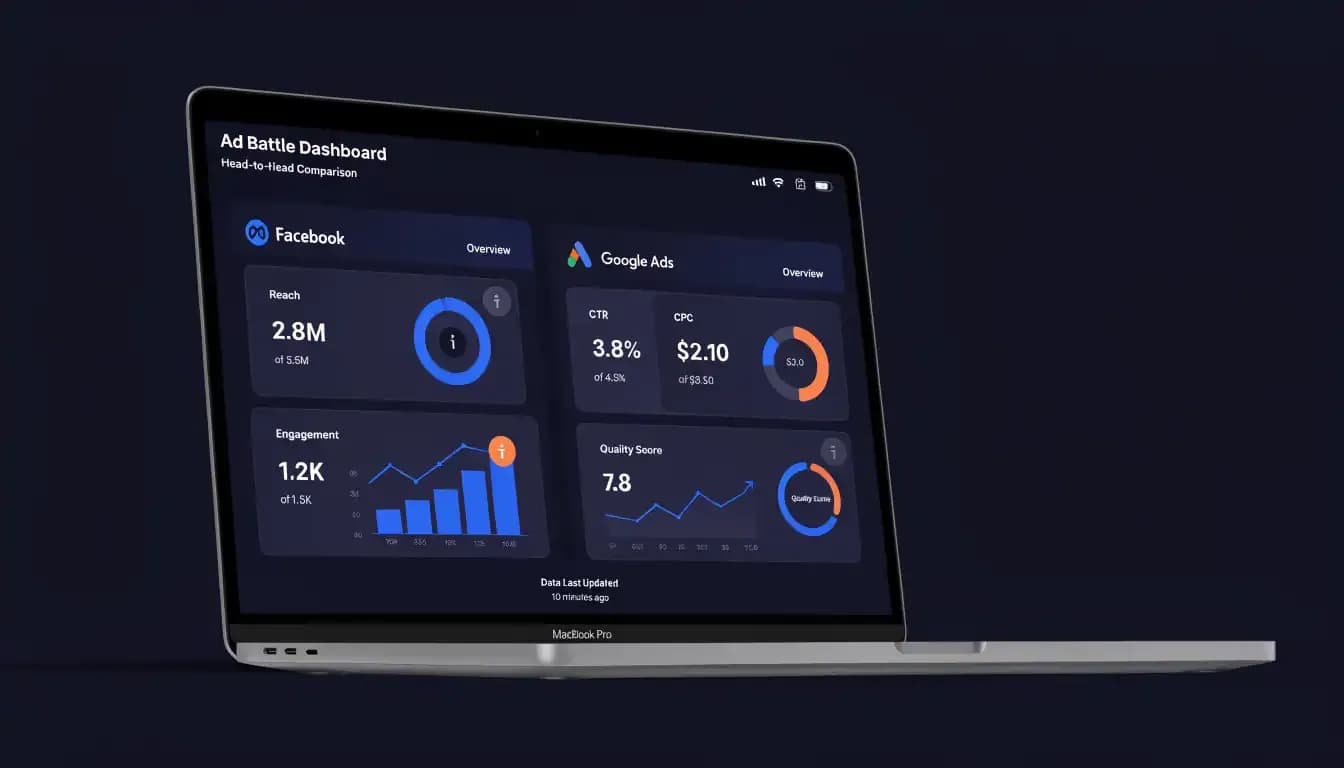
Facebook Ads vs Google Ads: compare costs, targeting, formats & ROI in 2026. Find out which platform wins for your business — or why you need both.
Quick Answer: Google Ads wins when people are already searching for what you sell — it captures high-intent demand and converts at roughly 7.5% on average. Facebook Ads wins when you need to build awareness, reach new audiences, or sell visually-driven products at a lower cost per click. For most businesses in 2026, the smartest move is running both together as a full-funnel system.
Every marketer with a budget has faced the same crossroads: should you spend on Facebook Ads or Google Ads? It sounds like a simple either/or question, but the real answer depends on your goals, your audience, and where your customers are in the buying journey. Both platforms are massive, both are getting smarter with AI, and both can deliver serious ROI — if you use them correctly. Let's break down exactly how they compare in 2026.
Facebook Ads vs Google Ads: The Core Difference
The single most important distinction between these two platforms comes down to intent versus interruption.
Google Ads is demand capture. When someone types "best CRM for small business" or "emergency plumber near me" into Google, they're actively looking for a solution. Your ad appears exactly when they're ready to buy. With over 5.8 billion searches happening on Google every day, you're fishing in a pond where every fish is already hungry.
Facebook Ads is demand creation. Nobody opens Facebook to find a product — they're scrolling through their feed, watching Reels, or catching up with friends. Your ad interrupts that scroll and introduces them to something they didn't know they needed. It's interruptive, but with 3.07 billion monthly active users, the targeting precision is unmatched. You can put the right message in front of the right person before they ever think to search for it.
This fundamental difference shapes everything: how you write your ads, how you measure success, what budgets make sense, and which businesses thrive on each platform. In 2026, both platforms are blurring the lines — Google's Performance Max now runs across YouTube and Gmail, while Meta's Advantage+ uses AI to optimize placements like Google's smart campaigns — but the core intent vs. interruption dynamic still holds.
Facebook Ads vs Google Ads at a Glance
Here's how the two platforms compare across the metrics that matter most in 2026:
Factor | Facebook Ads (Meta) | Google Ads |
|---|---|---|
Avg. CPC (US) | ~$1.14–$1.72 | ~$5.42 (Search) |
Avg. CPM | $6.96–$13.48 | ~$3.12 (Display) |
Avg. CTR | 1.57%–2.19% (Feed) | 6.66% (Search) |
Avg. Conversion Rate | 1.8%–3.5% (cold traffic) | 4.4%–7.5% |
Avg. Cost Per Lead | $18–$40 | $45–$85 |
Best for | Awareness, mid-funnel, retargeting | High-intent, bottom-funnel |
Ad Formats | Image, video, carousel, Stories, Reels | Search text, Shopping, Display, YouTube |
Targeting | Demographics, interests, behaviors, lookalikes | Keywords, intent, topics, demographics |
Audience Size | 3.07B monthly active users | 5.8B daily searches |
Learning Curve | Moderate | Moderate–High |
AI Bidding | Advantage+ Suite | Performance Max 2.0 |
Sources: WordStream 2026 Google Ads Benchmarks; Superads/Visiblefactors Facebook Ads Benchmarks 2026; Stackmatix 2026 Comparison.
The numbers tell an interesting story: Google's average CPC is roughly 4–5x higher than Facebook's, but Google's conversion rate is also 2–3x higher. Higher cost per click doesn't automatically mean worse ROI — it means higher intent.
When Facebook Ads Work Better
Facebook (Meta) Ads tend to outperform Google in specific scenarios. You should lean toward Facebook when:
You're building brand awareness. Nobody searches for a brand they've never heard of. Facebook lets you introduce your product to exactly the right audience — by age, location, income, interests, and even life events — before they ever think to search for you on Google.
Your product is visual or lifestyle-driven. Fashion, beauty, food, home décor, fitness, and consumer goods shine on Meta's visual-first formats. A stunning product video in a Reel or a carousel of before-and-after images can generate impulse purchases that keyword-intent never could.
You want to reach a specific audience demographic. Want to target new parents in Austin with household incomes over $75K who are interested in organic products? Facebook's behavioral data from 3.07 billion users makes that possible. No other platform offers this level of audience granularity for cold audience prospecting.
You're selling impulse purchases. The social scrolling environment creates spontaneous buying behavior. Products priced under $100 with immediate visual appeal — gadgets, accessories, subscription boxes — consistently perform well on Facebook's feed placements.
You're retargeting website visitors. The Meta Pixel lets you serve highly personalized ads to people who've already visited your site, viewed a product, or added something to their cart. Retargeting campaigns on Meta often deliver the platform's strongest ROAS. For a deeper dive into the full Meta advertising toolkit, see our complete Meta Ads guide.
Your budget is limited. With average CPMs of $6.96–$13.48 and CPCs around $1.14–$1.72 across industries (2026 benchmarks), Facebook lets you reach a large audience for less money upfront — especially valuable when you're still testing messaging and creative.
When Google Ads Work Better
Google Search Ads are the go-to channel when purchase intent is clear. Choose Google when:
People are actively searching for your product or service. If someone types "buy standing desk online" or "SEO tool for agencies," they're ready to buy. Google puts your offer directly in front of that high-intent searcher at the exact right moment — and pays off with an average conversion rate of 4.4%–7.5% across industries (WordStream 2026).
You're in a local services business. Plumbers, dentists, lawyers, contractors — service businesses with immediate needs get exceptional results from Google Search. A search for "emergency electrician [city]" is as high-intent as it gets. Industries like Automotive Repair see conversion rates of 14.67% on Google Search (WordStream 2025 benchmarks).
You're selling considered, high-ticket purchases. B2B software, legal services, financial products, and healthcare — these require research and comparison before a decision. Google captures that active research behavior. B2B/SaaS on Facebook Ads averages $2.94 CPC, but Google delivers the intent-driven clicks that B2B buyers make.
Speed matters. For a campaign that needs to generate leads this week — a product launch, an event, a seasonal promotion — Google Search can drive qualified traffic from day one without the algorithm learning phase that Facebook requires. If you're new to pay-per-click, our guide to what is PPC advertising covers everything you need to get started.
You have a clear, searchable value proposition. If someone would logically type what you sell into a search bar, Google Ads is your strongest channel. If your product solves a problem people don't yet know they have, Facebook is the better choice to create that awareness.
You want Shopping ads. For ecommerce, Google Shopping lets you show product images, prices, and reviews directly in search results — capturing buyers at the moment of highest purchase intent with a format that's inherently more relevant than text alone.
Cost Comparison: Facebook Ads vs Google Ads
Cost is often the first question marketers ask, but comparing raw CPC figures is misleading without understanding conversion rates and cost per acquisition.
CPC (Cost Per Click)
The average Google Ads CPC in 2026 is $5.42 (WordStream/LocaliQ benchmarks, 16,000+ campaigns). Competitive industries push much higher: Attorneys & Legal Services average $9.87, Home & Home Improvement $8.33, and Dentists $8.00.
Facebook's average CPC sits far lower: $1.14 globally, approximately $1.24 in the US (Superads, January 2025–January 2026 data from $3B in ad spend). Traffic campaigns average just $0.70 per click, while lead gen campaigns average $1.92.
CPM (Cost Per Thousand Impressions)
For brand reach campaigns, Google Display averages $3.12 CPM, while Facebook's median CPM is $13.48 — making Google Display cheaper for sheer impression volume, though Facebook's targeting precision often makes the premium worthwhile.
Where It Gets Interesting: Cost Per Lead & Cost Per Acquisition
Google's average cost per lead across industries is $66.69 (WordStream 2026). Facebook's median cost per acquisition is $38.17. On the surface, Facebook looks cheaper. But lead quality matters:
- A $50 Google lead that converts at 4% costs $1,250 per customer
- A $25 Facebook lead that converts at 1.5% costs $1,667 per customer
The cheaper lead isn't always the cheaper customer. Always compare cost per customer (not just cost per lead) across both platforms using consistent attribution windows.
Budget Guidance for 2026
- Under $1,000/month: Start with Google Search for clear-intent products. The algorithm needs less learning budget than Facebook.
- $1,000–$5,000/month: Run Google Search as primary, test Facebook retargeting to warm audiences.
- $5,000+/month: Invest in both platforms as a full-funnel system. Google captures active demand; Facebook builds the top and middle of the funnel.
Targeting Capabilities Compared
This is where the platforms diverge most sharply.
Facebook's Targeting Edge
Facebook's data advantage comes from what users voluntarily share: age, location, relationship status, job title, life events (new baby, new home, recently engaged), interests, and behaviors. The platform allows you to build incredibly specific audience profiles:
- Core Audiences: Demographics, location, interests, behaviors
- Custom Audiences: Upload customer lists, target website visitors via Pixel, reach app users
- Lookalike Audiences: Find new users who resemble your best customers
- Advantage+ Audiences: AI-powered audience expansion that finds your best customers automatically
Both platforms let you target by age, gender, location, and income. But Facebook goes dramatically deeper — targeting parents with children ages 5–7, vegetarian pet owners, or people who've recently moved.
Google's Targeting Edge
Google's power is keyword intent. You're not guessing about who might be interested — you're reaching people in the act of looking for what you sell.
- Search Keywords: Exact, phrase, and broad match targeting
- Audience Segments: In-market, affinity, and custom intent audiences
- Customer Match: Upload your email list to target or exclude existing customers
- Similar Segments: Find new users similar to your existing converters
- Geographic & Device Targeting: Bid adjustments for location, device, time of day
In 2026, Google's AI has significantly improved audience targeting through Performance Max, which automatically allocates budget across Search, Display, YouTube, and Gmail to find your best converters — making intent-based targeting more accessible than ever.
Ad Formats: What Can You Create?
Facebook Ads Formats
Facebook offers some of the most creative ad formats in digital advertising:
- Image Ads — Single static image; simplest format, still effective
- Video Ads — From 1 second to 241 minutes; short-form Reels dominate in 2026 (73% of top-performing Q1 2026 ads were video)
- Carousel Ads — Up to 10 images or videos in a swipeable format; excellent for ecommerce catalogs
- Collection Ads — Mobile-first format with a hero image/video plus product grid; instant purchase experience
- Stories & Reels Ads — Full-screen vertical format; Reels placement shows 26% lower CPC than feed placements in 2026
- Instant Experience (Canvas) — Full-screen immersive mobile experience
- Lead Ads — Native lead forms that collect info without leaving the platform
Google Ads Formats
Google's ad ecosystem spans every corner of the internet:
- Responsive Search Ads (RSAs) — AI assembles the best combination of up to 15 headlines and 4 descriptions to match each search query
- Performance Max — Single campaign type that runs across Search, Display, YouTube, Gmail, and Maps simultaneously
- Shopping Ads — Product image, price, and store name shown directly in search results
- Display Ads — Visual banner ads across 35 million websites and apps in the Google Display Network, reaching 90%+ of internet users
- YouTube Ads — Video ads before, during, or after YouTube videos (skippable, non-skippable, bumper)
- Demand Gen — Social-style visual campaigns across YouTube, Discover, and Gmail
In 2026, both platforms are heavily AI-driven: Meta's Advantage+ automates creative and audience optimization, while Google's Performance Max uses machine learning to find the best moments and placements automatically.
Measuring Performance: Key Metrics for Each
Measuring success on these platforms requires platform-specific benchmarks — don't compare Facebook CTR to Google CTR and draw conclusions.
Google Ads Metrics to Track
Metric | 2026 Benchmark |
|---|---|
CTR (Search) | 6.66% avg. (aim for your industry average) |
Conversion Rate | 7.52% avg. across industries |
Cost Per Click | $5.42 avg. Search; $0.63 Display |
Cost Per Lead | $66.69 avg. |
Quality Score | Aim for 7–10 (affects CPC and ad rank) |
ROAS | Varies by industry; track blended ROAS |
Facebook Ads Metrics to Track
Metric | 2026 Benchmark |
|---|---|
CTR (Feed) | 1.57%–2.19% (traffic); up to 4.13% (lead gen) |
Conversion Rate | 1.8%–3.5% (cold); 1.5%–3.0% (warm) |
CPC | $1.14 global avg.; ~$1.24 US |
CPM | $6.96–$13.48 by industry |
Cost Per Acquisition | $38.17 median |
ROAS | 1.93x ecommerce median |
The Metric That Actually Matters
For both platforms, the metric that connects to your business bottom line is cost per customer — not cost per click, not even cost per lead. Build a simple model:
Cost Per Customer = Cost Per Click ÷ (CTR × CVR × Lead-to-Customer Rate)
Run this calculation for both platforms with your actual data, compare side by side, and let the math guide your budget allocation rather than platform loyalty.
Can You (Should You) Run Both?
Yes — and the data strongly suggests you should.
The most effective advertisers in 2026 don't choose between Facebook and Google. They use each platform for what it does best:
Facebook builds the funnel. Awareness campaigns introduce your brand to cold audiences who match your customer profile. Engagement campaigns nurture interest. Retargeting brings back visitors who didn't convert.
Google captures the demand Facebook creates. After seeing your Facebook ad, prospects search for your brand or solution on Google. Your Google Search campaign closes the deal at the moment of highest intent.
This full-funnel approach creates a compounding effect: Meta spend increases brand search volume, which improves Google's brand campaign efficiency, which lowers average CPA across the entire account. Research shows that tri-channel ad strategies (Facebook + TikTok + Google) are used by 30–55% of medium and large advertisers — and the adoption rate rises with ad budget maturity.
For small businesses under $3,000/month: Start with Google Search (faster results, lower learning curve), then add Facebook retargeting once your Google campaigns are optimized.
For growing businesses at $5,000–$15,000/month: Run both simultaneously. Allocate roughly 60–65% to Google Search/Shopping and 35–40% to Facebook for prospecting and retargeting.
For scaling businesses above $15,000/month: Full funnel — Facebook prospecting and awareness, Google intent capture, plus YouTube or Performance Max for mid-funnel nurturing.
How Allable Makes Managing Both Platforms Easier
Running campaigns on both Google and Facebook means doubling your workload — strategy, creative, copy, analysis, optimization. That's where Allable comes in.
Allable is an all-in-one AI marketing platform that handles everything from campaign strategy to content creation across both channels in one place:
- AI Campaign Strategy: Ask Allable to build a full-funnel AI marketing strategy for your business — it maps budget allocation, audience segments, and messaging hierarchy across both platforms, tailored to your goals
- Ad Copy Generation: Generate high-converting RSAs for Google, write Facebook ad headlines and primary text in your brand voice, and A/B test variations without switching between tools
- SEO + PPC Together: While your paid campaigns drive immediate traffic, Allable's SEO tools build organic visibility that reduces paid dependency over time — a compounding growth flywheel
- Competitor Intelligence: See what your competitors are bidding on, what their ad copy looks like, and where their keyword gaps are — so you can outmaneuver them on both platforms
- Performance Analysis: Connect your Google Ads and Meta Ads data for unified reporting, identify what's working across the funnel, and get AI-powered optimization suggestions
Instead of juggling Semrush for SEO, Jasper for copy, HubSpot for automation, and separate analytics for each ad platform, Allable consolidates everything into a single chat-first workspace. One AI. Every marketing task covered.
→ Try Allable free at studio.allable.ai
Frequently Asked Questions
Is Facebook Ads or Google Ads better in 2026?
Neither is universally better — they serve different purposes. Google Ads is better when people are actively searching for what you sell (high purchase intent). Facebook Ads is better when you need to reach specific audience segments who haven't searched for you yet (demand creation). Most growing businesses benefit from using both in a complementary full-funnel strategy.
Which is cheaper: Facebook Ads or Google Ads?
Facebook Ads have a significantly lower average CPC (~$1.14–$1.72 vs. $5.42 for Google Search in 2026). However, Google's higher-intent traffic converts at 2–3x the rate of Facebook. When you calculate cost per customer rather than cost per click, the platforms often come closer to parity than the CPC difference suggests.
Which platform is better for small businesses with a limited budget?
For most small businesses under $3,000/month, Google Search Ads typically deliver faster results because you're reaching people already looking for what you sell. Facebook requires more budget for the algorithm to learn and optimize, plus ongoing creative production. Start with Google, then layer in Facebook retargeting as your budget grows.
What is the difference between Facebook Ads and Google Ads targeting?
Google targets based on keyword intent — what people are actively searching for. Facebook targets based on audience demographics, interests, and behaviors — who people are and what they care about. Facebook offers deeper behavioral segmentation; Google offers better purchase-intent capture. Both platforms now support lookalike/similar audiences and first-party data integration.
Can I run Facebook Ads and Google Ads at the same time?
Yes, and most successful advertisers do. The platforms serve different stages of the buyer journey — Facebook builds awareness and interest, Google captures that intent when it converts into a search. Running both creates a full-funnel system where Facebook spend often increases brand search volume on Google, lowering your blended CPA.
What are the best ad formats for Facebook in 2026?
Short-form video (Reels) is dominating in 2026 — 73% of top-performing Q1 2026 ads were video format, and Reels placements show 26% lower CPC than feed placements. For ecommerce, Collection Ads and Dynamic Product Ads consistently deliver strong ROAS. For lead generation, native Lead Ads reduce friction by collecting info without leaving the platform.
How do I measure success on Google Ads vs Facebook Ads?
Use platform-appropriate benchmarks. For Google Search, monitor CTR (aim above 6.66%), conversion rate (benchmark: 7.52%), and cost per lead ($66.69 average). For Facebook, monitor CPM ($6.96–$13.48), CPC (~$1.14 US average), and cost per acquisition ($38.17 median). For both platforms, build a unified view of cost per customer to make true cross-platform budget decisions.
Ready to stop managing separate tools for SEO, Google Ads, and Meta — and run your entire marketing operation from one AI platform?