
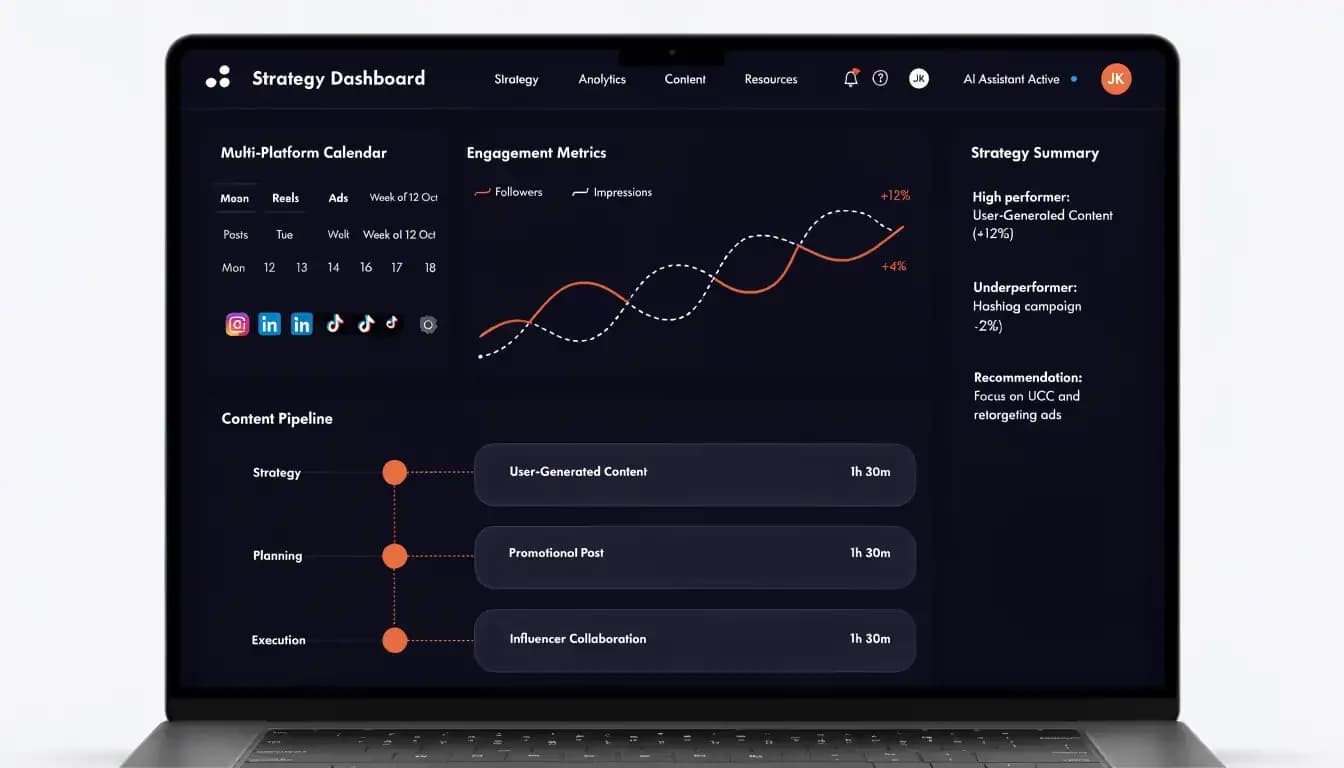
Most social media strategies collapse in month three. Not because the content was bad. Because one step gets skipped — and it's the one that makes everything else sustainable.
Quick Answer: A social media marketing strategy is a documented plan that defines your goals, target audience, platform selection, content approach, and performance metrics. To build one in 2026: set SMART goals → identify your audience → choose platforms → audit existing content → optimize profiles → plan a content mix → create a calendar → engage your community → measure and refine.
Social media has moved far beyond simple brand awareness. Today, 96% of marketers report positive returns from their social media marketing efforts, and platforms like TikTok and Instagram have evolved into full-stack commerce channels where users discover, evaluate, and buy products without leaving the app. Yet despite this opportunity, most brands still treat social media as a series of disconnected posts rather than a unified, intelligence-driven strategy.
This guide walks you through a complete, step-by-step social media marketing strategy built for 2026 — covering everything from goal setting and platform selection to content planning, community building, and performance measurement. Whether you're starting from scratch or auditing what's already working, you'll leave with a clear path forward.
What Is a Social Media Marketing Strategy?
A social media marketing strategy is a structured, documented plan for using social platforms to achieve specific business goals. It defines who you're talking to, what content you'll publish, which platforms you'll use, how often you'll post, and how you'll measure success.
The key components of a strong strategy include:
- Goals and KPIs — what you want to achieve and how you'll measure it
- Target audience — who you're speaking to on each platform
- Platform selection — where your audience actually spends time
- Content plan — what you'll publish and in what format
- Publishing schedule — how often and when you'll post
- Engagement approach — how you'll respond and build community
- Analytics and optimization — what you'll track and how you'll iterate
Without a documented strategy, social media becomes reactive and inconsistent. With one, every post serves a purpose and every metric tells you something actionable.
Why You Need a Social Media Strategy in 2026
The social media landscape in 2026 is more competitive — and more rewarding — than ever. Three forces are reshaping how brands need to approach it.
Algorithm changes are accelerating. Instagram now lets users partially control their own algorithm, suppressing content categories they don't want to see. This means passive discovery is no longer reliable. Brands must create content that their specific audience actively wants — not content that game the algorithm's old rules.
AI content competition is intensifying. In 2025, AI-generated articles surpassed human-written content online for the first time (Hootsuite Social Trends Report, 2026). As AI floods every feed with generic content, authenticity and depth are becoming competitive moats. Brands that invest in real expertise and genuine storytelling stand out dramatically.
Short-form video still dominates — but the rules have shifted. Reels now account for 35% of all time spent on Instagram, and users spend an average of 59 minutes per day on TikTok. But platforms are now rewarding longer, higher-quality storytelling alongside quick-hit clips. Instagram has expanded Reels eligibility to longer formats and increased carousel limits to 20 slides — both signals that depth drives dwell time.
Meanwhile, 47% of businesses plan to increase their social media advertising budgets in 2026 (LocalIQ), which means organic reach is being squeezed further. A solid organic strategy, backed by selective paid amplification, is how smart brands stay visible without overspending.
Step 1: Define Your Social Media Goals
Every effective social media marketing plan starts with clear, measurable goals. Without them, you have no benchmark for success and no framework for prioritizing your efforts.
Use the SMART framework: every goal should be Specific, Measurable, Achievable, Relevant, and Time-bound.
Common social media goals and what they look like as SMART targets:
Goal type | Vague version | SMART version |
|---|---|---|
Brand awareness | "Get more followers" | "Grow Instagram follower count by 15% in Q3" |
Engagement | "Post more consistently" | "Achieve avg. engagement rate of 3%+ across LinkedIn posts by Q4" |
Traffic | "Drive traffic to the blog" | "Generate 500 monthly website visits from social media by month 3" |
Lead generation | "Get more leads" | "Generate 100 qualified newsletter signups from social content in 90 days" |
Align your social goals directly with broader business objectives. If your company goal is to grow revenue by 20% this year, your social goal should connect to lead generation or conversion — not just vanity metrics like follower count.
According to HubSpot's State of Marketing Report 2026, the top five metrics that matter to marketers are: lead quality and MQLs (39%), lead-to-customer conversion rate (34%), ROI (31%), customer acquisition cost (30%), and lead generation volume (29%).
Step 2: Know Your Target Audience
Knowing your audience sounds obvious, but most brands are working from assumptions rather than data. The better you understand who you're speaking to — their demographics, behaviors, and problems — the easier it becomes to create content that stops the scroll.
How to research your audience:
- Review your existing analytics. Instagram Insights, LinkedIn Analytics, and Facebook Audience Insights all reveal age, gender, location, and active hours for your current followers.
- Survey your customers. Ask which social platforms they use most and what type of content they find useful.
- Build buyer personas. Create 2–3 detailed profiles representing your ideal customers — their job titles, daily challenges, content preferences, and which platforms they use.
Platform demographics at a glance (2026):
- Instagram — Strongest with 18–34 year-olds; highly visual; strong in lifestyle, e-commerce, and B2C brands
- LinkedIn — Dominates for B2B; 48% of businesses use it for professional content, thought leadership, and recruiting
- TikTok — Massive reach with under-35 audiences; entertainment-first; growing fast among older demographics
- Facebook — Broadest demographic reach; used by 91% of businesses for community building and targeted advertising
- YouTube — Ideal for educational, how-to, and long-form content; second-largest search engine globally
- X (Twitter) — Still used by 56% of businesses; best for real-time commentary, customer service, and industry news
One practical tip: start with two or three platforms where your audience is most active and where you can realistically create consistent, quality content — rather than stretching thin across every channel.
Step 3: Choose the Right Social Media Platforms
Choosing where to show up is one of the highest-leverage decisions in your entire social media marketing strategy. Being present on the wrong platform wastes time and budget; being present on the right ones compounds your effort.
The platform decision framework:
- Where is your audience? — Match platforms to your audience demographics (see Step 2)
- What content format suits your brand? — Video-first brands fit TikTok and YouTube; visual brands fit Instagram; text/thought-leadership brands fit LinkedIn
- What does your competition look like? — Analyze where your competitors are seeing traction
- What resources do you have? — TikTok and YouTube require significant video production; LinkedIn and X are more text-accessible
Quick platform guide:
Platform | Best for | Content that performs |
|---|---|---|
B2C, lifestyle, e-commerce | Reels, carousels, Stories | |
B2B, SaaS, professional services | Long-form posts, thought leadership, video | |
TikTok | Brand awareness, younger audiences | Short-form video, trending audio, tutorials |
Community building, broad reach, ads | Groups, video, events | |
YouTube | Education, SEO, long-form | How-to videos, tutorials, series |
X (Twitter) | Real-time, news, customer service | Threads, commentary, announcements |
You don't need to be everywhere. A focused presence on two or three platforms consistently outperforms a scattered presence on six.
Step 4: Conduct a Social Media Audit
Before creating new content, understand what you already have. A social media audit gives you a clear baseline: what content you've published, what's performed well, where the gaps are, and what your profiles currently communicate to a first-time visitor.
What to include in your audit:
- All active profiles — Are they all necessary? Are usernames consistent across platforms?
- Profile completeness — Is your bio optimized? Do you have a link, profile image, and header/cover photo?
- Content performance — Which post types, topics, and formats drove the most engagement and reach?
- Follower growth trends — Has growth been consistent? What caused spikes or drops?
- Competitor comparison — How does your posting frequency, engagement rate, and content quality compare?
Use a simple spreadsheet to log each platform, your follower count, last 30-day engagement rate, top three performing posts, and any profile gaps. This document becomes your baseline — you'll reference it every quarter to measure progress.
Step 5: Optimize Your Profiles
Your social media profiles are often the first thing potential customers see. A half-finished profile signals an absent or unprofessional brand. Before you create a single piece of new content, make sure every profile is working for you.
Profile optimization checklist:
- Bio/About section — Clearly state who you help and how. Include your primary keyword naturally. For Instagram: 150 characters max; make every word count. For LinkedIn: use the full About section to tell your brand story.
- Profile image — Use a consistent logo or brand image across all platforms. It should be recognizable at small sizes.
- Header/cover image — Update seasonally or use it to highlight a current offer or campaign.
- Link in bio — Use a link-in-bio tool (or your homepage URL) strategically. On LinkedIn, add your website to the page info.
- Username/handle — Keep it consistent across platforms. Inconsistency confuses search and makes cross-promotion harder.
- Keywords — Search engines and platform algorithms index your bio text. Include your main keyword or service category naturally.
- Category/niche tags — Instagram and Facebook let you specify your business category. Use it.
Optimized profiles improve discoverability — especially as social platforms increasingly function as search engines. 72.3% of online audiences now use social media to research brands before purchasing (SQ Magazine, 2026), which means your profile is part of the buying process.
Step 6: Plan Your Content Mix
Content mix determines whether your feed feels balanced and valuable or promotional and self-serving. The most successful social media strategies in 2026 follow a structured content pillar approach — a set of recurring themes that organize all of your content into coherent, recognizable buckets.
The 80/20 content rule: 80% of your content should educate, entertain, or add value to your audience. The remaining 20% can be directly promotional. A useful variation is the 50-30-20 rule: 50% value-driven content, 30% curated or reshared content from your industry, 20% promotional.
Content pillars example for a B2B SaaS brand:
- Educational — How-tos, tips, explainers, industry stats
- Behind-the-scenes — Team culture, product development, process
- Social proof — Customer testimonials, case studies, user-generated content (UGC)
- Thought leadership — Opinions, industry commentary, trend analysis
- Product/promotional — Feature announcements, offers, demos
Top-performing content formats in 2026:
- Carousels — Instagram carousels generate an average engagement rate of 0.76%, compared to 0.59% for single-image posts
- Short-form video — Reels achieve a 2.46% average engagement rate on Instagram (Sprout Social, 2026); TikTok's short-form format continues to lead all platforms for raw reach
- Long-form video — Platforms are rewarding depth; 3-minute tutorials and product walkthroughs now perform in the Explore feed
- Video ads — Video ads deliver approximately 48% higher engagement than static image ads (SQ Magazine, 2026)
Build your content pillars first, then map formats to each pillar. This makes content creation systematic rather than reactive.
Step 7: Create a Content Calendar
A content calendar turns your strategy from a document into a daily operating system. It specifies what gets posted, on which platform, on which day — eliminating last-minute scramble and keeping your presence consistent even during busy periods.
Recommended posting frequencies by platform (2026):
Platform | Recommended frequency |
|---|---|
4–5x per week (Reels + carousels prioritized) | |
3–4x per week | |
TikTok | 5–7x per week (consistency is key) |
3–5x per week | |
YouTube | 1–2x per week |
X (Twitter) | 1–3x per day |
Content calendar workflow — batch creation approach:
- Plan monthly themes aligned with business campaigns, seasonal events, and content pillars
- Script and create in batches — dedicate one day per week to creating 5–7 pieces of content rather than creating daily
- Schedule in advance using a social media scheduling tool
- Leave 20% of slots open for reactive or trending content
- Review weekly — check what performed well and adjust upcoming posts
Map important dates to your calendar early: product launches, industry events, holidays, and campaign windows. Early planning means you're creating content proactively rather than scrambling during peak moments.
Step 8: Engage and Build Community
Publishing content is only half of the equation. Engagement — responding to comments, joining conversations, fostering community — is what transforms followers into loyal customers and advocates.
73% of businesses now prioritize organic social media to build authentic, two-way conversations rather than using platforms purely for broadcasting (GoatAgency, 2026). This shift reflects what the data already shows: community-driven brands have higher retention, higher LTV, and stronger brand equity.
Practical engagement tactics:
- Respond to every comment within the first hour — the first 60 minutes after posting are critical for algorithmic reach; engagement signals boost distribution
- Ask questions in your captions — direct prompts significantly increase comment rates
- Use interactive Stories features — polls, Q&As, sliders, and question boxes drive easy micro-engagements
- Reply to DMs promptly — treat social DMs like a customer service channel
- Engage with your audience's content — like, comment, and share from accounts in your niche; community is reciprocal
- Spotlight your community — share UGC, tag loyal customers, and reshare positive mentions
Building community also means listening. Social listening — tracking brand mentions, competitor mentions, and relevant conversations — surfaces insights you can't get from posting alone. Use it to refine your messaging, spot emerging topics, and respond to customer feedback in real time.
Step 9: Measure and Optimize Results
What gets measured gets improved. Without tracking the right metrics, you're flying blind — posting more hoping something sticks rather than doubling down on what actually works.
Core metrics to track for each business goal:
Goal | Key metrics |
|---|---|
Brand awareness | Reach, impressions, follower growth rate |
Engagement | Engagement rate, likes, comments, shares, saves |
Traffic | Click-through rate (CTR), link clicks, website sessions from social |
Lead generation | Form submissions, email signups, cost per lead |
Revenue | Conversions, revenue attributed to social, ROAS |
Benchmarks to aim for in 2026:
- Average cross-platform engagement rate: 1.8% (SQ Magazine, 2026)
- Instagram Reels engagement rate: 2.46% (Sprout Social, 2025 Content Benchmarks)
- Instagram carousels: 0.76% vs. single images at 0.59%
- Social media average ROI: $5.20 for every $1 spent (SQ Magazine, 2026)
Build a monthly reporting rhythm:
- Pull key metrics from each platform's native analytics
- Compare against your baseline (from the social audit in Step 4)
- Identify the top three performing posts — note format, topic, and caption style
- Identify the three lowest performers — note what they had in common
- Adjust next month's content mix based on findings
- Review goal progress against your SMART targets
Optimization is not a one-time event. The best social media strategies treat each month as an experiment: test, learn, and improve.
Social Media Tools Worth Using in 2026
Allable.ai — An all-in-one AI marketing platform built for modern marketers. Allable combines AI-powered social media content creation, multi-platform scheduling, marketing strategy automation, and analytics in a single workspace. It's particularly powerful for teams that need to maintain consistent output across multiple platforms without a large content team. Free plan available; paid plans from ~$29/month.
Buffer — A straightforward scheduling tool for managing posts across Instagram, Facebook, LinkedIn, TikTok, X, and Pinterest. Best for small teams who need a clean, simple publishing workflow without advanced analytics.
Hootsuite — One of the most established social media management platforms, covering scheduling, inbox management, analytics, and team collaboration. Suited for mid-to-large teams managing multiple accounts.
Sprout Social — A data-rich platform with strong analytics, social listening, and CRM integration. Best for enterprise brands and agencies that need deep reporting and cross-functional collaboration.
For most growing businesses, an AI-native tool like Allable provides the best combination of content creation speed and strategic clarity — especially as AI content competition makes differentiation harder with generic approaches.
Frequently Asked Questions About Social Media Marketing Strategy
What is a social media marketing strategy?
A social media marketing strategy is a documented plan that defines your goals, target audience, platform selection, content approach, and how you'll measure success. It ensures every post serves a purpose and every metric connects back to a business outcome.
How long does it take to build a social media strategy?
You can build a solid foundational strategy in one to two weeks — covering goals, audience research, platform selection, content pillars, and a basic calendar. Refining and optimizing the strategy is an ongoing process that gets sharper with every month of data.
How many social media platforms should a business be on?
Most small-to-medium businesses should focus on two to three platforms where their target audience is most active. Spreading thin across six platforms with low-quality, inconsistent content is far less effective than a strong, consistent presence on two.
How do you create a social media strategy for a business with no following?
Start by fully optimizing your profiles, then post consistently valuable content aligned with your audience's interests. In the early stages, engage heavily in your niche by commenting on relevant accounts and joining conversations. Paid social advertising can also accelerate initial reach and follower growth while your organic presence builds.
What is the best content mix for social media in 2026?
The most effective content mix follows the 80/20 or 50-30-20 rule: the majority of posts should educate, entertain, or add genuine value — not promote your product. Prioritize Reels and short-form video for reach, carousels for engagement depth, and thought-leadership text posts on LinkedIn for professional audiences.
How do I measure social media marketing success?
Track metrics that align with your goals: reach and impressions for awareness, engagement rate for connection, CTR and sessions for traffic, and conversions or cost-per-lead for revenue impact. The average social media ROI is $5.20 for every $1 spent — use that as a rough benchmark while building your own historical data.
How often should you post on social media in 2026?
Frequency depends on the platform: Instagram performs best at 4–5 times per week (prioritizing Reels), LinkedIn at 3–4 times per week, TikTok at 5–7 times per week, and YouTube at 1–2 videos per week. Consistency matters more than volume — it's better to post three strong pieces per week than seven rushed ones.
Conclusion: Build Your Strategy, Then Build Your Audience
A social media marketing strategy is not a nice-to-have in 2026 — it's the foundation of any brand that wants to grow sustainably on social media. Platforms are more competitive, algorithms are less predictable, and audiences are more discerning than ever. The brands that win are the ones with a documented plan, consistent execution, and a genuine willingness to learn from data.
Here's what to do next: pick one platform where your target audience is most active, set one SMART goal for the next 90 days, and publish your first week of planned content. Strategy without execution stays a document. Start small, stay consistent, and optimize as you go.
Ready to put your strategy into practice? Allable.ai gives you AI-powered content creation, a multi-platform content calendar, and performance analytics in a single platform — so you can build and execute your social media marketing strategy without switching between a dozen tools.
Related reading: