Content Marketing Strategy 2026: Complete Guide to Planning, Creating & Distributing Content
 Written by Martin J.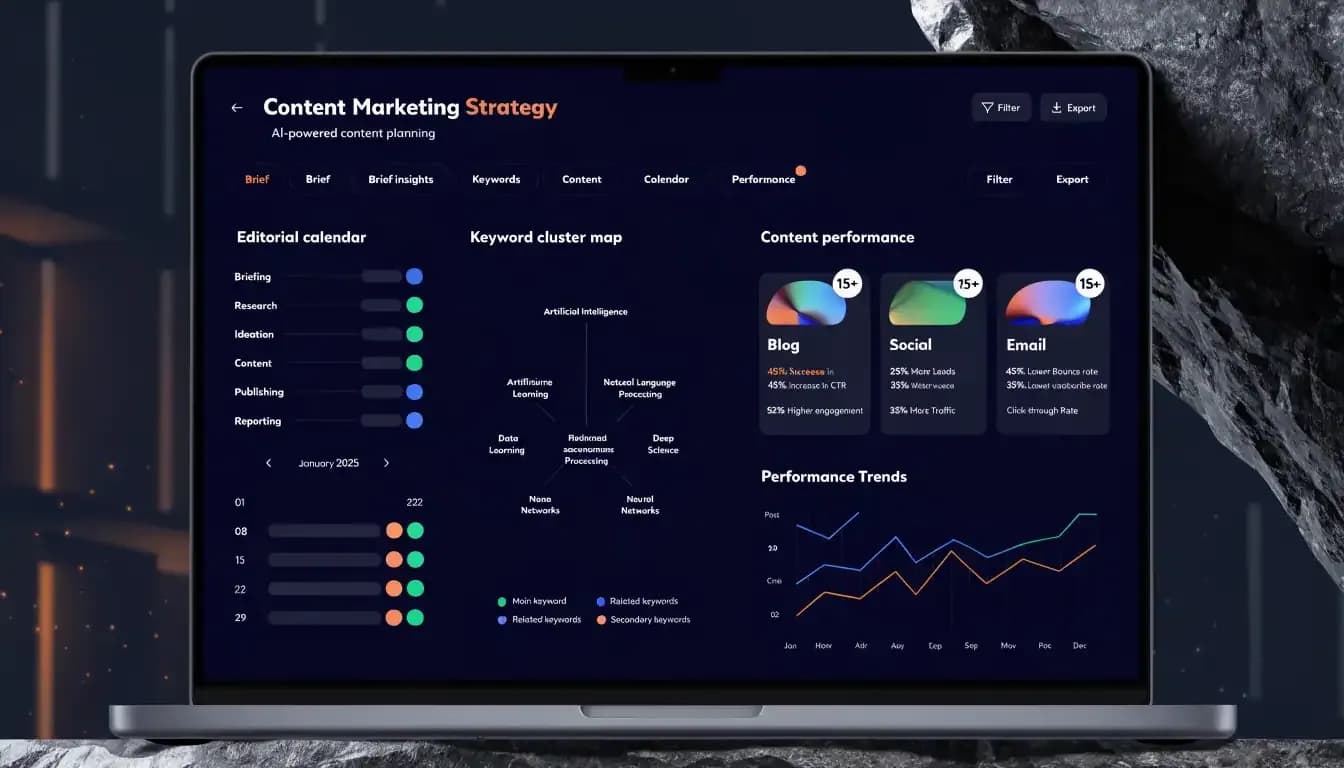
Most content strategies fail at distribution, not creation. You plan the articles, write them, publish — and then wonder why no one reads them. The bottleneck isn't your content. It's what happens after you hit publish.
Quick Answer: What is a content marketing strategy?
A content marketing strategy is a documented plan for creating, publishing, and distributing valuable content to attract and retain a defined audience. It aligns content types, topics, channels, and publishing cadence with specific business goals — turning your content output into a predictable driver of traffic, leads, and revenue.
Content is everywhere in 2026 — and that's exactly the problem. With AI tools making it trivially easy to publish thousands of articles a week, the brands that actually win are the ones with a real content marketing strategy behind every piece they create. Without a plan, you're adding noise. With one, you're building an asset.
This guide walks you through every step of building a content marketing strategy that works: from setting goals and understanding your audience to creating a content calendar, distributing content effectively, and measuring what actually matters.
What Is a Content Marketing Strategy?
A content marketing strategy is more than an editorial calendar or a list of blog post ideas. It's the overarching plan that connects your content decisions to your business outcomes. It defines who you're creating content for, what topics and formats you'll use, where you'll distribute it, and how you'll measure success.
The Content Marketing Institute defines it as a documented approach to managing content as a business asset. That word — documented — matters more than you might think. Companies with a documented content strategy report around 33% higher ROI and up to three times more leads than outbound marketing, at 62% lower cost.
A strong content marketing strategy includes:
- Goals and KPIs tied to business outcomes (not just pageviews)
- Audience research — buyer personas, pain points, content preferences
- Topic and keyword framework — pillar pages, content clusters, search intent mapping
- Content types and channels — blog, video, email, social, podcast
- Publishing cadence — realistic frequency you can sustain at quality
- Distribution plan — how each piece reaches the right audience
- Measurement framework — the metrics that tell you it's working
Why You Need a Content Marketing Strategy in 2026
Global revenue tied to content marketing is projected to surpass the $100 billion mark in 2026. Yet according to CMI's B2B Content and Marketing Trends survey, only 29% describe their content strategy as "extremely or very effective." A further 58% rate it as merely "moderately effective," and 42% attribute underperformance directly to a lack of clear goals.
Three forces are reshaping the competitive landscape right now:
1. The AI content flood. Non-AI blog creation has dropped from 65% to just 5% of total output. The volume of published content has exploded, but quality hasn't kept pace.
2. Zero-click search. About 60% of Google searches in the US now end without a click to an external website. Content that only chases traffic metrics is increasingly fragile.
3. LLMs as research tools. An estimated 94% of B2B buyers now use large language models during their purchase journey. If your content isn't deep, specific, and credible enough to be cited by AI summaries, you're invisible in a growing share of early-stage research.
Step 1: Define Your Goals and KPIs
Every piece of content needs to serve a purpose. Before you write a single word, decide what you're actually trying to achieve.
Goal | Example KPIs |
|---|---|
Brand awareness | Organic impressions, branded search volume, social reach |
Lead generation | Form fills, content downloads, demo requests |
SEO traffic | Organic sessions, keyword rankings, featured snippets |
Customer retention | Email engagement, repeat visits, content-to-conversion rate |
Align each goal to a stage of your marketing funnel:
- Top of funnel (ToFu): Awareness content — educational guides, how-to posts, trend pieces
- Middle of funnel (MoFu): Comparison content, case studies, webinars, email sequences
- Bottom of funnel (BoFu): Product pages, demos, ROI calculators, customer stories
Step 2: Know Your Target Audience
The most common reason content fails is not poor writing — it's poor targeting. Content written for everyone resonates with no one.
Build buyer personas that go beyond job title and company size. For each persona, define:
- Demographics: Role, seniority, industry, company size
- Goals: What are they trying to achieve professionally?
- Pain points: What problems keep them up at night?
- Content preferences: Where do they look for information?
- Buying triggers: What moves them from awareness to evaluation?
Once you've defined your audience, validate it. Interview five to ten customers. Run a quick survey to your email list. Review what questions come up repeatedly in sales calls.
Step 3: Conduct a Content Audit
If you've been publishing content for more than six months, don't start fresh — start with a content audit. A thorough audit tells you what's already working, what's underperforming, and where the gaps are.
- Inventory all existing content — blog posts, landing pages, whitepapers, videos, case studies
- Measure performance — organic traffic, backlinks, rankings, conversions for each piece
- Categorize each piece — Keep / Optimize / Consolidate / Remove
- Map to buyer journey — Identify which funnel stages you're over- or under-serving
- Spot content gaps — Topics your audience searches for that you haven't covered
A content audit often reveals that refreshing your top 20 existing posts delivers faster ROI than creating 20 new ones. Refreshed content can generate up to 70% more organic traffic and 32% higher engagement time than the original version.
Step 4: Keyword Research and Topic Planning
Search intent is the foundation of any SEO-driven content marketing strategy. The goal isn't to rank for every keyword — it's to rank for the keywords that signal the right type of buyer, at the right stage of their journey.
The pillar-cluster model is the most effective framework for building topic authority:
- A pillar page covers a broad topic comprehensively
- Cluster pages go deep on specific subtopics linked back to the pillar
- Internal links between cluster and pillar signal topical authority to search engines
Keyword research workflow:
- Identify 3–5 core topics aligned with your product and audience
- For each topic, build a keyword universe — head terms, long-tail variants, question queries
- Classify by intent: informational, commercial, transactional
- Prioritize based on search volume, difficulty, and business relevance
- Map one primary keyword per content piece — no keyword cannibalization
Step 5: Choose Your Content Types and Channels
Format | Best for | Funnel Stage |
|---|---|---|
Long-form blog posts | SEO, authority building | ToFu / MoFu |
Short-form video | Awareness, social reach | ToFu |
Case studies | Purchase decision support | MoFu / BoFu |
Email newsletters | Nurturing, retention | MoFu |
Webinars | Lead generation, education | MoFu |
Podcasts | Thought leadership, loyalty | ToFu / MoFu |
Whitepapers / reports | B2B lead gen, authority | MoFu / BoFu |
According to CMI's 2026 B2B survey, 58% of B2B marketers say video delivers the best results, followed by case studies and customer stories.
Step 6: Create a Content Calendar
A content calendar is the operational core of your strategy. It's where your goals, audience research, and keyword plan translate into a publishing schedule your team can actually execute.
What a content calendar should include:
- Publish date — planned live date for each piece
- Title / working title — with primary keyword included
- Content type — blog post, video, infographic, email, etc.
- Target keyword — one per piece, mapped from your research
- Funnel stage — ToFu / MoFu / BoFu
- Owner — who is writing, editing, and approving
- Status — idea / in progress / in review / scheduled / published
- Distribution notes — where and how it gets promoted
Step 7: Content Creation Best Practices
SEO-optimized writing fundamentals:
- Include your primary keyword in the H1, the first 100 words, at least one H2, and the conclusion
- Use secondary keywords naturally throughout
- Write for the reader's intent first, search engines second
- Break up long sections with subheadings, bullets, and tables
- Keep paragraphs to 3–5 sentences for readability
E-E-A-T: Google's quality rater guidelines increasingly reward content that demonstrates first-hand experience. That means real data, named authors, specific examples from your own work, and perspectives that can't be replicated with a generic AI prompt.
94% of marketers plan to use AI for content creation in 2026. The best use of AI is accelerating research, drafting outlines, repurposing content across formats, and editing for clarity. The distinctive value — your original perspective, proprietary data, and customer insights — still needs to come from you.
Step 8: Content Distribution Strategy
The 80/20 rule of content distribution: spend 20% of your time creating content and 80% distributing it. Most teams do the opposite — and most content gets lost.
Core distribution channels:
SEO: The backbone of sustainable content distribution. On-page optimization, internal linking between cluster and pillar pages, and link-building through digital PR and partnerships.
Email: The highest ROI distribution channel for most B2B and B2C businesses. Your email list is an owned audience — not subject to algorithm changes.
Social media: Repurpose, don't just reshare. A long-form blog post can become a Twitter/X thread, a LinkedIn carousel, a short-form video script, and three to five quote graphics.
Paid amplification: For key pieces — especially BoFu content or original research — targeted paid promotion on LinkedIn, Google, or Meta can jumpstart distribution and accelerate link building.
Step 9: Measure and Optimize
Stage | Key Metrics |
|---|---|
Awareness | Organic sessions, impressions, branded search volume growth |
Engagement | Average time on page, scroll depth, social shares |
Lead generation | Content-attributed leads, form fills, email signups |
Revenue | Content-attributed pipeline, content-to-close rate |
Content Marketing Strategy Template
Element | Your Answer |
|---|---|
Primary goal (90 days) | e.g., Grow organic blog traffic by 25% |
Target audience (Persona 1) | Role / Pain point / Preferred channel |
Core topics (pillar pages) | Topic 1 / Topic 2 / Topic 3 |
Primary content type | e.g., Long-form blog + short-form video |
Primary distribution channels | e.g., SEO + Email + LinkedIn |
Publishing cadence | e.g., 2x blog posts/week, 1x email/week |
Key metrics | 3–5 KPIs with baseline and target |
FAQ: Content Marketing Strategy
What's the difference between a content strategy and a content marketing strategy?
A content strategy covers all content decisions for a brand. A content marketing strategy is specifically focused on using content to attract, engage, and convert an audience — audience-facing and tied to marketing and revenue goals.
How long does it take to see results from content marketing?
Organic SEO results typically take three to six months to build meaningful traction. The compounding effect builds significantly over 12 to 24 months.
How much should I budget for content marketing?
Content marketing now accounts for an average of 26% of total marketing spend. For B2B companies, the CMI recommends allocating roughly 25–30% of your marketing budget to content and SEO.
How do AI tools fit into a content marketing strategy in 2026?
AI tools are most effective as force multipliers: accelerating research, generating outlines, repurposing content across formats, and editing for clarity and SEO. The content that performs best still relies on original perspectives and differentiated insights.
Conclusion: Build Your Content Marketing Strategy With Allable
A content marketing strategy isn't a one-time document — it's a living system you refine every month based on what the data tells you. The brands that win in 2026 aren't necessarily publishing the most. They're publishing the most strategically: the right topics, for the right audience, through the right channels, with a clear plan for distribution and measurement.
Allable combines AI-powered keyword research, content writing, SEO audits, and AI marketing strategy generation in a single platform.