
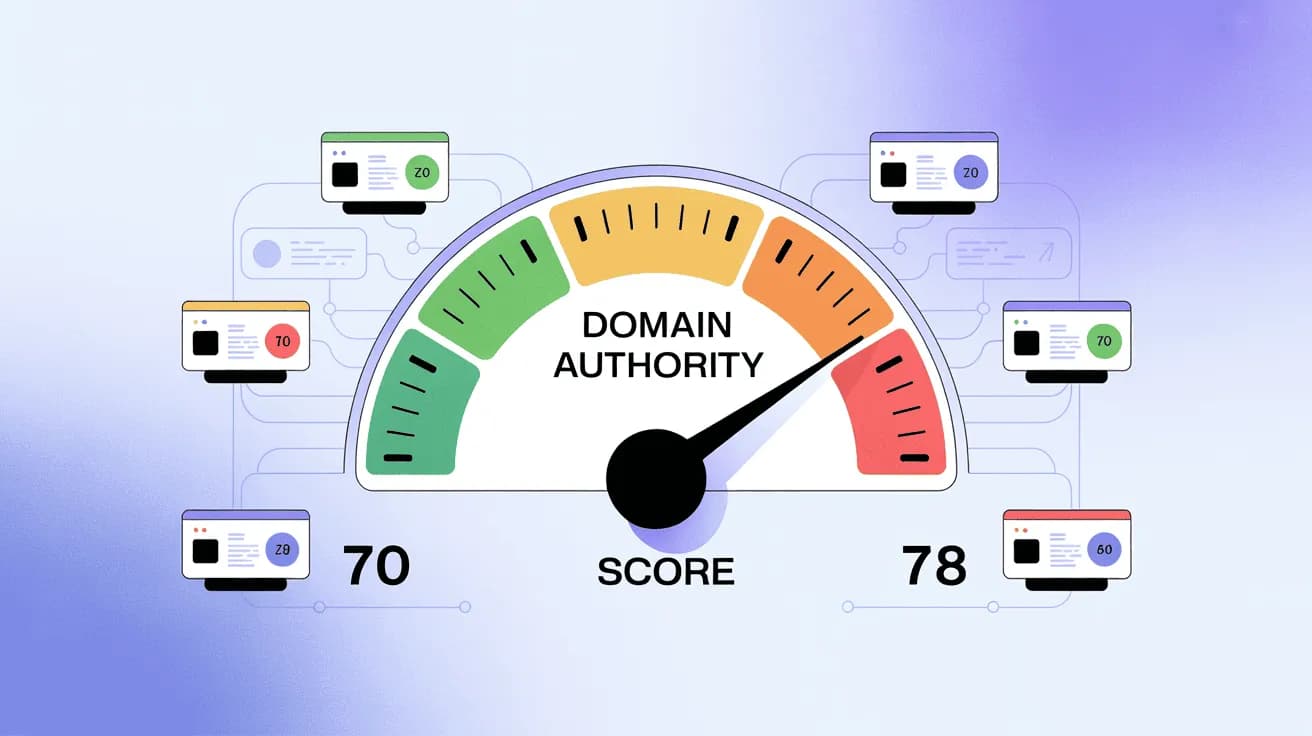
Learn what Domain Authority is, how it's calculated, and 7 proven strategies to improve your DA score in 2026. Includes free checker tools and expert tips.
TL;DR: Domain Authority (DA) is a score from 1-100 created by Moz that predicts how likely your website is to rank in search results. It measures your backlink profile strength — not a Google metric. The single most effective way to raise your DA is earning high-quality backlinks from authoritative, relevant websites.
What Is Domain Authority? (And Where Did It Come From?)
Domain Authority (DA) is a search engine ranking score developed by Moz, one of the most well-known SEO software companies. Moz introduced it in 2004 as a way to give website owners and SEO professionals a single number that approximates how well a domain can compete in search engine results pages (SERPs).
On a scale from 1 to 100, a higher DA score means stronger potential to rank. A brand-new blog starts somewhere between 1 and 10. A globally recognized publication like the New York Times or Wikipedia sits above 90.
What makes this scale tricky is that it's logarithmic — not linear. That means jumping from DA 20 to DA 30 is much easier than climbing from DA 70 to DA 80. The higher you go, the harder each point becomes to earn. This matters when you're setting realistic goals for your site.
Moz calculates DA using around 40 signals, with the biggest weight given to:
- Number of linking root domains — how many unique websites link to yours
- Quality of inbound links — whether those links come from authoritative, trusted sources
- MozRank and MozTrust — sub-scores that measure link equity and trustworthiness
- Total link count — the overall volume of backlinks pointing to your domain
One important thing to keep in mind from the start: Domain Authority is a third-party metric created by Moz — it is not a Google ranking signal. Google does not use DA or any equivalent metric when deciding which pages to rank. You'll read more on this in a dedicated section below.
Domain Authority vs. Domain Rating: What's the Difference?
If you've used Ahrefs alongside Moz, you've probably noticed that both tools give your site an authority score — but the numbers never quite match. That's because they're measuring the same general concept with different methodologies.
Metric | Tool | What It Measures | Scale |
|---|---|---|---|
Domain Authority (DA) | Moz | Backlink profile quality, link equity, linking root domains | 1-100 |
Domain Rating (DR) | Ahrefs | Strength of backlink profile based on quantity + quality of dofollow links | 0-100 |
Authority Score (AS) | Semrush | Link power + organic traffic + spam factors combined | 0-100 |
Domain Rating (DR), developed by Ahrefs, specifically focuses on the quality and quantity of dofollow backlinks pointing to your site, as well as the DR values of those referring domains. A site with many links from strong DR sites will score higher.
Moz's DA weighs similar signals but applies a different algorithm and crawls its own independent web index. This is why the same website might have a DA of 45 in Moz but a DR of 52 in Ahrefs — both reflect real data, just through different lenses.
Semrush's Authority Score goes a step further by factoring in organic traffic and spam detection alongside link data, making it a slightly broader composite metric.
The bottom line: All three scores are useful for benchmarking and competitor research. None of them is a Google metric. For practical SEO work, pick one tool and use it consistently so your progress comparisons stay apples-to-apples.
What Is a Good Domain Authority Score?
There is no single universal "good" DA score — it depends entirely on your niche and who you're competing against. A DA of 35 might make you the most authoritative site in a small local market, while the same score would be quite low in a competitive national industry.
That said, here are general benchmarks to help you orient your goals:
DA Range | What It Means | Typical Sites |
|---|---|---|
0-20 | New or very low-authority site | Brand-new domains, micro-niche blogs |
21-40 | Developing authority | Growing SMB websites, newer niche blogs |
41-60 | Moderate authority | Established small-to-mid businesses, active content sites |
61-80 | Strong authority | Well-known industry publications, major SaaS platforms |
81-100 | Very high authority | Wikipedia, BBC, major global brands |
For brand-new websites, a DA between 10 and 20 is perfectly normal. According to Vazoola's research, aiming for a DA of around 30 is a realistic near-term target for most website owners starting from scratch.
The most useful approach: Pull the DA scores of the top 5 competitors ranking for your target keywords. That's your actual benchmark. If your competitors sit at DA 40-50, that's your goalpost — not 90.
Does Domain Authority Directly Affect Your Google Rankings?
No — and this distinction matters.
Google does not use Domain Authority in its ranking algorithm. DA is Moz's own proprietary score based on the data Moz collects and the algorithm Moz has built. Google has its own internal signals — including PageRank, which is not publicly visible — and has never incorporated any third-party DA score into its ranking decisions.
So why does DA still matter to SEOs?
Because it's a strong proxy. Sites with high DA tend to rank well on Google, not because Google reads the DA score, but because the same underlying factors that drive DA up — high-quality backlinks, trusted referring domains, a healthy overall link profile — are also the signals Google cares deeply about.
Think of it this way: a rising DA score means you're doing the right SEO work. It's a lagging indicator that you're building real authority. The score itself doesn't move rankings; the work behind the score does.
What this means practically:
- Don't obsess over the DA number itself
- Use DA to compare yourself to competitors, not as a vanity target
- Focus on the actions that improve DA — because those same actions improve your actual Google rankings
How to Check Your Domain Authority (Free Tools)
You have several solid options to check your website's domain authority score, most of them free:
1. Moz Link Explorer — The original DA checker, available at moz.com/link-explorer. Free with a limited number of queries per month. Shows DA, Page Authority (PA), total linking domains, and inbound links.
2. MozBar — Moz's free Chrome extension that displays DA and PA scores directly in your browser while you search Google or browse websites. Extremely useful for quick competitor checks without leaving the page.
3. Ahrefs Website Authority Checker — Available at ahrefs.com/website-authority-checker. Shows Domain Rating (DR) for free, without needing an account. Add the free Ahrefs Chrome extension to see DR scores on every page you visit.
4. Semrush Domain Overview — Semrush's Authority Score is visible in the free Domain Overview tool. Also shows traffic trends, keyword counts, and backlink numbers alongside the score.
5. Third-party DA/PA checkers — Tools like Small SEO Tools, PrepostSEO, and others offer bulk domain authority checking, useful when you need to compare multiple competitors at once.
Pro tip: If you want to analyze your full backlink profile — including which links are helping vs. hurting your authority — Allable's website authority and backlink tools let you track your DA-equivalent score alongside your keyword rankings, all in one place.
7 Proven Ways to Improve Your Domain Authority in 2026
Here's what actually moves the needle — based on what works across hundreds of real SEO campaigns:
1. Build High-Quality Backlinks from Relevant Sites
This is the single most impactful driver of DA. When a high-authority website in your niche links to your content, Moz's algorithm interprets that as a strong vote of confidence.
What works in 2026:
- Digital PR — create data studies, original research, or expert commentary that journalists and industry blogs want to cite
- Guest posting on established publications in your niche (focus on relevance over volume)
- Link building through original content — guides, tools, calculators, or resources others naturally reference
- HARO / media outreach — getting quoted as an expert in articles earns editorial backlinks
One well-placed link from a DA 70+ site can do more for your score than 50 links from low-quality directories.
2. Create Content That Earns Links Naturally
The best link-building strategy is publishing content people want to link to without being asked. Think:
- Original research and data — unique statistics that no one else has published
- Comprehensive guides — the single best resource on a topic in your niche
- Free tools — calculators, templates, checklists that others embed or share
- Infographics — visual summaries of complex topics that bloggers want to use
This ties directly into what SearchAtlas found in their analysis of 400+ campaigns: sites that built 25-30 deeply interlinked articles within a single content cluster saw ranking gains up to 3x faster than those focused purely on link acquisition. Great content and strong DA go hand in hand.
3. Audit and Remove Toxic Backlinks
Not all backlinks help. Links from spammy directories, link farms, or penalized websites can actively drag your DA down. Run a periodic backlink audit using Moz's Link Explorer or Ahrefs to identify low-quality links.
For links you can't get removed, use Google's Disavow Tool to tell Google to ignore them. Moz will also eventually stop counting disavowed or lost links in your DA calculation.
4. Strengthen Your Internal Linking Structure
Internal links distribute link equity (the SEO value passed from one page to another) throughout your site. A strong internal linking strategy ensures your most important pages receive the authority signals they need to rank.
Every time you publish a new article, link it to relevant existing content — and link from older content back to the new piece. This is one of the fastest wins available to you because it's entirely within your control.
5. Fix Technical SEO Issues
Technical problems — broken links, crawl errors, slow page speed, missing HTTPS, and duplicate content — don't directly factor into Moz's DA calculation, but they do affect how well Google can crawl and index your site. Poor indexation means fewer pages get linked to, which limits your DA ceiling.
Use a free technical audit from Allable's SEO checker or tools like Screaming Frog or Google Search Console to catch and fix:
- Broken internal and external links (404 errors)
- Redirect chains that bleed link equity
- Slow load times (under 2.5 seconds is the target)
- Missing or duplicate meta tags
6. Expand Your Topical Authority Through Content Clusters
A growing body of 2026 SEO research supports this: depth beats breadth. Instead of publishing random blog posts on scattered topics, organize your content around clusters — a pillar page on a core topic, supported by 8-15 detailed articles on related subtopics.
When your site comprehensively covers a subject area, more authoritative sites in that niche are more likely to discover and link to you. Use competitor keyword research to identify which subtopics your competitors rank for that you haven't yet covered.
7. Be Consistent and Patient
DA improvement is not a sprint. It's the result of months of compounding effort. Sporadic link-building campaigns followed by months of inactivity produce poor results. The websites that reach DA 60+ have almost universally maintained a consistent publishing and outreach rhythm over 12-24+ months.
Set a realistic schedule — one or two quality articles per week, regular outreach, monthly audits — and stick to it. Your DA will reflect that consistency.
How Long Does It Take to Improve Domain Authority?
There's no shortcut here: meaningful DA improvement takes 3 to 12 months, and sometimes longer depending on where you start and how competitive your niche is.
Here's a realistic timeline:
Timeframe | What to Expect |
|---|---|
Month 1-2 | Technical fixes, content publishing, initial outreach. DA may not change yet. |
Month 3-4 | First backlinks indexed, some DA movement possible. Rankings may start to improve. |
Month 6 | Visible DA gains if outreach has been consistent. Rankings improving meaningfully. |
Month 12+ | Significant DA improvement for sites with active link building and content programs. |
A few things to keep in mind:
- Moz updates DA scores approximately monthly, so you won't see real-time changes. Don't panic if your score dips after an update — this is often because Moz's index has crawled new competitors' links, shifting relative scores.
- Moving from DA 20 to DA 40 is far more achievable in a year than moving from DA 60 to DA 80. The logarithmic scale makes higher ranges exponentially harder.
- Early-stage sites (DA 20-30) tend to see the fastest relative gains because there's more low-hanging fruit in terms of obtainable backlinks.
The takeaway: commit to a sustainable strategy, measure progress quarterly, and compare yourself to your direct competitors — not to industry giants.
Frequently Asked Questions
What is Domain Authority in simple terms?
Domain Authority is a score from 1 to 100 created by Moz that predicts how likely your website is to rank in search results. It's based primarily on your backlink profile — the quality and number of websites linking to yours. A higher score generally indicates stronger ranking potential.
Is Domain Authority a Google ranking factor?
No. Domain Authority is a proprietary metric created by Moz, not Google. Google does not use DA in its ranking algorithm. However, the underlying factors that improve DA — high-quality backlinks, authoritative referring domains — are the same signals Google values, which is why the two tend to correlate.
What's the difference between DA and PA?
DA (Domain Authority) measures the ranking potential of your entire domain. PA (Page Authority) measures the ranking potential of a single specific page. Both use the same 1-100 scale. For most SEO work, DA is the primary metric for overall site health, while PA is useful for evaluating individual landing pages or blog posts.
How can I check my domain authority for free?
Use Moz's free Link Explorer (limited queries per month), the MozBar Chrome extension, or Ahrefs' free Website Authority Checker. Semrush also displays an Authority Score in its free Domain Overview tool.
What is a good domain authority score for a new website?
New websites typically start between DA 1 and 20. A DA of around 30 is a realistic short-to-medium-term goal for new sites actively working on SEO and link building. Always benchmark against your direct competitors rather than chasing an arbitrary number.
Does buying backlinks improve domain authority?
Buying backlinks violates Google's guidelines and can result in a manual penalty. While spammy link purchases might temporarily inflate DA, they often include low-quality links that don't pass real ranking value — and can actually cause a DA drop when Moz's algorithm catches up. Earned, editorial backlinks are the only sustainable path to lasting DA improvement.
Does changing my domain name reset my DA?
Yes. If you move to a new domain without proper 301 redirects, your DA will drop significantly since the new domain starts with no link history. If you migrate correctly with full 301 redirects and maintain your backlink profile, most of your DA transfers over — though there's typically a temporary dip during the transition.
Start Building Real Website Authority Today
Domain Authority is one of the most useful benchmarks in your SEO toolkit — but it's a compass, not a destination. The real goal is building a website that earns trust: from search engines, from readers, and from other sites in your niche.
The formula is straightforward, even if the execution takes time:
- Publish content worth linking to
- Earn backlinks from sites that matter in your space
- Keep your site technically clean and fast
- Be consistent for long enough to see compounding results
If you want to skip the guesswork and see exactly where your site stands — your current authority score, which backlinks are helping or hurting, and which competitors you're within reach of overtaking — analyze your website's authority and backlink profile with Allable.
You'll have a clear picture of your baseline and a prioritized action plan in minutes.