
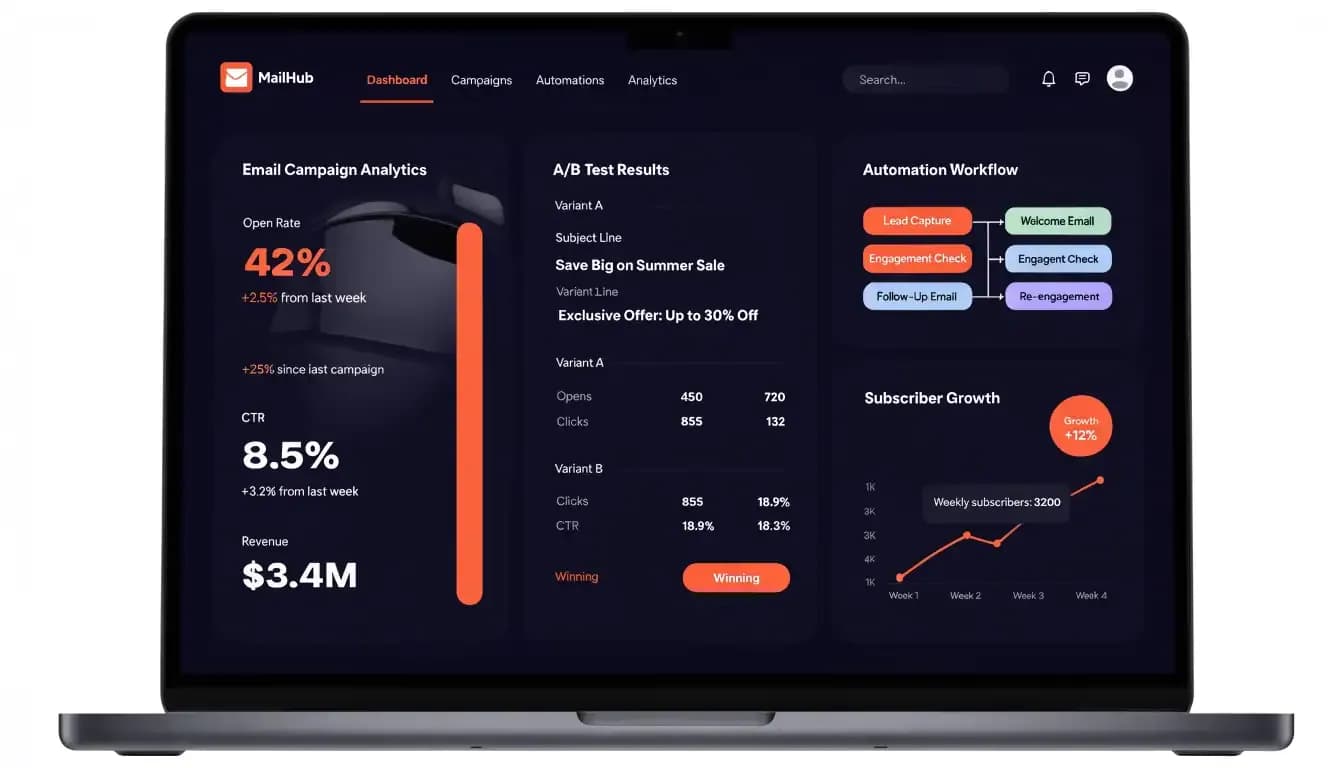
Email marketing has the highest ROI of any channel. Most people building a list right now are doing it wrong — and won't find out until their open rates flatline. The list size isn't the problem. What you offered to get the signup is.
Quick Stats — Why Email Still Wins in 2026
📈 $36–$42 ROI for every $1 spent — the highest of any digital channel
📬 4.8 billion email users worldwide
📂 99% of users check their inbox every day
📊 Average open rate: 22.15% | Average CTR: 3.43%
🤖 AI-optimized subject lines improve open rates by 26%
If someone told you that one marketing channel could return up to $42 for every dollar you invest, you'd use it every single day. That channel is email marketing — and this email marketing guide 2026 will show you exactly how to harness it, whether you're starting from zero or scaling past 10,000 subscribers.
Why Email Marketing Still Dominates in 2026
In 2026, email marketing is stronger than ever. The numbers speak for themselves:
- Email delivers $36–$42 per $1 spent, outperforming paid search ($2), paid social ($2.80), and display advertising ($1.35) by a wide margin.
- 4.8 billion people worldwide use email in 2026.
- 99% of users check their email inbox every single day.
- Automated email flows now account for 30–50% of total email revenue for brands that have set them up properly.
Getting Started: Email Marketing Essentials
Choosing an Email Marketing Platform
- Mailchimp — Best for beginners. Free plan up to 500 contacts, clean drag-and-drop editor, solid automation basics.
- ActiveCampaign — Best for advanced automation. Powerful CRM integration, conditional logic in workflows, strong deliverability.
- Klaviyo — Best for e-commerce. Deep Shopify/WooCommerce integration, revenue-per-email reporting, abandoned cart flows out of the box.
- Kit (formerly ConvertKit) — Best for creators and solopreneurs. Clean interface, tag-based subscriber management, great for digital products.
Understanding Key Email Metrics
Metric | Definition | Benchmark |
|---|---|---|
Open Rate | % of recipients who opened your email | 22–25% |
Click-Through Rate (CTR) | % of recipients who clicked a link | 2–4% |
Click-to-Open Rate (CTOR) | Clicks ÷ opens | 10–15% |
Unsubscribe Rate | % who opted out per send | Under 0.5% |
Bounce Rate | % of emails that couldn't be delivered | Under 2% |
Deliverability Rate | % landing in inbox (not spam) | 95%+ (98% excellent) |
Step 1: Build Your Email List
An email list is a business asset. Unlike social media followers (which platforms can take away overnight), your subscriber list is yours.
Lead Magnets That Actually Work
A lead magnet is something you offer in exchange for an email address. High-performing lead magnet formats in 2026:
- PDF checklists and templates — still the highest opt-in conversion rate
- Email courses (5–7 day sequences) — high engagement, low unsubscribe
- Free tools or calculators — excellent for SaaS and B2B
- Webinar or workshop access — strong for high-ticket offers
- Exclusive data or research reports — great for building authority
Opt-In Forms: Where and How to Place Them
- Exit-intent popups — catch visitors before they leave (typically 3–5% conversion rate)
- Inline forms within blog posts — especially after proving value in the first 500 words
- Sticky header or footer bars — always visible without interrupting content
- Dedicated landing pages — built for a single CTA, no navigation distractions
- After a content upgrade — offer a bonus resource at the end of a post
Step 2: Segment Your Audience
Segmented campaigns generate up to 760% more revenue than non-segmented batch-and-blast sends (DMA). They also reduce unsubscribes and improve your sender reputation.
Segmentation types to start with:
Behavioral: Purchased vs. never purchased, clicked a specific link, abandoned cart, active vs. inactive.
Demographic: Industry or job title, location or timezone, company size or plan tier.
Engagement-based: Highly engaged (opens every email), moderately engaged, at-risk (no opens in 60–90 days).
Step 3: Write High-Converting Emails
Subject Lines That Get Opened
In 2026, AI-generated subject lines outperform manually written ones by 26%. Subject line best practices:
- Keep it under 50 characters — especially for mobile (where over 60% of emails are opened)
- Create curiosity or urgency — without fake scarcity or clickbait
- Emojis can lift open rates by up to 56% — test one vs. none
- A/B test every send — even a minor change can shift open rates by 5–10 points
Email Body Copywriting
Structure for high-converting emails:
- Hook (first 1–2 lines) — match the energy of your subject line
- Value delivery — teach, entertain, or solve a problem before you ask for anything
- Transition — bridge from value to action
- CTA — one clear action, not five
Step 4: Set Up Email Automation
The Four Automations Every Business Needs:
1. Welcome Sequence (5–7 emails over 10–14 days) — Your most valuable automation. Welcome emails have an average 50% open rate.
2. Nurture Drip (ongoing, 2x/week) — Keep engaged subscribers warm with educational content, case studies, and product insights.
3. Abandoned Cart / Checkout Recovery (e-commerce) — Send 3 emails: 1 hour after abandonment, 24 hours later, and 72 hours later. Typically recovers 5–15% of lost revenue.
4. Re-Engagement Sequence (subscribers inactive 90+ days) — Send a short 2–3 email sequence before suppressing inactive subscribers.
Step 5: Email Deliverability Best Practices
Roughly 1 in 6 legitimate marketing emails never reaches the inbox (Validity's 2025 Benchmark Report).
Authentication — The Non-Negotiable Foundation:
- SPF — tells receiving servers which IP addresses are authorized to send email on your domain's behalf
- DKIM — a cryptographic signature that proves the email wasn't tampered with in transit
- DMARC — a policy that tells receiving servers what to do with emails that fail SPF or DKIM checks
List hygiene essentials: Remove hard bounces immediately, suppress unsubscribes automatically, re-verify old lists, prune inactive subscribers after 180 days.
Step 6: A/B Test Your Campaigns
What to test (one variable at a time):
- Subject lines — the highest-impact test; run with every send if your list is large enough
- Send time and day — Tuesday–Thursday, 9–11am local time is a common benchmark
- From name — personal name vs. brand name
- CTA button copy — action verbs vs. benefit-first text
- Email length — short vs. long format for the same message
For statistical validity, you need at least 1,000 recipients per variant.
Step 7: Analyze and Optimize
- Review opens and CTR after every campaign
- Track revenue per email — the north star metric for commercial email programs
- Map click patterns — which links got clicked tells you what your audience cares about
- Monitor unsubscribe and spam complaint rates — above 0.1% is a red flag
- Review your automation performance monthly
Email Marketing Mistakes to Avoid
- Buying an email list — it doesn't work, damages your sender reputation, and is illegal in many jurisdictions
- Sending without a clear goal — every email should have one objective
- Ignoring mobile — over 60% of emails are opened on mobile
- Emailing too infrequently — subscribers who haven't heard from you in months forget who you are
- Not honoring unsubscribes immediately — legally required in most markets
FAQ: Email Marketing in 2026
How much does email marketing cost?
Most ESPs offer a free plan for small lists (under 500–1,000 contacts). Paid plans start around $10–$15/month for basic features and scale based on list size.
Is email marketing still relevant when social media is everywhere?
Extremely relevant. The $36–42 ROI per $1 spent speaks for itself. You also own your email list — no algorithm can take it away.
What is a good open rate for email marketing in 2026?
The industry average is approximately 22–25% across all sectors. Welcome emails and triggered transactional emails can achieve 50%+ open rates.
What's the difference between email marketing and marketing automation?
Email marketing refers to sending campaigns to your subscriber list. Marketing automation refers to behavior-triggered workflows. Email marketing automation is where the real ROI lives.
Conclusion: Your Email Marketing Action Plan
Email marketing is the highest-ROI channel available to marketers in 2026. Here's your 7-step email marketing checklist:
- Choose an ESP and configure SPF, DKIM, and DMARC authentication
- Create a high-value lead magnet and add opt-in forms to your best-performing pages
- Build a 5–7 email welcome sequence
- Segment your list from day one (start with acquisition source)
- Write emails like a human — one clear message, one CTA
- A/B test every subject line
- Review your metrics monthly and update your automations quarterly
If you're looking for an AI-powered platform to help plan your email marketing strategy alongside your SEO and content efforts, Allable.ai brings your entire digital marketing strategy into one workspace.