Every 2026 list of n8n alternatives sorts by use case. Two print the billing unit in a column, and neither sorts by it. So the number that sets your invoice never reaches the ranking, and the unit is what decides it.
Every 2026 list of n8n alternatives sorts the field by what each tool helps you do. Two of them print the billing unit in a comparison column. Lindy names that unit as one of two things that decide your choice, then sorts by user type anyway. So the one fact that sets your invoice never reaches the sort. Your automation is not billed by its purpose. It is billed by a unit, and that unit decides whether the cheap option really is cheap. Have you ever checked which unit your own bill counts? Somewhere in your last renewal there is a number you approved without dividing it by anything. It looked like a plan price, so you compared it to other plan prices, and the comparison was between two meters wearing the same label. That is how a $19.99 tool and a $200 tool land on the same shortlist.
What an n8n Alternative Actually Costs You
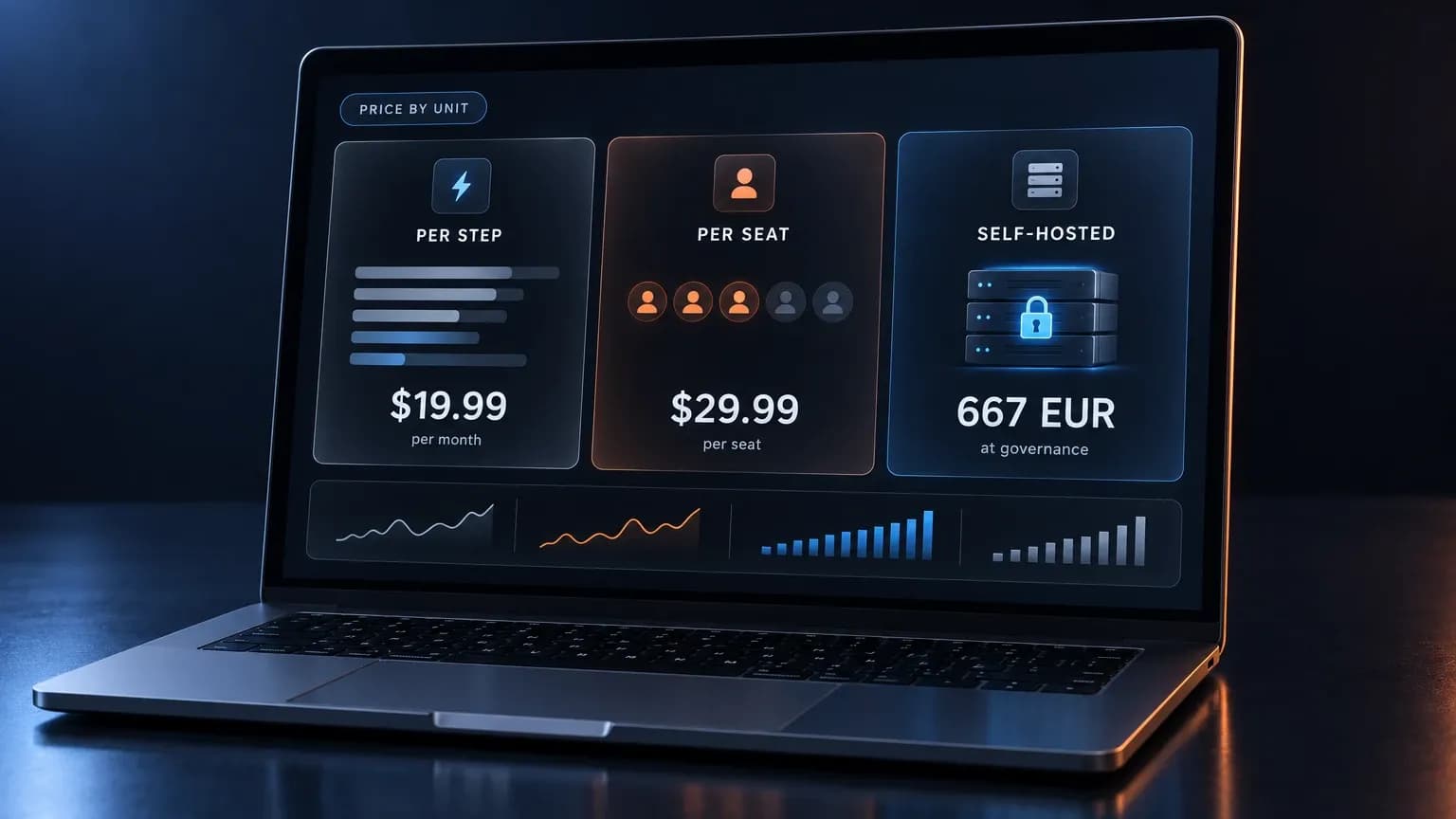
Composio builds a real pricing-model column and prints nine different billing units in it. Lindy says outright that the unit is one of two things that decide your choice. Then both file their picks under use case. This is the only list organized by what you actually pay, and the only one that prices the trap built into each model. Every price below was read from the vendor on 15 November 2026. The trap is where the money leaves. A step-metered tool gets more expensive as your workflow gets cleverer, because every branch and every AI call is a billed event. An execution-metered tool gets more expensive as your workflow gets chattier, because a webhook that fires 5,000 times costs 5,000 executions even when each run does one small thing. A seat-metered tool is indifferent to both and charges for the people who open it twice a month.
Make's pricing page returned a bot challenge instead of a plan table, Kestra publishes no tier price, and n8n Enterprise is Contact Sales, so those three carry no number. A list that prices all of them has filled the gaps from elsewhere.
The Three Cost Models, and What Each One Punishes
Model | You pay per | Tools in this group | What the model punishes |
|---|---|---|---|
Hosted, per unit of work | A step, a credit, a run or a task | Zapier, Make, n8n Cloud, Gumloop, Pipedream, Activepieces | Workflow complexity. Every branch and every AI call adds a billed event, so the better engineered the automation, the higher the bill. |
Hosted, per seat | A person with access | Lindy, Power Automate, Windmill Cloud | Headcount, not usage. A teammate who touches it twice a month costs the same as one who lives in it. |
Self-hosted | A machine and the hours to run it | n8n Community, Kestra, Node-RED | Nothing until governance. The paid edition unlocks SSO, roles and audit, so the trigger to pay is an audit rather than a volume ceiling. |
The model is not a pricing detail. It is a forecast of what your company looks like in twelve months, and you already know which way yours is growing.

Hosted, Paid per Unit of Work
Six entries. Most readers start here, because n8n Cloud sits here and so does most of the market.
Zapier
Zapier bills a task per successful step rather than per run. Pricing starts from $19.99 per month on Professional and $69 per month on Team, the latter including 25 users and SAML SSO. Both are a floor on a task slider, not a fixed fee, and Zapier pricing works that ladder through.
The trap: the bill scales with complexity, not volume. Zapier's own task-rate page confirms a standard step is one task, its built-in tools cost zero, Lead Router costs five per step, MCP calls cost two, and AI steps cost one, three or five by model tier. The moment an automation becomes genuinely intelligent, one run stops costing one unit.
Make
Make bills in credits, where most module actions cost one. I could not read the price: make.com/en/pricing returned HTTP 403 behind a Cloudflare challenge on 15 November 2026, so this entry stays unpriced rather than quoted from a competitor's table. The page does state that credits become the billing unit as of 27 August, the entry tier carries 1,000 a month, router and error-handler modules consume none, and unused credits expire.
The trap: a parallel branch bills for both sides. The readable canvas and the cheap run are not the same canvas, and nothing on the design surface tells you which is which until the counter moves. Three competing pages quote $12, $14 and $16 as Make's entry price.
n8n Cloud
n8n Cloud bills per execution, where one execution is one run of the whole workflow however many nodes it touches. Starter is 20 EUR a month billed annually for 2,500 executions. n8n prices in euros, so keep those apart from the dollar tools here. The full ladder is in n8n pricing, the pair page to this one: it owns what n8n costs, this page owns what you pay instead.
The trap is the mirror of Zapier's. A 50-node workflow costs one execution, so the unit rewards big workflows and punishes many small ones. Only production runs count, and manual runs and sub-workflow children are free of quota, so a fan-out costs one execution while a chatty webhook costs one per inbound request. The zapier vs n8n question is usually argued on connectors and settled here, on the unit.
Gumloop
Gumloop bills in credits plus an orchestration fee. Pro starts at $37 per month for 20,000 credits with unlimited seats, and the vendor page states an 8% orchestration fee on usage. The trap: two meters, not one. The credit count is the number you compare, the percentage fee is the number that follows real usage, and a heavy AI workflow burns 20,000 credits faster than the plan reads. Gumloop vs n8n runs the marketing head-to-head.
Pipedream
Pipedream bills in credits on top of an AI-token allowance. Basic is $29 per month, Advanced $49, Connect $99. The trap: two budgets. Credits for workflow use, and AI tokens at 1M on the entry tier, 20M on Basic and 50M on Advanced. A workflow can sit inside its credit allowance and still be throttled by tokens.
Activepieces
Activepieces bills per run, one credit per run however many steps it has, with AI priced on top. Plus is $20 per month flat for 10,000 credits and up to 5 users, overage at $0.007 per credit, and Team is $200 flat for 50,000 credits and 25 users with SSO.
The trap, in the vendor's own words: a run is one credit however many steps it has, and AI is the exception. A fast model costs 2 credits, a smart model 10, a frontier model 20. Bring your own AI keys and every AI step drops to one credit, so the flat price is flat only until the automation thinks. Second trap: the 5-user cap on the two cheapest plans is a seat ceiling, not a seat price.
Hosted, Paid per Seat
Three entries. Each is decent value for a small team that opens it daily, and each gets expensive in a way that has nothing to do with how much work it does.
Lindy
Lindy charges per active user, with each seat carrying its own credit bundle into a shared pool. Team is $29.99 per month per seat for 3,000 credits each, and the ladder runs to 1,750,000 credits at $9,999.50. That $29.99 is a seat, not a plan, which is the error most roundups make when they quote it.
The trap is in the vendor's own FAQ: anyone who uses Lindy takes a seat, whether they sign up, join your workspace, or @mention Lindy in Slack. A teammate who pings it twice a month costs a full $29.99.
Microsoft Power Automate
Power Automate charges per user plus a separate per-bot meter the moment work runs unattended. Premium is $15.00 per user per month paid yearly, Process is $150 per bot per month and Hosted Process $215. The trap: two ladders that look like one. The $15 seat is the number in every comparison and it is real, but the first flow that runs without a human watching moves to the $150 meter, ten times the seat. Department-wide rollout math fails on that step change.
Windmill Cloud
Windmill Cloud charges per builder seat, with non-builders at half price, on top of a compute-unit meter. Builder is $20 per month, non-builder $10, and the vendor's own example configuration lands at $170 per month. The trap: three meters stacked, and the seat price is the smallest and easiest to quote.
The case against seat pricing is measurable. Zylo's 2026 SaaS Management Index puts license utilization at 54% and average annual license waste at $19.8M, while BetterCloud's 2026 figure has 63% of organisations naming unused apps plus license pressure as their reason to consolidate.
Self-Hosted
Three entries, and every one is free in license terms. This is where the marketing gets romantic and the arithmetic gets real, because the license is free and the labour is not. The U.S. Bureau of Labor Statistics put the median annual wage for network and systems administrators at $99,130 in May 2025, or $47.66 an hour. Price your hours near that and "free to self-host" becomes a statement about who is not doing their actual job.
n8n Community Edition
The n8n Community edition is free and self-hosted, confirmed on two vendor pages: the pricing card and the editions documentation both describe the edition that runs without a license key. What it does and who it suits is covered in n8n for marketing.
The trap: the license is free and the features are not. Community excludes SSO by SAML and LDAP, Git version control, multiple environments, projects, external secret stores, log streaming and workflow sharing. A team needing any single one buys the paid self-hosted license and still pays for the server. That is the honest answer on n8n enterprise too: it exists above that tier for governance, not throughput.
Kestra
Kestra publishes no number anywhere. Open Source is free with unlimited flows and executions, 2,600+ plugins, an MCP server for agents and Git integration. Cloud is request-access, and Enterprise is an annual subscription priced per instance. The trap: the absence is the finding. No tier price is offered, so you cannot compare it before you talk to somebody, and the Enterprise feature list is the procurement set: SSO, SCIM, RBAC, policies, audit logs and worker groups.
Node-RED
Node-RED is free under Apache 2.0 with 5,000+ community nodes, an OpenJS Foundation project that began at IBM in 2013, with FlowFuse as its commercial layer. The trap: nothing is gated, and that is the problem here. There is no support contract to buy, so the burden lands on whoever installed it. Right for hardware wiring, wrong for a team that needs a support number when a flow breaks on a Friday.
The Governance Finding
Line the group up and it stops being about price. n8n charges 667 EUR per month at the point where you need SSO, projects or log streaming. Activepieces moves from $20 to $200 the moment a sixth person needs access. Windmill gives ten users with SSO and charges from $120 for audit logs. Node-RED gates nothing, including support.
Nobody upgrades a self-hosted instance because it ran too much. The trigger is a second person, an auditor, or a client asking who can see the credentials. The free edition is the acquisition funnel, and the price is set where governance arrives.

If You Are Leaving n8n Specifically
A workflow is portable. A node graph is not. What moves is the trigger, the HTTP call and the payload. What does not is the node for the SaaS tool you depend on, the expression syntax that shaped your data, and the error branch that only works because of how n8n retries.
So price the migration. A 40-node workflow rebuilt on another canvas is a day of somebody's time, and if that somebody is an engineer, the saved subscription competes against $47.66 an hour. Three workflows and an afternoon is a fine trade. Twenty is a project, and the new invoice will not mention it.
Worth knowing before you go: n8n raised $180M in a Series C at a $2.5B valuation, led by Accel. That is the tool you are leaving, and it is the best funded in its category, so nobody should expect it to get cheaper. Two questions decide more than any feature table: does the new tool count a production run the way your current one does, and does it gate the same governance features, so you are not buying SSO twice?
Frequently Asked Questions
Is there a genuinely free, open source n8n alternative?
Yes, several, and all of them are self-hosted. n8n's own Community edition, Kestra's Open Source edition and Node-RED cost nothing in license terms, and Activepieces and Windmill are free self-hosted too. Every free tier on a paid tool is a trial, not a working deployment, and Zapier's no-cost tier stops at 100 tasks a month.
What is the best n8n alternative for a marketing team?
The one whose meter matches how your team works. Build many small webhook-driven flows and per-execution billing is the cheapest unit available, which is n8n Cloud's own model. Build a few large flows and per-step billing hurts less than you expect. If the team is the variable, a per-seat tool charges for growth whether or not the new people use it.
Is n8n enterprise the only way to get SSO?
On n8n, yes. SAML and LDAP single sign-on, Git version control, multiple environments, projects, external secret stores, log streaming and workflow sharing all sit outside Community, which is why the paid self-hosted license exists. n8n enterprise is the sales-led tier above it, sold as Contact Sales with custom execution counts, hosted or self-hosted, and it publishes no price. Windmill does the same: audit logs and SAML group sync land in Enterprise from $120.
Can I run my n8n workflows on another platform?
The trigger, the HTTP request and the payload survive the move. Tool-specific nodes, expression syntax and error branches do not, and each one you depend on becomes rebuild time. Take your three most critical workflows, count the nodes that are not native HTTP, and treat each as an hour. Then compare that total with what a year of the new subscription saves.
Which of these has no published price at all?
Three. Make's pricing page returned HTTP 403 behind a bot challenge on 15 November 2026, so the model is clear and the plan prices are not readable. n8n Enterprise is Contact Sales by design, and Kestra publishes no tier price anywhere. Any list that prints a figure for all three is guessing, as the pages quoting $12, $14 and $16 for the same Make plan show.
Conclusion
The cheapest n8n alternative is not a tool. It is the right unit applied to your own volumes, and no feature table will tell you which. One question decides the group: does what you pay grow when your workflow gets cleverer, when it gets busier, or when your team gets bigger?
What surprised me while pricing this set is how little of the decision is about price. The paid slot sells a comparison against n8n's annual figure, the organic results sell workflows, and the answer sits in a definition of what counts as one run.
If you are leaving n8n because the unit stopped fitting, the arithmetic above will find you a cheaper meter. If you are leaving because the maintenance outgrew the team, no meter fixes that.

Get Started: Price Your Own Unit
Pull three months of your own automation volume, work out whether the meter that bills you counts runs, steps or people, and multiply. The model that survives is the only one worth a trial.