Sales Pipeline Management: The Number Marketing Is Quietly Accountable For
 Written by Martin H.
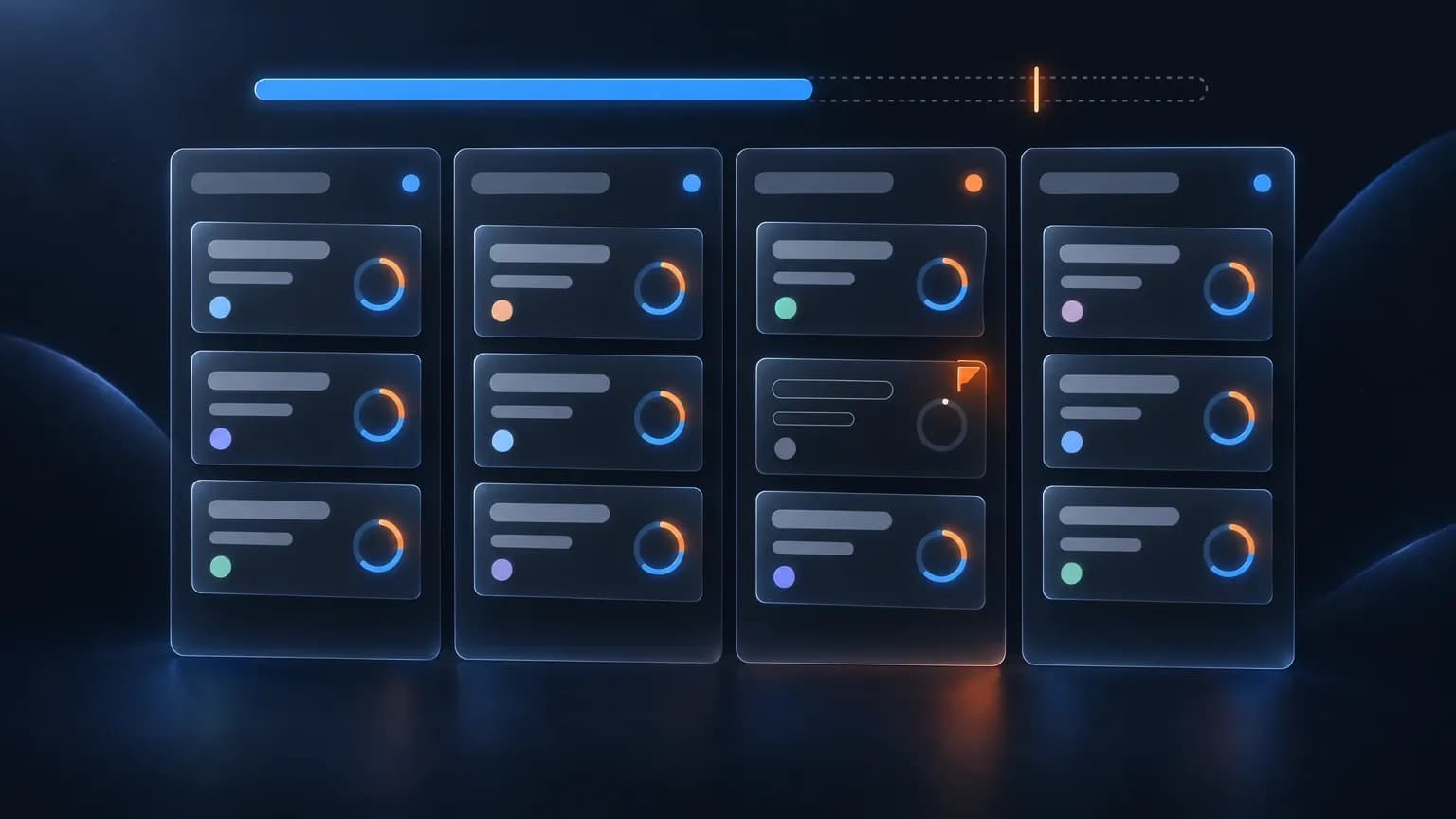
Your pipeline rarely leaks where the dashboard points. It leaks in the weeks after entry, when nobody owns the next step. Marketing is often the only team that can see a deal go quiet. How much of the coverage number is yours to defend?
There is a deal in your pipeline right now with a stage, an owner, and a next step that has a date on it. Nothing about it is red. It is also the deal you will be asked about in eleven weeks, and the honest answer will be that it stopped moving long ago and nobody said anything. You lost it to a Tuesday when it stopped producing evidence and the record kept showing a stage. Salesloft's 2026 benchmark puts an estimated 19.7% of pipeline in exactly that condition, and finds only about 32% of the people accountable for it can instantly say why a deal stalled. That gap is where your quarter goes.
What Sales Pipeline Management Actually Governs
The standard answer hands you a definition of sales pipeline management, a stage list, and two qualification frameworks. Your vendor's help center does the same.
What neither tells you is who is accountable, and accountability is the only part of sales pipeline management that changes what you do on Monday. Take this as the working definition: pipeline management is the discipline of deciding, before a deal is counted, whether it has earned the stage it sits in. The practice is the judgment, and judgment belongs to a person with a name.
Three things follow, and they are what this article hands you: coverage (how much pipeline has to exist, how much of it your function sourced), entry (what evidence a deal presents before it enters a stage), and silence (what happens when it stops producing evidence, and who notices).
Most teams run all three badly and cannot say which one is failing, because the dashboard reports the sum: a coverage shortfall, a sloppy stage and a dead deal arrive as the same low number. Our piece on marketing operations treats them as one system.
Pipeline Coverage: The Math Before the Dashboard
Every coverage conversation starts with a ratio, usually three to five times the target. Fullcast makes the sharpest case against the flat version: in many organizations high-ICP accounts are only 23% of total pipeline, so one multiplier treats your best-fit deals exactly like your worst-fit ones.
That critique is correct, and still a whole-pipeline critique. Here is the part nobody publishes: marketing's obligation is not a fraction of the ratio. It is the ratio applied to the sourced share. Those are different numbers, and the gap is where marketing teams get under-resourced for two quarters and then replaced.
The worked example. A $6,000,000 revenue target, a $50,000 average deal size, marketing sourcing 45% of pipeline, sourced deals converting from entry to closed-won at 25%.
Line | Baseline | Sourced share at 55% |
|---|---|---|
Revenue target | $6,000,000 | $6,000,000 |
Share of pipeline sourced by marketing | 45% | 55% |
Marketing-sourced revenue target | $2,700,000 | $3,300,000 |
Average deal size | $50,000 | $50,000 |
Deals marketing has to source | 54 | 66 |
Sourced-deal conversion, entry to won | 25% | 25% |
Opportunities needed at entry | 216 | 264 |
Pipeline value marketing must open | $10,800,000 | $13,200,000 |
Marketing's obligation is $10,800,000, which is 4.0 times its own $2,700,000 share. It is not 4.0 times the company's $6,000,000, which would be $24,000,000.
Two mistakes this table prevents. The first is the shortcut: apply a 3x rule to the total target, get $18,000,000, hand marketing 45% of it, land on $8,100,000. At a 25% conversion rate that buys 162 opportunities against a requirement of 216. The plan is 54 short on the day it is signed.

The second is subtler. A team measures its sourced share of closed-won revenue, gets a respectable 45%, and defends that figure at entry, where its actual share is 31%. Closed-won tells you what you produced last year. Entry tells you what you are producing now, and only the second determines whether next year is reachable.
It needs four inputs you probably have: revenue target, sourced share at entry, average deal size, your own stage conversion. No CRM admin rights required. Definitions are covered in marketing KPIs.
Entry Criteria: A Stage Without a Definition Is Not a Stage
Fullcast's 2026 benchmark report is the most uncomfortable reading here. Over half of deals bypass critical early stages: qualification is skipped in 59% of deals, discovery in 38%, alignment in 52%, proposal in 40%, negotiation in 25%. The report's own line is the one to keep. These are not administrative steps.
Skipped is the operative word. Those deals did not fail inside a stage; they were recorded as having passed through one. A failure inside shows up as a long dwell time. A skipped stage shows up as a fast deal, which reads as good news on every dashboard that exists.
Most pipelines answer this with exit criteria. Pipedrive gets close: move a deal only after a meaningful customer milestone, because progressing on assumptions reduces forecast accuracy. None of that tests how the stage was entered.
An entry criterion is a different object: the evidence a deal must present to be counted at a stage at all, answerable by someone looking at the record from outside. Three questions do the work:
- Who is the named human on the buying side who agreed to the action this stage is named after? Not the account, not the job title. A person.
- What is the dated artifact that proves it happened? A transcript, a reply, a published scope, a signed document. Something a stranger could open.
- What is the next step, with a date, and did that person accept it? A next step nobody on the buying side agreed to is a follow-up, not a commitment.
If any is missing, the deal still exists. It sits at the previous stage until the evidence arrives. That gate costs nothing, because it asks for artifacts that either already exist or never did.
This is where a marketing reader has more room to move than their title suggests. The artifacts for the first two stages are produced by or adjacent to marketing: the form fill, the content that started the conversation, the notes from the first call. That is narrower than auditing a rep's diligence. Did your own funnel's raw material become a confirmed fact about a named person?
If deals repeatedly die at the same stage, the sellers are not the problem and the stage count is not the problem. The entry criteria for that stage are wrong, or nobody was told what they were.
The Quiet-Deal Signal and Who Owns Detecting It
Salesloft's benchmark, run by Censuswide across 500 U.S. sales and revenue decision-makers, puts an estimated 19.7% of pipeline into stalled deals, slipped close dates and other execution breakdowns, and finds only about 32% of respondents can instantly diagnose why a deal stalled. A fifth of the pipeline is degraded, and two thirds of the people responsible cannot say what degraded it.
EY's 2026 front-office research reframes the silence. Eighty-nine percent of B2B buyers report a deal stalled in the past year, up from 71% three years earlier. Roughly 40% of qualified pipeline now dies to no decision rather than to a competitor, which EY reads from Forrester and calls the largest single loss category in most enterprise pipelines. A quiet deal is not a safe deal. Nobody won it.
The mechanism is documented. Dixon and McKenna's analysis of 2.5 million recorded conversations found that of deals lost to no decision, 44% went to a preference for the status quo and 56% to indecision driven by fear of failure. A buying group that has gone quiet usually cannot decide, and pressure makes it worse.
So define the quiet deal precisely. A stalled deal is one the CRM reports as old. A quiet deal is one the CRM cannot distinguish from a healthy one: it has a stage, an owner, a next step, and no new evidence inside a window you defined in advance. That is a detection problem, and detection is where a marketing operator contributes something nobody else has.
The window comes from your own data, not a benchmark. Take the median days a deal at that stage normally spends between recorded activities over your last two quarters, and double it. Past that, it is quiet. That beats a flat 30-day rule, too generous late and too strict at the first meeting.
Three signals readable without touching the record:
A date that expired without moving. A rep rescheduling a next step is a sign of life. A date that silently passes with nothing attached is not.
A disappeared human. The person who confirmed the action the stage is named after has not appeared in any artifact since. The deal still has a champion in the record. The champion stopped being one.
Account engagement with no deal-side echo. The buying group is still reading, still visiting, after the deal went quiet, and nobody on the deal has been told. Only marketing can see that one, and it separates a dead deal from one whose buying group is still working without you. Whether that engagement should earn credit is argued in revenue attribution; here it is only an input to detection.
Ownership is the part everyone skips. The rule that survives a review you were not invited to: the person who can see the silence reports it, the person who owns the record answers it. Marketing brings a list, the deal owner brings an explanation or moves the stage. Bring the verdict instead and the list stops being read.
Where Marketing Changes Pipeline Health
The sourced share moves before the quarter ends. The coverage table is a multiplier: five points of improvement at entry raises the requirement by 48 opportunities and $2,400,000 in that example. That is not a reason to celebrate. It is a reason to know the number before someone sets it for you.
You supply most of the evidence the gate needs. If entry at qualification requires a dated artifact from a named human, the form, the content and the first call are that gate's raw material. Building evidence where it is created costs less than reconstructing it in a review.
You can see account-level engagement the deal record cannot. Paid clicks, organic sessions and content consumption arrive at account level, and none of it attaches to an opportunity by default. That is where this stopped being a spreadsheet exercise for us: campaign and engagement data sit in one workspace, so the quiet list is a query, not a Friday afternoon.
Marketing cannot rewrite a stage definition it does not own. The contribution is narrow: a coverage number and a weekly list, both defensible without authority.
None of this replaces the earlier part of the system. If the funnel is not producing qualified conversations, coverage math only tells you how short you are. That belongs to lead generation funnels and demand generation strategy.
What to Review Weekly (and What to Ignore)
Twenty minutes, three items, one list.
The coverage gap. Required opportunities at entry minus opportunities opened this month, against your own sourced share rather than the company total. One number, trending in one direction.
The quiet list. Every open deal past its stage window with no new evidence. Owner, days quiet, last artifact. No theory about why.
Entry failures. Deals that entered a new stage this week without the three entry answers. Usually short, usually the most informative thing in the review.
What to ignore matters as much. The total pipeline number is not yours. Win rate by competitor is noise at most teams' sample sizes. And the forecast call is a different meeting: merging momentum with a forecast number turns a review into a negotiation.
When twenty minutes becomes ninety, you are reviewing deals rather than the system that produces them.
Frequently Asked Questions
What is sales pipeline management, in one working definition?
Deciding, before a deal is counted, whether it has earned the stage it sits in. In practice: how much pipeline has to exist and how much your function sourced, what evidence a deal presents to enter a stage, and who notices when it stops producing evidence.
What is pipeline management in sales, and where does marketing fit?
It belongs to whoever owns the record, and the operating questions are coverage, stage definitions and forecast accuracy. Marketing sits outside that record and still supplies three inputs: a defined share of the pipeline, most of the artifacts stage entry depends on, and account-level engagement that never reaches it.
How much pipeline coverage does marketing actually need to defend?
Multiply the revenue target by your sourced share at entry, divide by average deal size, then divide by your own sourced-deal conversion rate. That last figure is the one to bring to planning. A ratio applied to the company total, or to last year's closed-won share, gives a number too small to fund or too large to believe.

Run the Math Before Your Next Pipeline Review
Take four numbers into your next review: the revenue target, your sourced share at entry, the average deal size, and your sourced-deal conversion rate. Allable keeps the engagement side of that picture in one workspace, so the quiet list becomes a query instead of a Friday afternoon.