Ten days is all the time most TikTok videos get, and the report that judges them still treats every video the same. Some of your videos answer a question someone types into the app and keep arriving for months. Which kind did you make last week?
At 9:20 on a Monday, someone in your buying audience types a question into TikTok's search bar. Not your product name. A full sentence, the kind they would have typed into Google three years ago. The results page hands them a grid of videos and almost none of them answers it.
Search inside TikTok is no longer a secret. Metricool's 2026 guide opens on it, Hootsuite carries a section headed "Optimize for TikTok SEO and discoverability", and the Digital Codex page has its own block on it. They name it. None of them plans on it: search gets one paragraph inside a guide about pillars and posting cadence, and the plan stays what it was.
Adobe Express surveyed 807 US consumers and 200 small business owners, with data collected in January 2026. 49 percent said they had used TikTok as a search engine, up from 41 percent two years earlier. Among Gen Z respondents, 65 percent had done it, and only 25 percent said it worked well. And 85 percent of everyone surveyed still named Google as the most helpful place to find something, against 16 percent for TikTok.
The behavior is broad. The answers are thin. That is the opening.
Two Kinds of TikTok Content, Two Clocks
Every video you publish is one of two things, whether or not you decided which.
A trend-shaped video is built from a sound, a format or a moment that is moving this week. You shoot it fast because speed is the entire value. Its audience was not looking for you.
A search-shaped video is built from a sentence someone typed into the app. You write the question down before you write the answer. Its audience arrived already looking.
Production splits first. A trend is one decision made quickly: take the format, drop your subject in. A search video is slower at the front and faster at the back, and the same setup then carries five more questions in one afternoon. Format follows from that. Trends run short and sound-led. Answers run long enough to carry the question, the answer and one piece of proof.
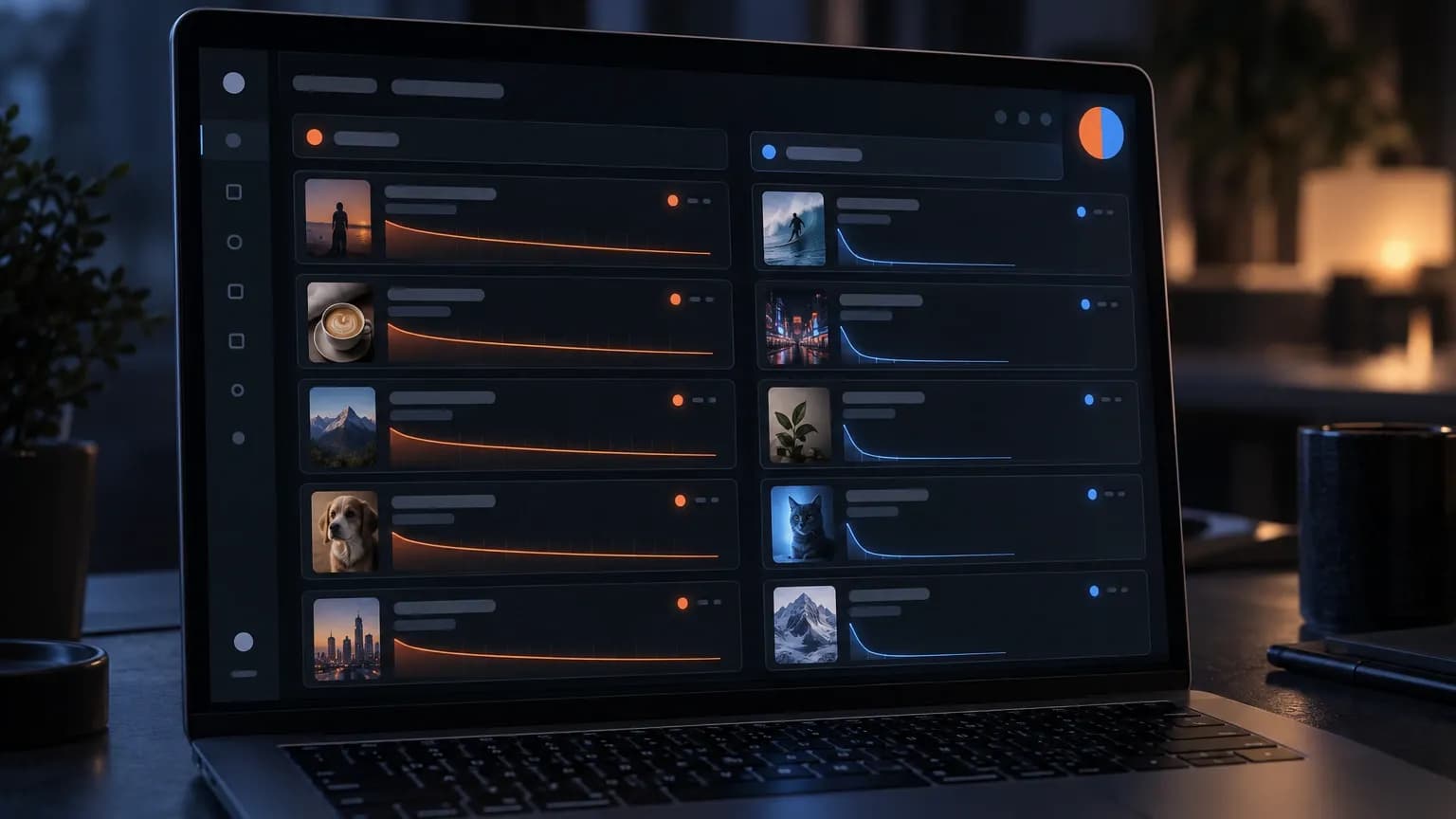
The expiry is where the two separate completely. Metricool measured 2,314,756 posts across more than 92,000 accounts and found that 96 percent of a post's total reach and nearly 98 percent of its interactions land inside the first ten days. That is the useful life of a trend video. A search video does not run on that clock, because the question stays in the app long after the sound has gone.
| Search-shaped | Trend-shaped |
|---|---|---|
How it is produced | The question is chosen and written first; five answers get shot in one session | The format is chosen and shot the same week; speed is the value |
Format it wants | 60 to 90 seconds, the question on screen and spoken, one clear answer | Short, sound-led, built on a format that is already moving |
When you read it | Day 30, then day 60 | Day 3, final by day 10 |
Useful life | Months, for as long as people keep typing the question | About ten days, by measurement |
What it is for | Being the answer when someone arrives with a question | Being seen by people who were not looking for you |
One calendar for both is what makes a plan fail. Fill slots with whatever is rising and the account owns nothing after a quarter. Fill them with whatever is easiest and nobody new finds you. Neither failure shows up in a weekly report.
Pillars, calendar fields and the split between planned and reactive posts belong to our social media content strategy guide. What changes here is the clock you judge a video by.
Mining the Query Set Inside the App
The query set is the list of sentences your buyers type into the app before they have decided anything. It is not a keyword list: keywords are short and bought, queries are full sentences from someone who wants an answer rather than a link. Build one in an afternoon.

Start with the category phrase, not your brand. Type it into the search bar and read the completions, not the results. Those are what other people finished typing. Write down every one that ends in a question word, because each has an answer behind it. Twenty to thirty makes a first pass, and the useful ones sit at the bottom.
Your own comments hold the second version of the same question. A question asked twice in different words has proof of demand attached. Ask the sales team what people ask on a call before they buy: those questions have money on them.
Next, run each query and look at the grid. How old are the answers: if every video is older than six months and the answer has not changed, you have a public gap. And do the results answer the question or only mention it. A video that says the words and never resolves them is the best gap available.
Score what you collected on four passes. Is it asked repeatedly, across more than one source. Is the person asking in your buying audience. Does a good answer already exist. Does the answer change every few months. That last pass does the filtering nobody else does: a question whose answer moves with the news is a trend video wearing a question mark.
One piece of scale, with the caveat attached. Metricool's guide puts search at nearly 4 percent of impressions on the average video, above 6 percent for accounts with more than a million followers, and reports hashtag-driven views up 114 percent over a year. That is vendor panel data, not an audited measurement. The direction still helps: a few percent that arrives for months is a different asset from a spike that ends.
What the Ten-Day Window Actually Costs a Trend Video
If 96 percent of reach lands inside ten days, then day eleven onward is 4 percent of the total. A video that reaches 40,000 people leaves 1,600 for the rest of its life. You are not buying a video. You are buying a ten-day window and a small tail.

That would be a fair trade if windows were getting wider. They are not. The same study measured views down 31.30 percent, reach down 28.73 percent and interactions down 31.17 percent year over year, against publishing volume up 72.10 percent. More than 92,000 accounts posted substantially more and reached substantially less. If your team has been answering a flat month with more output, sit with that number.
The study has a second half almost nobody quotes. 16.47 percent of those accounts moved up a follower tier, more than on any other network it compared. Harder per post, still the easiest place to grow an account, and a plan built on either half alone will be wrong in a way you can predict.
So when is a trend still the right buy? When the moment has a deadline you do not control: a launch week, a seasonal window, a sound genuinely rising, news in your category. If nothing bad happens when you miss it, it is not a trend, it is a format, and formats can wait for a library slot.
What a trend is never good for is answering a question, because the answer has to outlive the sound. A trend video is a rental. Renting is fine. A plan that only rents is not.
Building a Library That Keeps Serving
A library is not an archive of everything you posted. It is a set of videos that each answer exactly one query from the set you built, produced so the answer does not depend on a trend being alive.
The format is consistent because the job is. Sixty to ninety seconds. The question on screen in the first frame, then said out loud. The answer. One piece of evidence: a screen, a product, a number or a demonstration. No trending sound, because a sound dates the video. Captions on, because search results get watched in rooms with other people in them.
On length, the honest version. Buffer analyzed more than 1.1 million TikToks and found that videos over 60 seconds are associated with 43.2 percent more reach than videos in the 30 to 60 second band, and that only 12.3 percent of videos are that long. Buffer also says plainly that length is not causal. What the data supports is enough: about 86 percent of videos are under a minute, so the bracket with room to answer a question is the least crowded one on the platform. You are not choosing length for reach. You are choosing it because a question needs the room.
Sizing the library is the part no source will do for you. No credible published number exists, so derive it from what you own. Count the distinct questions your team answered last month, on calls, in comments, in tickets. That is your floor. If it lands at twenty, twenty is the number you plan from, and the count you repeat next quarter is how you find out whether the floor is rising. A floor is a direction, not a deadline.
Then set the signal that says it is working. A library video is carrying itself when its second month beats its first and a share of those views arrives from search. The first ten will not do it. Ten answers, shot in two sessions, is roughly where a set starts to read as a body of work.
What a Search Viewer Needs in the First Two Seconds
They already have the question. They typed it. The results page handed them a grid of faces, and they are not curious, they are checking. Your first two seconds have to confirm that you have the answer.
So put the question on screen as text, say it out loud, start answering. If the words match what they typed, they stay. If the words are a related question, they scroll.
This is where search-shaped video pulls against the hook advice you have already read. A hook withholds. An answer confirms. Withholding works on a viewer with no question. It fails on a viewer who already asked.
Show the shape of the answer early. "Three things decide this, and the second one is the part nobody tells you" is confirmation. So is a frame that shows the result before the explanation. Both tell the viewer the question is about to be resolved.
Reading a Video at Day 7 and at Day 30
One read date cannot judge both content types, and most reporting systems force you to try.
A trend video is finished by day ten. Read it at day three and close it at day ten, on reach and completion. Anything after day ten is the tail, not a verdict.
A library video should not be read before day thirty. Read it at day seven and it looks like a failure by design, because most of what it earns lands after the window everyone measures. At day thirty, read how much traffic arrived from search, and the slope to day sixty.
Carry one number per type into the review. For trends, reach at day ten. For the library, search-attributed views at day thirty, read again at sixty. Two numbers, two dates, no averaging.
The vocabulary matters less than the date. Our social media analytics guide covers which metrics deserve a dashboard and which ones only look good on one.
The risk is structural rather than analytical. A weekly report that ranks every video by first-week views ranks library videos last, every week, and the team learns to stop making them. Build it in two columns.
The Ratio: How Many Library Videos a Trend Video Buys
Every trend video pays for one library video before the next trend video gets a slot. One to one is the floor, not the target, and it is the number this plan turns on.
A trend buys ten days and a library video buys months. At one to one, half your output compounds and half rents reach. Below that, everything you make is gone by the end of the month and the account has no assets, only a feed. And you can still respond to a moment, because you have not banned trends. You made them pay rent.
Monthly output | Library videos | Trend videos | Move the ratio when |
|---|---|---|---|
4 videos | 2 | 2 | nothing has moved by day 90, which usually means the library is too thin to read rather than wrong |
8 videos | 5 | 3 | a library video's second month beats a trend video's first ten days |
16 videos | 10 | 6 | search views pass a quarter of total views on the library pieces |
The left column is whatever your team can produce in a month including editing, approval and captions. The middle two are the floor applied to it.
Once a month, count what you published in each column and read the two numbers from the previous section. If the ratio drifted, the calendar drifted, because trends feel urgent and answers never do. Nobody has ever been pinged about a question that has been asked for two years.
The paid side touches this in exactly one place. If you put money behind a video, put it behind a library video that already earns search views. You are not buying attention there, you are widening a door that is already open. The cost side belongs to TikTok ads for businesses.
What a Business Account Owns That a Creator Does Not
The guides ranking here are written for "brands and creators" as one audience. They are not one audience, and that assumption is why so much of the advice does not transfer.
The first difference is hands. A creator is one person with one face and one voice. A business has a subject expert, a presenter, and somebody who signs things off. That changes which format is cheaper: a trend needs the presenter in the room this week, while a library answer can be scripted once and shot in a batch.
The second is the approval chain. Ten days is shorter than most review cycles, so a trend video that has to clear legal clears legal after the trend has died. The way out is to approve shapes instead of videos, signing off formats, answer structures and claim language in advance so what gets reviewed is the template.
The third is where money changes hands. A creator is paid for reach. A business is paid when somebody buys, and the buying happens on a website, in a call, in a shop, somewhere that is not the app. That is why search-shaped content is worth more to a business than its view count suggests, and why a trend video can succeed by every number on the platform and produce nothing.
Which lever you have depends on the platform. On Instagram the mix is a proportion across different jobs, and the constraint is what to make rather than when to read it, which is the argument in our Instagram content strategy. On the B2B side the non-obvious lever is the comment layer, covered in our LinkedIn content strategy. TikTok is the one where a typed query does the routing, which makes it the one where content distribution strategy starts with a search bar.
Start With the Query Set, Not the Calendar.
If you take one thing from this page, take the order. The query set comes before the calendar, because a calendar can only schedule what you have already decided to make.
Sit down with the search bar for one afternoon. Write twenty sentences your buyers type. Run the four passes and drop the ones whose answers move with the news. Pick five. Shoot them in one session. Then let trends fill the slots that are left.
The accounts that lose this are not the ones posting too little. They are the ones posting a lot and owning nothing after ten days.
Frequently Asked Questions
Is TikTok actually a search engine, or does it just have a search bar?
It has both, and the gap between them is the whole opportunity. Adobe Express surveyed 807 US consumers and 200 small business owners, with data collected in January 2026, and found 49 percent had used TikTok as a search engine, including 65 percent of Gen Z. Only 25 percent of those Gen Z respondents said it worked well, and 85 percent of everyone surveyed still named Google as the most helpful place to find something. A majority of young users have tried the behavior and a quarter think it delivers, which is why a clear answer outranks a clever one here.
How long does a TikTok video keep getting views?
Ten days, if it is a trend video. Metricool measured 2,314,756 posts across more than 92,000 accounts and found 96 percent of total reach and nearly 98 percent of interactions land inside the first ten days. That number describes a video whose audience was never looking for it. A search-shaped video is not bound by it, because the question stays in the app after the sound has gone, which is why the two types need different read dates.
Should I post trends or build a library?
Both, at one to one as a floor: every trend video pays for one library video before the next trend gets a slot. A trend buys ten days and a library answer buys months, so a plan built only on trends ends each month with a feed and no assets. Keep trends for moments with a deadline you do not control, and let the query set decide everything else.

Start with the queries, not the calendar
Research the sentences your buyers type, draft the answers, and keep the trend slots in the same plan. Seven days free, and ten answers is enough to read.