
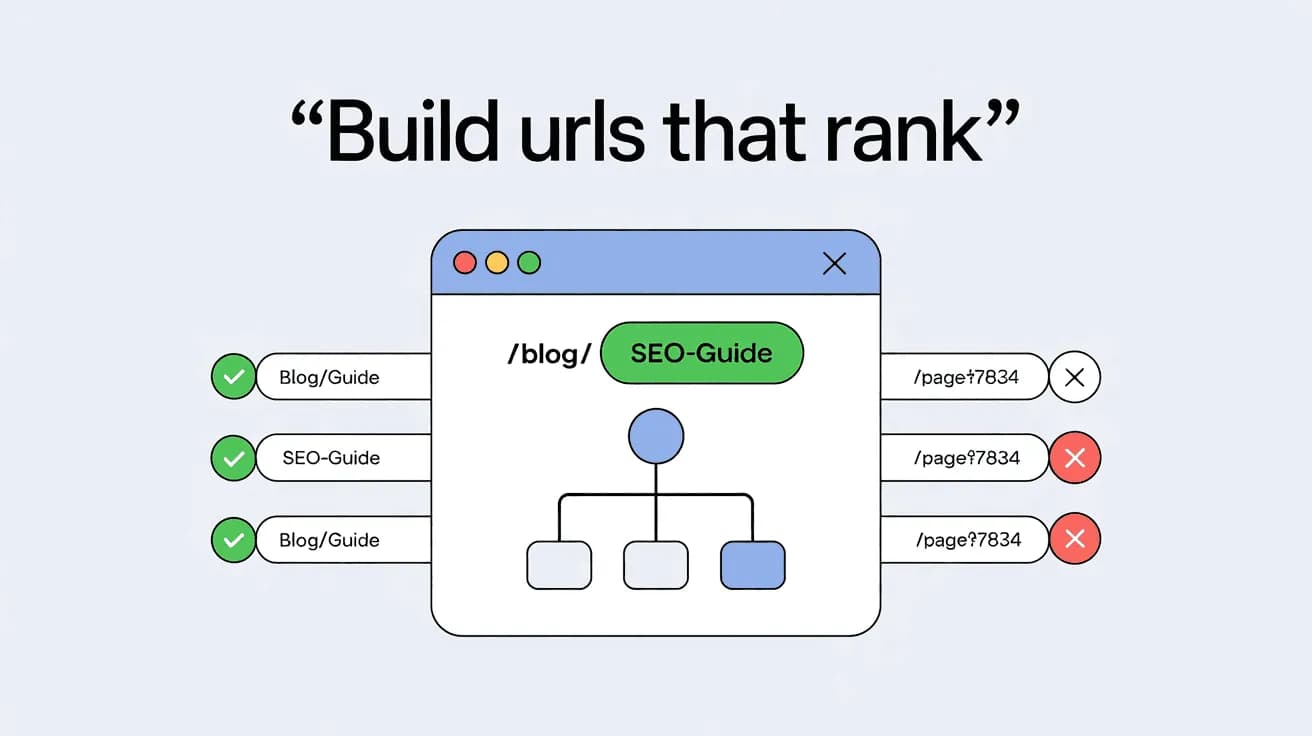
Learn SEO URL structure best practices in 2026. Discover how to create clean, keyword-rich URLs, fix bad URL structures, and handle redirects without losing rankings.
TL;DR: A clean URL tells both users and search engines exactly what a page is about before they even click. The three rules that matter most: (1) keep it short and descriptive with your target keyword in the slug, (2) use hyphens to separate words and lowercase letters throughout, and (3) reflect your site hierarchy logically — no deeper than 3–4 levels.
Your URL is the first thing Google reads about a page. Before crawling your content, before parsing your title tag, before checking your headings — it reads the address. And yet most websites treat URL structure as an afterthought, auto-generated by a CMS and never reviewed again.
That's a missed opportunity. A well-structured URL is one of the cheapest, highest-signal things you can get right for SEO. This guide covers every aspect of URL structure for SEO, from how to build clean slugs to what to do when you've inherited a messy structure and need to fix it without losing rankings.
Why URL Structure Matters for SEO (And How Much?)
URL structure affects SEO in three concrete ways.
It communicates site architecture. A URL like example.com/blog/seo/url-structure-guide tells Google that this is a blog post, it's in the SEO category, and the specific topic is URL structure. That kind of clear hierarchy helps Googlebot crawl and categorize your site more efficiently.
It signals relevance. When your target keyword appears in the URL slug, it sends a topical signal to both search engines and users. According to Backlinko's analysis of 4 million search results, URLs containing a matching keyword earn 45% more clicks in the SERPs than those without. That's a meaningful CTR difference for zero additional content effort.
It affects crawl budget. Messy URL structures with excessive parameters, session IDs, or redundant paths force Google to waste crawl budget on duplicate or low-value pages. Clean URLs mean more of your important pages get crawled and indexed.
That said, Google has been clear: URL length itself is not a ranking factor. John Mueller has stated explicitly: "We use URLs as identifiers; it doesn't matter how long they are." What matters is structure, not character count.
The Anatomy of an SEO-Friendly URL
Every URL has the same building blocks. Understanding them helps you make deliberate decisions at each level:
https://www.example.com/blog/url-structure-seo
│ │ │ │Protocol Domain Directory Slug
- Protocol: Always
https://. If you're still on HTTP, that's your first fix — it's a confirmed ranking signal and basic security requirement. - Domain: Your brand's root domain. For SEO, stick to a root domain rather than a subdomain for your blog (more on subfolders vs. subdomains below).
- Directory/path: The folder structure that shows where a page lives on your site —
/blog/,/services/seo/,/products/running/. - Slug: The last segment of the URL, specific to the page. This is where your target keyword goes:
/url-structure-seo, not/page?id=8734.
A clean SEO-friendly URL format looks like this:
https://example.com/blog/url-structure-seo
Not like this:
https://example.com/blog/2024/03/14/understanding-all-about-url-structuring-best-practices-and-tips?ref=social&session=abc123
7 URL Best Practices for Better Rankings (With Examples)
1. Use Hyphens to Separate Words — Not Underscores
This is the one URL rule that trips up developers most often. Google treats hyphens (-) as spaces, so url-structure-seo reads as three separate words. Underscores (_) are treated as word joiners — url_structure_seo reads as one long word to Googlebot.
✅ Correct | ❌ Wrong |
|---|---|
|
|
|
|
2. Use Lowercase Letters Throughout
URLs are case-sensitive on most servers. Example.com/Blog/SEO-Guide and example.com/blog/seo-guide can resolve as two separate pages, creating duplicate content. Set your CMS to always generate lowercase URLs and you'll never have to think about this again.
3. Include Your Primary Keyword Once — No Stuffing
Your target keyword belongs in the URL slug, used once. A URL like example.com/seo-url-structure-seo-url-best-practices-seo-guide doesn't rank better — it looks spammy and makes Google second-guess what the page is actually about. Pick the clearest version of your keyword and use it cleanly:
✅ example.com/blog/url-structure-seo❌ example.com/blog/seo-url-structure-seo-url-best-practices-seo-tips
4. Keep the Slug Short and Descriptive
The ideal slug uses 3–5 words that accurately describe the page's content. Remove stop words ("the", "a", "and", "of", "how", "to") unless they're part of a well-known keyword phrase. Dates belong in your content, not your URL — they age out and force you to either keep outdated URLs or migrate them later.
✅ Good | ❌ Avoid |
|---|---|
|
|
|
|
5. Use a Logical URL Hierarchy (3–4 Levels Max)
Your URL path should mirror your site's content structure. A clear hierarchy helps Googlebot understand how pages relate to each other and prevents crawl budget from being wasted on deeply nested paths.
A good seo url structure for different site types:
Site Type | Pattern | Example |
|---|---|---|
Blog / Content |
|
|
E-commerce |
|
|
Services |
|
|
Resources |
|
|
Keep depth to a maximum of 3–4 levels. Pages buried at /store/mens/shoes/running/trail/waterproof/product-name are harder to crawl and harder for users to parse.
6. Use Subfolders, Not Subdomains, for Your Blog
When you put your blog at blog.example.com, Google treats it as a separate site from example.com. All that link authority from blog posts flows to the subdomain, not your root domain. Use example.com/blog/ instead — it keeps all authority under one roof.
7. Keep URLs Stable — Don't Change Them Without a Plan
Once a URL earns backlinks and rankings, changing it without a 301 redirect means starting from scratch. URL stability is an underrated ranking factor. Build your URL structure deliberately from the start so you're not migrating it in two years. If you do need to change URLs, there's a safe way to do it (covered in the last section of this guide).
URL Length: How Long Is Too Long?
Here's the honest answer: URL length is not an SEO ranking factor. Google has confirmed this multiple times. John Mueller put it bluntly: "When it comes to search rankings, neither the URL length nor the number of slashes matter."
The technical maximum for a URL in the browser address bar is 2,048 characters — you're unlikely to hit that.
That said, shorter URLs are better for user experience. Search engines display URLs in the SERP snippet, and long URLs get truncated, which can make your result look messy and reduce trust. Industry guidance typically points to keeping the full URL under 75 characters as a practical readability threshold, and slugs in the 3–5 word range.
So the rule is: make your URLs as short as they need to be to clearly describe the page content — but don't obsess over shaving one or two words if doing so makes the URL ambiguous.
URL Parameters and Dynamic URLs: What to Do With Them
URL parameters are the ?key=value strings added to a URL by your CMS, analytics platform, or e-commerce engine. They look like this:
example.com/products?color=blue&size=large&sort=price&page=3
The problem is that a single product page can generate dozens of parameter combinations, each appearing to Google as a unique URL — all with the same (or very similar) content. This creates duplicate content issues that dilute rankings and burn crawl budget.
How to handle URL parameters for SEO:
- Use canonical tags. Add a
rel="canonical"tag pointing to the clean, parameter-free version of the page. This tells Google which URL to index and consolidates any link signals to that version. - Minimize parameters at the source. Work with your development team to reduce unnecessary tracking parameters. If UTM parameters are appended to internal links, strip them.
- Block with robots.txt. For parameters that generate truly useless page variants (like session IDs), use
robots.txtto block Googlebot from crawling those URL patterns altogether. - Replace with path-based structure where possible. Instead of
/products?category=shoes, use/products/shoes/. A path-based structure is cleaner, easier to read, and better for SEO.
Google's official documentation explicitly recommends: "Avoid the use of session IDs in URLs and consider using cookies instead." Session IDs in URLs are a classic source of crawl waste.
For deeper technical issues like these, running a full technical SEO audit helps surface all the parameter and duplication problems across your site at once.
How to Fix Bad URL Structure Without Losing Rankings
You've inherited a site with ugly URLs, dates in slugs, or deeply nested paths that no longer reflect your content structure. Here's how to clean it up without tanking your organic traffic.
Step 1: Audit your current URL structure
Before changing anything, map out all your existing URLs and identify which ones have earned backlinks, organic rankings, or significant traffic. These are the URLs you need to handle most carefully. A content audit is the right starting point — it gives you a complete inventory with performance data attached.
Step 2: Plan your new URL structure
Design the clean structure you want: logical hierarchy, keyword-rich slugs, lowercase and hyphenated. Map each old URL to its new equivalent.
Step 3: Implement 301 permanent redirects
A 301 redirect signals to Google that a URL has permanently moved to a new location. Google now confirms that 301 redirects pass link equity without loss — there's no longer a "redirect tax." Set up your redirect map in your server config or CMS before making any live changes.
Step 4: Update internal links and your sitemap
Don't rely on the redirects forever. Update your internal links to point directly to the new URLs, and resubmit your sitemap in Google Search Console. This speeds up re-crawling and helps Google process the changes faster.
Step 5: Be patient — Google takes several weeks
Google needs time to recrawl old URLs, follow the redirects, and reassign rankings and link signals to the new destinations. Expect a temporary fluctuation before things stabilize. If rankings don't recover within 4–6 weeks, audit your redirects for chains or loops.
A common mistake: Changing URLs on pages that don't need it. If a page is ranking well with a mediocre URL, the risk of migration rarely outweighs the benefit of a cleaner slug. Only migrate URLs where the benefit is clear — for example, removing dates from a blog that's now evergreen content.
For on-page factors like URL optimization alongside title tags, meta descriptions, and heading structure, the on-page SEO optimizer handles all of these in one place.
Good vs. Bad URL Examples
Page Type | ❌ Bad URL | ✅ Good URL |
|---|---|---|
Blog post |
|
|
Product page |
|
|
Service page |
|
|
Category page |
|
|
Location page |
|
|
FAQ
What makes a URL SEO-friendly?
An SEO-friendly URL is short, descriptive, and lowercase, with hyphens separating words and the target keyword appearing once in the slug. It follows a logical site hierarchy, runs on HTTPS, and contains no unnecessary parameters or session IDs.
Do URL keywords still matter for SEO rankings?
Keyword in the URL is a minor ranking signal — it's not going to make or break your rankings on its own. What it does affect meaningfully is click-through rate: users scanning SERP results are more confident clicking a URL that matches their search query. For new pages, always include your primary keyword in the slug.
Should I use www or non-www in my URLs?
Either works — what matters is consistency. Pick one format (www or non-www), make it your canonical version in Google Search Console, and ensure the other version 301-redirects to it. Mixing both without a redirect creates duplicate content.
Can URL parameters hurt my SEO?
Yes, if left unmanaged. Parameter-heavy URLs can create hundreds of near-duplicate pages that dilute rankings and waste crawl budget. Use canonical tags to point to the clean version of each page, and use robots.txt to block pure session or tracking parameters from being crawled. See our technical SEO checklist for a full parameter management workflow.
How often should I audit my URL structure?
After your initial setup, a URL structure audit makes sense any time you redesign the site, migrate to a new CMS, significantly expand your content categories, or notice crawl coverage drops in Search Console. For most sites, a comprehensive on-page SEO check once or twice a year catches the common issues before they compound.
Ready to Audit Your URL Structure?
Getting URL structure right is one piece of a larger technical SEO puzzle — but it's one of the few pieces you can fix site-wide with a systematic approach.
Audit your site's URL structure and technical SEO with Allable — our technical SEO audit tool scans your entire site for broken URL patterns, duplicate content from parameters, redirect chains, and crawlability issues. Pair it with the on-page SEO optimizer to optimize slugs, meta tags, and headings across all your pages from a single dashboard.