
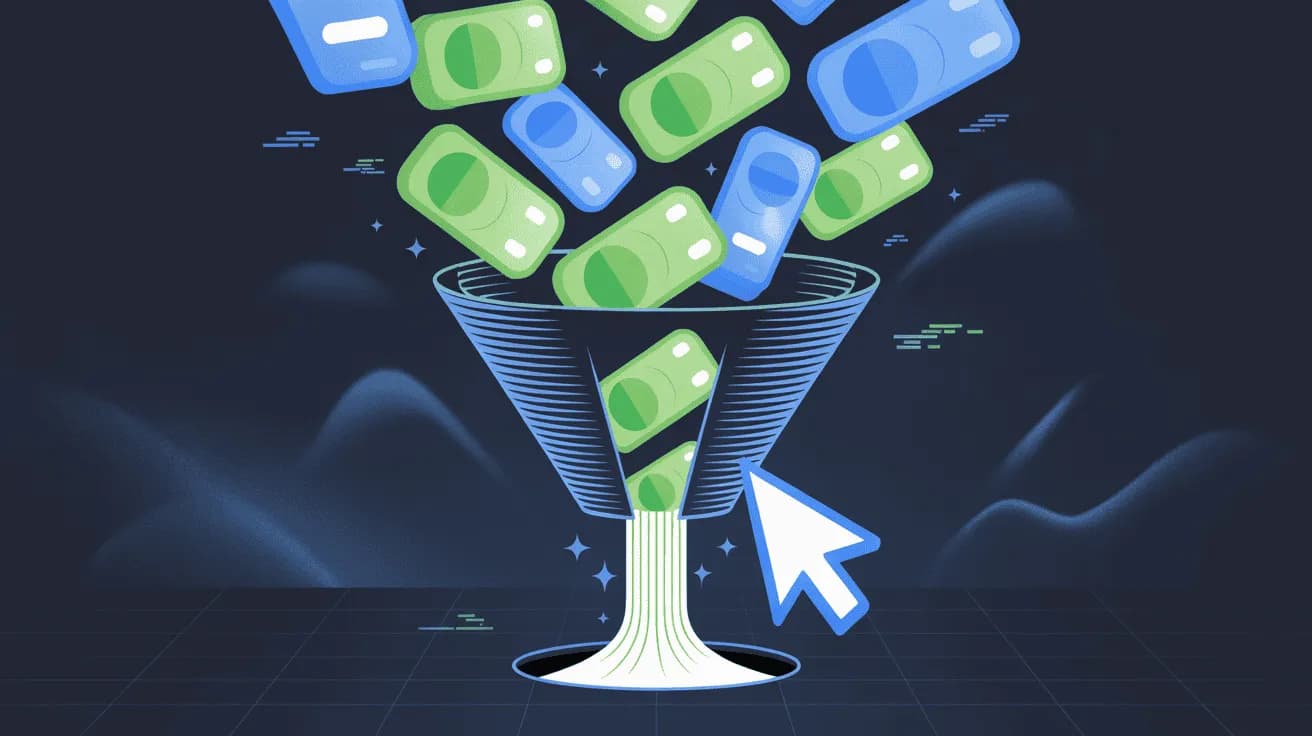
Complete beginner's guide to PPC advertising. Learn how pay-per-click works, types of PPC ads, key metrics, average costs, and how to get started in 2026.
Global spending on pay-per-click advertising hit $190.5 billion in 2024 — a 12.8% jump from the year before. Yet for every marketer running profitable PPC campaigns, there are plenty more burning through budget on clicks that never convert.
The difference usually comes down to understanding: knowing exactly what PPC is, how the auction works, which metrics actually matter, and whether paid search makes sense for your specific goals. This guide covers all of it — from the bare-bones definition to a practical roadmap for getting started.
What Does PPC Stand For? (Simple Definition)
PPC stands for pay-per-click — a digital advertising model where you pay a fee each time someone clicks on your ad. Instead of paying a flat rate for placement, you only pay when someone actually engages.
The most common form is search engine advertising, where your ad appears at the top or bottom of Google's results page when someone searches for a relevant keyword. But PPC also spans display banners, shopping listings, YouTube video ads, and paid social placements on platforms like Facebook and Instagram.
The key idea: you're essentially buying visits to your website rather than earning them organically. Done well, those visits are highly targeted — you're reaching people who are actively searching for exactly what you offer.
How Does Pay-Per-Click Advertising Work?
PPC isn't as simple as writing an ad and paying for it to run. Behind every click is a real-time auction that determines whether your ad shows at all, and where.
The Auction Model
Every time a user enters a search query, Google (or whichever platform you're using) runs an instantaneous auction among all advertisers bidding on keywords that match that query. The winner isn't simply the highest bidder — a range of factors influences who shows up and in what position.
Here's the simplified version of how it works:
- You choose keywords — the search terms you want your ad to appear for.
- You set a maximum bid — the most you're willing to pay per click.
- Google runs the auction — comparing your bid against competitors and factoring in ad quality.
- Your ad either shows or doesn't — based on your final "Ad Rank" score.
- You pay when clicked — and the actual amount is often less than your maximum bid.
The practical takeaway: a smaller budget with a highly relevant, well-structured ad can outperform a bigger spender with a generic one.
Ad Rank and Quality Score
Quality Score is Google's rating (1–10) of how relevant and useful your ad, keywords, and landing page are to the user. It's calculated from three components:
- Expected click-through rate — how likely your ad is to be clicked when shown
- Ad relevance — how closely your ad matches the intent behind the search query
- Landing page experience — whether the page people land on actually delivers what the ad promises
Ad Rank is what determines your position. It combines your maximum bid with your Quality Score, plus a few additional context signals. The formula simplifies to:
Ad Rank = Maximum Bid × Quality Score (+ context signals)
A high Quality Score does two important things: it improves your ad position, and it lowers your actual cost per click. That's why investing in strong ad copy and a relevant landing page isn't just good practice — it directly impacts your profitability.
PPC vs SEO: What's the Difference?
Both PPC and AI SEO aim to get your business in front of people searching on Google. But they operate very differently.
Factor | PPC | SEO |
|---|---|---|
Speed | Traffic starts immediately after launch | Results build over months |
Cost model | Pay per click | Time + resources (no per-click fee) |
Visibility | Top of page, clearly marked as ad | Organic results below ads |
Longevity | Stops when you stop paying | Compounds over time |
Targeting | Highly precise (keywords, audience, device) | Broader, intent-based |
Conversion rate | ~1.3% average across industries | ~2.4% average across industries |
Best for | Immediate results, promotions, testing | Long-term authority and traffic |
One telling stat: research from Business2Community found that marketers using both SEO and PPC see 25% more clicks and 27% more profit than those relying on one channel alone. The two strategies aren't competitors — they complement each other well.
Types of PPC Ads
Pay-per-click isn't just Google search boxes. The format has expanded across every major platform, each with its own mechanics and strengths.
Search Ads (Google Ads)
Search ads are the most familiar form of PPC — text ads that appear on Google's results page when someone searches for a term you're bidding on. They're identified by a small "Sponsored" label and appear above or below organic results.
Best for: High-intent targeting — reaching people who are actively searching for a product, service, or answer right now. If someone searches "emergency plumber near me," they want to book someone, not browse content.
Display Ads
Display ads are image or banner ads shown across Google's Display Network — a collection of over 2 million websites, apps, and platforms. Unlike search ads, they reach people who aren't actively searching but match a demographic or interest profile.
Best for: Brand awareness, retargeting visitors who've already been to your site, and keeping your brand visible during longer purchase cycles.
Shopping Ads
Shopping ads show up in Google Search and the Shopping tab with a product image, price, and store name. They're powered by your product data feed rather than keywords — Google determines which queries your listings match.
Best for: E-commerce businesses with product inventory. Shoppers clicking a shopping ad already know the price and see the product, so they tend to have strong purchase intent.
Video Ads (YouTube)
YouTube video ads appear before, during, or alongside videos. The most common format is the skippable in-stream ad, which viewers can skip after five seconds. You typically only pay if someone watches at least 30 seconds or interacts with the ad.
Best for: Building brand awareness, storytelling, and reaching audiences who are harder to capture via text-only formats. YouTube ads average around $0.20 per click — significantly cheaper than Google Search's average of $4.66.
Social Media PPC
Paid advertising on Facebook, Instagram, LinkedIn, TikTok, and X (formerly Twitter) also operates on a pay-per-click or cost-per-impression model. Social PPC is driven more by audience targeting (demographics, interests, behaviors) than by search intent.
Best for: Awareness campaigns, reaching specific demographics, and platforms where your audience already spends time. LinkedIn PPC, for example, is particularly effective for B2B companies despite its higher average CPC of $5.58.
Key PPC Metrics You Need to Know
Once your campaigns go live, you'll be swimming in data. Here are the metrics that actually tell you whether your PPC advertising is working.
CPC (Cost Per Click): What you pay each time someone clicks your ad. The average Google Ads CPC is $4.66, though this varies widely by industry — legal and financial services regularly see $20–$50 CPCs, while e-commerce may run much lower.
CTR (Click-Through Rate): The percentage of people who see your ad and click it. The average CTR across Google Search is 6.42% in 2026 — up from 6.11% in 2024, reflecting improved ad relevance scoring. Low CTR often signals misaligned keywords or weak ad copy.
Quality Score: Google's 1–10 score for your keyword-ad-landing page combination. Higher scores lower your CPC and improve position.
Conversion Rate: The percentage of clicks that result in a desired action (purchase, form fill, phone call). The average PPC conversion rate across industries is 1.3% — though this varies enormously. Some B2B industries see below 0.5%, while retail e-commerce can hit 3–5%.
CPA (Cost Per Acquisition): Total ad spend divided by the number of conversions. Your target CPA should be lower than the lifetime value of a customer.
ROAS (Return on Ad Spend): Revenue generated for every dollar spent on ads. Google's own methodology suggests you can see returns as high as $8 for every $1 spent in Google Ads — though most advertisers see closer to $2 on average.
Impression Share: The percentage of eligible auctions where your ad actually showed up. Low impression share often means your budget or bids are too low to compete for your target keywords.
How Much Does PPC Advertising Cost?
There's no fixed answer — PPC budgets range from a few hundred dollars per month for a local business to hundreds of thousands for enterprise advertisers.
What the data shows:
- 61% of businesses pay between $0.11 and $0.50 per click on Google Ads (WebFX, 2024)
- More than 44% of businesses spend between $100 and $10,000 per month on Google Ads
- Average CPC on the Google Search Network: $4.66
- Average CPC on the Google Display Network: lower, typically $0.50–$1.00
The industry you're in has a major impact. Highly competitive spaces like legal, insurance, and financial services can see CPCs of $20–$100+. Home services, software, and e-commerce typically sit in the $1–$10 range.
Three factors most directly control your costs:
- Your maximum bid — set this based on the lifetime value of a customer, not just gut feel
- Quality Score — improving your score is the most cost-efficient lever you have
- Campaign structure — tightly organized ad groups with relevant keywords and matching ad copy consistently outperform catch-all campaigns
Is PPC Worth It? Pros and Cons
PPC isn't the right move for every business at every stage. Here's an honest breakdown.
Pros:
- Immediate visibility — ads can go live the same day you set up a campaign
- Precise targeting — reach people by keyword, location, device, time of day, income level, and more
- Measurable ROI — every dollar is tracked; you can tie spend directly to revenue
- Scalable — increase or decrease budget based on performance
- Testing platform — quickly test messaging, offers, and landing pages before committing to longer-term SEO content
Cons:
- Cost — budgets disappear fast in competitive niches; there's no "set and forget"
- Requires ongoing management — campaigns that aren't actively monitored and optimized tend to get expensive quickly
- No lasting equity — when you stop spending, traffic stops immediately
- Learning curve — Smart Bidding strategies require at least 100 monthly conversions to work effectively (per Improvado data); accounts below this threshold can see 20–30% CPA volatility
- Ad blindness — some users deliberately skip ads in favor of organic results
PPC works best when you have a clear offer, a defined audience, and a landing page that actually converts. Without those foundations, you'll get clicks that don't turn into customers.
How to Get Started with PPC Advertising
If you've never run a PPC campaign before, here's a practical starting point:
1. Define your goal first. Are you trying to generate leads, drive product sales, or build brand awareness? Different goals call for different campaign types and bidding strategies.
2. Research your keywords. Use Allable's keyword research tool to identify the search terms your potential customers are actually using — and what the competition looks like for each. For a deeper dive, read our guide to PPC keyword research.
3. Set a realistic budget. Start with enough to generate meaningful data — typically $1,000–$2,000/month for a test campaign — and scale based on what you learn.
4. Write tightly focused ad groups. One theme per ad group, with keywords, ad copy, and landing page all aligned around the same intent. Broad, loosely organized campaigns are the fastest way to waste budget.
5. Build a dedicated landing page. Don't send paid traffic to your homepage. Create a page that directly matches the ad's promise, with a clear call to action.
6. Set up conversion tracking before launch. You need to know which clicks are turning into customers before you can optimize anything. Google's conversion tracking is free and should be in place from day one.
7. Review and refine regularly. Check your search term reports for irrelevant traffic, pause underperforming keywords, and test new ad variations. PPC rewards active management.
FAQ
What does PPC stand for?
PPC stands for pay-per-click. It's an advertising model where you pay a fee each time someone clicks your ad — rather than paying for impressions or placement.
Is Google Ads and PPC the same thing?
Google Ads is the most popular PPC platform, but PPC as a model extends to Bing Ads, Facebook Ads, LinkedIn Ads, Amazon Advertising, and many others.
How is PPC different from SEO?
SEO focuses on earning organic (unpaid) traffic over time. PPC buys traffic immediately through paid placement. SEO builds long-term equity; PPC delivers immediate visibility but stops when you stop paying.
How much should I budget for PPC?
There's no universal answer. A local service business might start at $500–$1,000/month; an e-commerce store competing nationally might spend $10,000+. Start with what you can afford to learn from, not what you hope to profit from immediately.
Can small businesses run PPC campaigns?
Yes — in fact, PPC's precise targeting makes it especially useful for small businesses with limited budgets. The key is starting narrow: one geographic area, a handful of high-intent keywords, and a clear conversion goal.
What's a good ROI for PPC?
The benchmark commonly cited is $2 in revenue for every $1 spent, with Google's own data suggesting returns as high as $8:$1 for well-optimized campaigns. Your actual ROI depends heavily on your industry, offer, and how well your landing page converts.
Start Running Smarter PPC Campaigns
PPC advertising is one of the few marketing channels where you can turn on traffic in hours, see exactly which keywords are converting, and scale what works. But it rewards preparation.
Before you spend a cent, know your keywords, understand your audience, and make sure your landing page can actually convert that traffic.
Allable.ai helps you build and optimize PPC keyword lists alongside your SEO strategy — so you're never guessing which terms are worth bidding on. Explore the keyword research tool and start building campaigns that work.