There's a gap between what SEO used to require and what it demands today. A few years ago, you could get by with a spreadsheet of keywords, a rank tracker, and a handful of browser extensions. Today, competing for organic traffic means publishing more content, optimizing it faster, monitoring SERP changes in near real-time, and doing it all across dozens — sometimes hundreds — of pages. The volume alone is unmanageable without serious automation.
That's why finding the best AI SEO tool has become one of the most practical decisions a marketer, content team, or business owner can make in 2026. The right platform doesn't just save time — it changes what's actually possible. The wrong one adds another subscription to your stack without moving the needle.
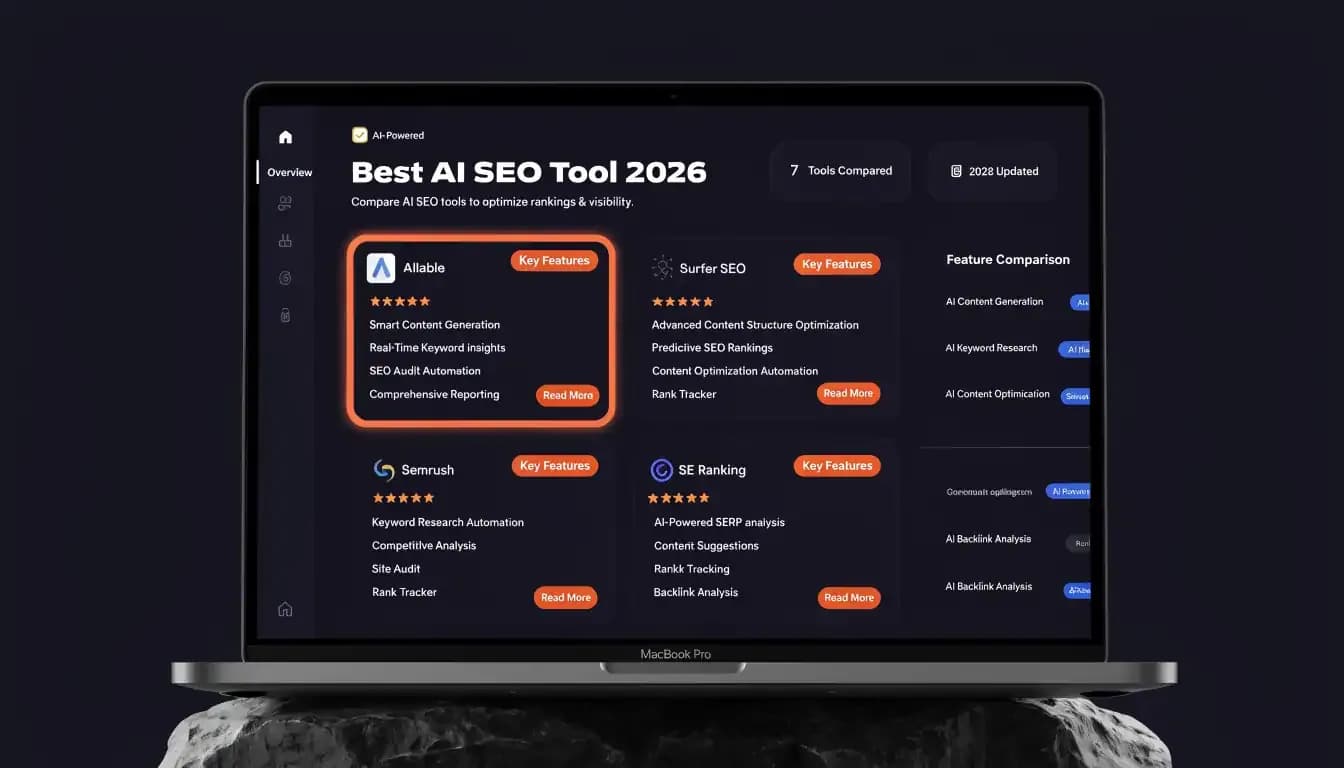
This guide compares the top AI-powered SEO tools available right now: what they do well, who they're built for, and how to make an honest choice based on your situation. We've included feature breakdowns, pricing, and a use-case comparison so you can cut through the noise. We also cover what AI SEO actually is if you're newer to this space.
What Makes an AI SEO Tool Different from a Regular SEO Tool?
Traditional SEO tools are data aggregators. They collect and display information — keyword search volumes, backlink counts, domain authority scores — and leave the analysis and decisions to you. They're valuable, but they don't really do anything on your behalf.
AI-powered SEO tools go a step further. Instead of just showing you a list of 500 keyword ideas, an AI SEO tool clusters them by topic, scores them by relevance, and suggests which ones to target first. Instead of simply flagging that your content is too short, it tells you which semantic terms you're missing and why competitors are outranking you.
The practical difference shows up in three areas:
- Speed. Tasks that once took hours — keyword research, content briefs, competitive gap analysis — can be completed in minutes.
- Scale. AI tools make it feasible to optimize dozens of pages simultaneously, something a small team couldn't realistically do manually.
- Recommendations, not just data. The best AI SEO tools translate data into actionable next steps: what to write, how to structure it, and where your content is falling short.
What they can't replace is strategic judgment. A tool that scores your content at 87/100 can't tell you whether that piece fits your broader content strategy or whether the topic is genuinely worth pursuing. That part still takes a human.
What to Look for in the Best AI SEO Tool
Not every tool needs to do everything. But before you commit to a platform, it's worth knowing what capabilities matter most for your goals.
Keyword research with real intelligence. Volume and difficulty scores are table stakes. What separates a good AI SEO tool is contextual understanding: search intent classification, keyword clustering, and recommendations tied to your domain's existing authority. Look for AI-powered keyword research features that go beyond a basic list.
On-page content optimization. This is where most AI SEO tools focus. The best ones analyze top-ranking pages, identify the semantic terms and structural patterns those pages share, and give your content a score with specific suggestions to close the gap. Check out our roundup of best on-page SEO tools for a deeper comparison in this category.
Site audit capabilities. AI-enhanced audits can prioritize technical issues by actual SEO impact rather than dumping every warning into an undifferentiated list. For a complete view of what these audits should cover, see our technical SEO checklist.
Automation and workflow depth. Can the tool draft content outlines, generate briefs, or write first drafts? Can it run competitor analysis without you pulling reports manually? The more of your workflow a single tool covers, the less time you spend stitching together data from five different places.
Ease of use. An enterprise-grade platform with a brutal learning curve isn't the right fit for a solopreneur or small team. Conversely, a tool that sacrifices depth for simplicity won't satisfy an agency running 20 client projects.
Pricing structure. Some tools charge per user, some per report, some per domain. Make sure you understand what you're actually getting at each pricing tier before you commit.
Best AI SEO Tools in 2026
Here's an honest look at the leading options — what they're genuinely good at, and who they're built for.
Allable.ai — Best All-in-One AI SEO Platform
Most AI SEO tools solve one part of the problem. Allable.ai solves the whole thing. It's an all-in-one AI marketing platform built around a conversational interface — you interact with it the way you'd interact with a smart marketing assistant, not a data dashboard.
Top features:
- AI keyword research — find high-impact keywords with volume, search intent, and difficulty in one view; identify competitor rankings and content gaps automatically
- Content creation and on-page optimization — write blog posts, landing pages, and ad copy; optimize content for SEO before publishing
- Campaign planning — structure Google and Meta Ads campaigns from scratch, generate ad copy variants for A/B testing, get bidding and budget recommendations
- Social media management — create posts, captions, and hashtags; schedule content calendars; track engagement across platforms
- Competitor analysis — analyze competitor strategies, rankings, and content gaps without switching between tools
- Marketing strategy — build full marketing strategies based on real data, align SEO, content, and paid campaigns into a single roadmap
Best for: Marketers, solopreneurs, small businesses, and agencies who want to stop juggling five different tools and run SEO, content, campaigns, and social from one platform.
Pricing: Free plan available (30 credits/month). Pro and Teams plans available — see /features/ai-seo-tools for full feature breakdown.
The most meaningful thing about Allable.ai isn't any individual feature — it's that keyword research, content optimization, competitor analysis, and campaign planning are all connected in one workflow. When you find a keyword gap, you can write the content, optimize it, and promote it without leaving the platform.
Surfer SEO — Best for Real-Time Content Optimization
Surfer SEO has become a go-to tool for content teams that produce at volume. Its core product is a content editor that scores your content in real time against the top-ranking pages for your target keyword, using NLP analysis to identify which semantic entities and structural elements you need.
Top features:
- Content Editor with live NLP scoring (benchmarked against SERP top results)
- Surfer AI: generates SEO-optimized content drafts in approximately 3 minutes
- Topical maps for planning content clusters and authority
- SERP Analyzer for competitive research
- Google Search Console integration for content auditing
Best for: Content teams scaling production who want deep NLP optimization with AI writing capabilities.
Pricing: Essential plan from $59/month (10 content editors, 20 audits, 2 websites). Scale plan at $89/month with higher limits.
Surfer reports over 150,000 customers globally, with enterprise users including Bolt, FedEx, ClickUp, Lenovo, and Shopify. Its strength is depth in content optimization; its weakness is that it doesn't cover keyword research, rank tracking, or technical SEO at the level of a full-suite platform.
Semrush — Best for Enterprise SEO Teams
Semrush is the most comprehensive traditional SEO platform, and its AI additions are substantial. The AI Visibility Toolkit — a $99/month add-on — tracks how often your brand appears in Google AI Overviews, ChatGPT, and Perplexity, giving you measurable data on AI search performance.
Top features:
- AI Visibility Toolkit: brand tracking across AI-generated search results
- Writing Assistant: SEO optimization, readability scoring, tone consistency, and plagiarism detection in one sidebar
- Full-suite SEO: keyword research, site audit, competitor analysis, backlink analysis
- Topic cluster and FAQ generation tools leveraging AI
- Keyword Insights for transforming keyword lists into content clusters
Best for: Enterprise SEO teams and agencies already invested in the Semrush ecosystem who need to add AI search visibility tracking.
Pricing: Pro plan from $119/month. AI Visibility Toolkit is a $99/month add-on to any paid plan.
Semrush's breadth is unmatched for traditional SEO. The challenge is cost: a fully-featured setup runs well above $200/month, and the platform's complexity can be overkill for smaller teams.
Clearscope — Best for Content Teams Who Prioritize Simplicity
Clearscope takes a deliberately simple approach to content optimization. Its letter-grade system (A++ down to F) makes it immediately clear how well-optimized a piece of content is, without requiring writers to interpret complex scores.
Top features:
- Letter-grade content scoring (A++ to F) that writers understand immediately
- NLP term suggestions with competitive context from top-ranking pages
- Clean, distraction-free content editor
- Smooth Google Docs and WordPress integrations
- Content inventory tracking across your site
Best for: Established content teams with dedicated writers who value clarity and collaboration over feature depth.
Pricing: Starts at $189/month (Essentials plan).
The trade-off with Clearscope is significant: there's no AI writing assistant, no content briefs, and no keyword clustering. It's strictly a content grading and optimization tool. At $189/month, you're paying a premium for an elegant interface — which is genuinely valuable if your team has writers who find other tools overwhelming, but hard to justify if you need broader functionality.
MarketMuse — Best for Long-Term Topical Authority Strategy
MarketMuse approaches SEO from a strategic angle that most other tools miss. Rather than optimizing individual pieces, it maps your entire domain's topical coverage, identifies gaps, and helps you build a content strategy that establishes genuine authority in your niche.
Top features:
- AI topic modeling that reveals coverage gaps across your whole domain
- Content briefs with strategic depth: related topics, questions to answer, competitive context
- Personalized keyword difficulty scores based on your domain's existing authority (not generic scores)
- Content clusters to build topical authority systematically
- First Draft AI writing capability for brief-to-draft workflows
Best for: SEO strategists and content directors planning large-scale content programs (50+ pages) where long-term topical authority is the goal.
Pricing: Free plan available with limited credits. Standard plan from $149/month.
MarketMuse's strength is planning. If you're mapping out a 200-page content strategy, its topic modeling is genuinely excellent. For teams just getting started or focused on optimizing individual articles, the investment is harder to justify.
SE Ranking — Best Value for Growing Teams
SE Ranking positions itself as the affordable full-suite alternative to Semrush and Ahrefs. It covers traditional SEO comprehensively — keyword research, rank tracking, backlink monitoring, competitor analysis — and has added meaningful AI features including AI-powered content optimization and GEO tracking (monitoring your visibility in Google AI Overviews, Perplexity, and ChatGPT).
Top features:
- Keyword research with detailed search data and competitive insights
- Rank tracking across Google, Bing, and AI search results
- Backlink monitoring and profile analysis
- AI content optimization and writing assistance
- AI visibility tracking (AI Overviews, ChatGPT, Perplexity)
- White-label reporting for agencies
Best for: Agencies and growing businesses that need comprehensive SEO coverage without the Semrush price tag.
Pricing: Plans start from approximately $51/month. 14-day free trial with full functionality (up to 10 projects, 750 tracked keywords/day).
SE Ranking hits a practical sweet spot for teams that need more than content optimization tools but aren't ready to spend $300+/month on enterprise SEO software.
NeuronWriter — Best Budget-Friendly Option
NeuronWriter offers strong AI content optimization capabilities at a fraction of what Surfer SEO or Clearscope charge. It focuses on semantic SEO, helping you identify the NLP terms, SERP-derived structures, and content depth that correlate with rankings — with particularly smooth WordPress integration.
Top features:
- NLP-driven content analysis comparing your content against top-ranking pages
- Semantic SEO optimization with entity recommendations
- AI writing assistance integrated into the content editor
- WordPress and Google Docs integrations
- Competitor content comparison within the editor
Best for: Freelance writers, solo bloggers, and budget-conscious content creators who want serious content optimization without Surfer-level pricing.
Pricing: Bronze plan from $23/month. Plans scale up to Diamond at $117/month. Lifetime deal also available via AppSumo at a one-time fee.
NeuronWriter won't replace a full SEO platform for teams that need rank tracking, backlink analysis, or campaign planning — but as a standalone content optimization tool, it's the best value option on this list.
AI SEO Tool Comparison: Which Is Best for Your Use Case?
Choosing based on features alone misses half the picture. The right tool depends on where you are, what you're building, and how your team works.
For solopreneurs and independent consultants: You need broad coverage without a bloated price tag. Allable.ai covers SEO research, content creation, competitor analysis, and social media in one platform — removing the need to juggle Surfer for content, Semrush for research, and a separate social tool. If budget is the top priority and your focus is purely content optimization, NeuronWriter is the most cost-effective single-purpose option.
For small businesses (2–10 person teams): SE Ranking covers traditional SEO comprehensively at a price that won't consume your marketing budget. If your primary goal is content quality and you have dedicated writers, Clearscope's simplicity may justify the $189/month. For teams that want AI-native workflows where strategy, SEO, and content creation are integrated, Allable.ai removes the coordination overhead.
For marketing agencies: Agencies managing multiple client accounts typically need strong rank tracking, white-label reporting, and workflow scalability. SE Ranking and Semrush are the natural choices for traditional SEO at scale. For agencies that also produce content and run paid campaigns, Allable.ai's all-in-one approach reduces the number of platforms your team needs to master and bill for.
For enterprise content teams: Semrush is the most powerful option for teams that need comprehensive data, AI visibility tracking, and deep competitor analysis. Surfer SEO or Clearscope pair well with Semrush for content-level optimization. MarketMuse is worth considering if you're building a 100+ page content strategy and need rigorous topical authority planning.
Tool | Best For | Starting Price | Covers Campaigns/Social? |
|---|---|---|---|
All-in-one: SEO + content + campaigns + social | Free tier available | ✅ Yes | |
Surfer SEO | High-volume content optimization | $59/month | ❌ No |
Semrush | Enterprise full-suite SEO | $119/month | ❌ No |
Clearscope | Content grading simplicity | $189/month | ❌ No |
MarketMuse | Topical authority strategy | $149/month | ❌ No |
SE Ranking | Affordable full-suite SEO | $51/month | ❌ No |
NeuronWriter | Budget content optimization | $23/month | ❌ No |
How to Get the Most Out of Your AI SEO Tool
The platforms above are powerful — but the results you get depend heavily on how you use them.
Start with a keyword and content audit before adding new content. Most teams default to creating new articles when an AI SEO tool surfaces keyword opportunities. Often, the faster win is optimizing existing pages that already rank on page two or three. Identify underperforming content first, improve it, and let those gains compound before scaling production.
Use AI for research, not wholesale writing. AI-generated first drafts save real time on structure and initial research. But content that reads as generic or low-effort tends to underperform over time. The best results come from using AI to accelerate the research, outline, and brief phase — then applying editorial judgment to the actual writing.
Connect your SEO and content workflows. If your keyword research lives in one tool, your content briefs in another, and your rank tracking in a third, information falls through the cracks. Platforms that unify these workflows (or tools like Allable.ai that are built as a single platform) reduce the coordination overhead significantly.
Track impact, not just scores. Content optimization scores are useful leading indicators. The actual metric that matters is organic traffic and ranking movement. Set a cadence — monthly is usually sufficient — to review whether the pages you've optimized are actually moving in search.
Revisit high-value pages quarterly. SEO is not a one-and-done activity. Pages that rank well today can slip as competitors update their content or as search intent shifts. Schedule regular content refreshes for your highest-traffic pages using your AI SEO tool's audit features.
Frequently Asked Questions
Is an AI SEO tool actually worth it?
For most teams, yes — especially if you're currently relying on manual research and writing. The time savings on keyword research, content briefs, and optimization feedback alone typically pay for mid-tier subscriptions within the first month. The caveat is choosing a tool that matches your actual workflow rather than paying for features you don't use.
Can AI replace SEO professionals?
No, and this question misunderstands how the tools work. AI SEO tools automate the most repetitive and data-heavy parts of SEO — gathering and analyzing information, scoring content, identifying gaps. Strategic decisions — which topics to target, how to position content, how to build topical authority over time — still require human judgment and understanding of your specific audience and business goals.
Which AI SEO tool is best for beginners?
If you're new to SEO and want a tool that explains context while you work, Allable.ai's conversational interface is the most accessible starting point. It guides you through keyword research, competitor analysis, and content optimization without requiring you to already know SEO methodology. For content-focused beginners on a tight budget, NeuronWriter offers a gentler learning curve than Surfer SEO.
Do I need separate tools for SEO and content creation?
Traditionally, yes — you'd use Semrush or Ahrefs for research, Surfer or Clearscope for content optimization, and something separate for writing. Allable.ai is designed specifically to collapse this into a single platform: keyword research, competitor analysis, content writing, and SEO optimization work together without exporting between tools.
How long does it take to see results from an AI SEO tool?
For content optimization on existing pages, ranking improvements typically show within 4–8 weeks for pages that are already indexed and receiving some traffic. For new content targeting competitive keywords, expect 3–6 months before significant movement. AI tools accelerate the work, but search engines still take time to re-crawl, re-evaluate, and rerank pages.
The Bottom Line: One Platform That Does It All
If you want the honest summary: most AI SEO tools are excellent at one thing and mediocre at everything else. Surfer SEO optimizes content brilliantly but doesn't do keyword strategy. MarketMuse plans authority brilliantly but doesn't write your ads. SE Ranking tracks rankings affordably but doesn't create your content.
Allable.ai is the exception. It's built from the ground up as a unified platform — AI keyword research, on-page optimization, competitor analysis, content creation, campaign planning, and social media management working together in one place. For marketers who are tired of the five-tool stack and the constant context-switching it requires, it's the most practical all-in-one option available.
Whether you're a solopreneur building your first content strategy or an agency trying to deliver more for clients without adding headcount, Allable.ai gives you the full AI SEO toolkit — and then some.