Jira Pricing in 2026: What Jira Software Pricing Really Costs Your Team
 Written by Martin J.
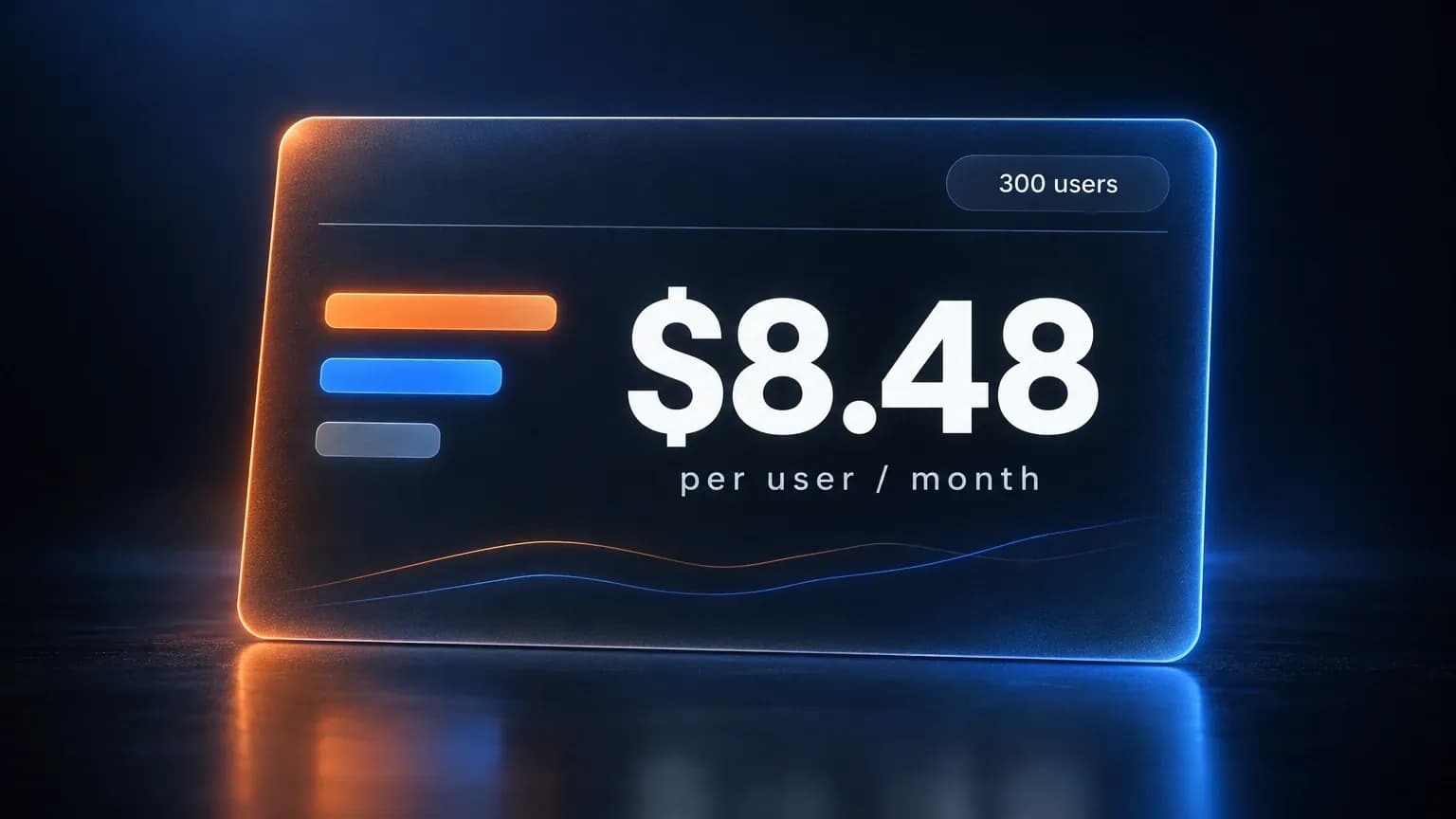
Jira pricing is published in full, and the number on the card is a figure almost nobody is charged. Set the counter to 50 users and watch it climb. What does your headcount cost?
Your renewal quote arrives, the per-user figure looks reasonable, and the total does not. Nothing on that quote is wrong, which is the frustrating part. The gap opens where one pricing model stops and another starts, and at 51 seats it is worth $3,781.60 a year.
Every figure below was read from atlassian.com on 15 November 2026, in USD, for the United States market. Where a number is my arithmetic on the vendor's rates rather than a figure printed on the page, I say so.
The Jira pricing ladder, dated
Atlassian sells four plans: a Free tier capped at 10 users with 2 GB of storage, then Standard, Premium and Enterprise. Standard and Premium sit on a public ladder. Enterprise does not. Where the free tier ends is a question of its own, and [Notion pricing](/blog/notion-pricing/) draws that line in a different place.
Worth saying plainly, because it explains why published Jira prices disagree: the pricing page and the licensing ladder behind it are the only two documents in this chain that publish a price at the source. Everything else is a copy of them, and some of the copies are a price increase behind.
The shape explains what follows. The monthly rate is progressive and the annual rate is a fixed tier. On monthly billing each user carries the rate of the band they fall into, so 300 users means 100 at the first rate, 150 at the second and 50 at the third. On annual billing you buy the whole tier.
That difference is why the card can look better than your own rate. Set the counter to 300, leave the toggle on Monthly, and Standard reads $8.48 per user / month. Recomputing from the band rates gives 100 at $9.70, 150 at $8.20 and 50 at $6.85, which is $2,542.50 for those 300 users, or $8.475 each. It is an average across three bands, and no 50-person team can buy it.
Part of what that second tier buys is an AI allowance rather than extra seats. Atlassian bundles Rovo credits into each plan at 25 per user per month on Standard and 70 on Premium, read from the pricing page on 15 November 2026. Both tiers price the same headcount, so the upgrade buys capability, not capacity. If nobody on your team touches Rovo, that allowance is the first thing to question before you move up.
Users | Standard, billed annually | Standard, effective per user / month | Premium, billed annually | Premium, effective per user / month |
|---|---|---|---|---|
1 to 10 | $950 | $7.92 at 10 users | $1,950 | $16.25 at 10 users |
11 to 15 | $1,450 | $8.06 at 15 users | $2,950 | $16.39 at 15 users |
16 to 25 | $2,450 | $8.17 at 25 users | $4,900 | $16.33 at 25 users |
26 to 50 | $4,850 | $8.08 at 50 users | $9,800 | $16.33 at 50 users |
51 to 100 | $9,700 | $8.08 at 100 users | $19,500 | $16.25 at 100 users |
101 to 200 | $18,000 | $7.50 at 200 users | $34,500 | $14.38 at 200 users |
Prices read from atlassian.com on 15 November 2026. The effective per-user column is my arithmetic: annual tier price divided by the top count in that band, divided by twelve. A team lower in the band pays the same total, so its effective rate is higher.
Two things follow. The rate you get quoted depends on where in a band you land, and the band is set by headcount rather than by negotiation. Enterprise is its own conversation: billed annually only, quoted by sales, starting above 800 users, no list price published.
Jira pricing at 10, 50 and 200 users
A Jira purchase usually starts from "about ten dollars a user". Here is what that comes to.
Users | Standard, annual tier | Standard, monthly billing over 12 months | Premium, annual tier | Premium, monthly billing over 12 months |
|---|---|---|---|---|
10 | $950 | $1,164.00 | $1,950 | $2,352.00 |
50 | $4,850 | $5,820.00 | $9,800 | $11,760.00 |
200 | $18,000 | $21,480.00 | $34,500 | $41,100.00 |
Prices read from atlassian.com on 15 November 2026. Annual tiers are published. The monthly column is my arithmetic: each user's band rate times twelve, summed across bands.
A 50-person team on Standard pays $4,850 a year, which is $8.08 per user per month. At 200 users it is $18,000, or $7.50 each. The curve does not bend the way you would guess: the 10-person team sits at $7.92, better than the 50-person team, because it lands at the top of a narrow band.
That seat-versus-tier question is not unique to Jira, and the ladder is where any comparison has to start. Smartsheet pricing works the same question through from its own rate card.
Where the Jira pricing tier boundary sits
Now the part that decides real money, and no pricing page states it. Because the annual price is a fixed tier and the monthly price is progressive, at the bottom of an annual tier the monthly option is cheaper. Thousands of dollars cheaper.
Six rows below, in three pairs. Each pair is the top of a band and the seat one past it.
Users | Standard, annual tier | Standard, monthly billing over 12 months | Cheaper option |
|---|---|---|---|
50 | $4,850 | $5,820.00 | Annual, by $970 |
51 | $9,700 | $5,918.40 | Monthly, by $3,781.60 |
100 | $9,700 | $11,640.00 | Annual, by $1,940 |
101 | $18,000 | $11,738.40 | Monthly, by $6,261.60 |
200 | $18,000 | $21,480.00 | Annual, by $3,480 |
201 | $25,500 | $21,562.20 | Monthly, by $3,937.80 |
Prices read from atlassian.com on 15 November 2026. Annual tiers are published. The monthly column applies the progressive band rates: 51 users is 50 at $9.70 plus 1 at $8.20, times twelve; 101 users is 100 at $9.70 plus 1 at $8.20; 201 users adds 100 at $8.20 plus 1 at $6.85.
A 51-person team on annual billing pays $9,700. The same 51 people on monthly billing pay $5,918.40 over the year. The annual tier threw them into the 51 to 100 band and charged for the whole band; monthly billing only added one person at the next rate down. At 101 users the gap grows to $6,261.60.

Premium has the same shape. At 51 users, annual is $19,500 and monthly comes to $11,935.80. At 201 users, annual is $46,500 and monthly comes to $41,222.40.
Atlassian's own page says annual billing "saves up to 17%" and that "for annual subscriptions, we'll charge you for the tier that most closely matches your user count". Both are accurate. The second one is the whole mechanism, and "up to" is doing more work there than it looks like.
What actually changed since 2024, and what did not
On 1 May 2024, Atlassian merged Jira Work Management and Jira Software Cloud into one product called Jira. That is a product consolidation, not a licensing change. The date still appears on the vendor's licensing page, in the answer to "why is Jira Cloud no longer called Jira Software Cloud?", which is why pages keep treating 2024 as the year the rules moved.
What did change since then touches a budget in three places.
Data Center sales to new customers ended on 30 March 2026, with end of life on 28 March 2029. If your team is still self-hosted, the runway is three years and the migration target is a cloud tier on the ladder above.
Automation is now counted in steps rather than flow runs, and Enterprise lost its unlimited allowance. The Free tier includes 150 steps per subscription per month. If your workflows were sized against the old allowance, recount them before you pick a tier.
Then there is the newest line on the invoice. Usage billing starts on 3 December 2026, and extra automation steps run at $0.50 per 1,000 steps.

One more change explains the numbers you will read elsewhere. On 13 October 2026 the cloud list prices moved: reported as 7% below 5,000 seats and 10% above, Enterprise at 8%. Three independent trackers record it and their figures agree, while Atlassian's own page does not advertise it. The result is not in dispute: $9.05 and $18.30 are no longer on the vendor's page, and guides dated September and October 2026 still print both. One of them carries an 18 October 2026 date and an $8.15 rate.
Is it still the expensive option?
The question is worth answering with a number rather than an adjective. A 50-person team on Jira Standard, billed annually, spends $4,850 a year: $404 a month for the whole team, or $8.08 per person.
Whether that is expensive depends on the tier you would otherwise buy, and I will not hand you a competitor table built on figures I could not verify at the source. Start from the Asana pricing and Monday.com pricing ladders instead and run your own headcount through them.
What is not in dispute is the direction of the company behind the price. Atlassian reported $6.6 billion in trailing twelve month revenue and 26% year over year growth as of 30 June 2026, and I would not budget on prices at that scale drifting back down.
So the useful question is narrower than the one usually asked. It is whether your headcount sits at the expensive end of a band, on the wrong billing cycle, or on a tier picked for an automation ceiling you have not measured.
The number to take to finance
Jira pricing is published, and once the two mechanics are separated it stops being complicated. The per-user figure on the card is a blended average at whatever headcount the card is set to. The annual figure is a fixed tier, so the bottom of each band is the most expensive place in it.
Two levers decide your number and both are yours to pull. Seat count decides which band you land in, and one seat can cost thousands more than the seat itself. Billing cycle decides whether you pay for the whole tier or only for the people in it. Neither lever requires talking to sales.
Run your headcount against the three tables above before you sign an annual order. One row at 51 or 101 users pays for the ten minutes on its own.
Prices as of 15 November 2026. Every Atlassian figure above was read on that date from atlassian.com/software/jira/pricing and atlassian.com/licensing/jira-software, in USD for the United States market. Totals marked as arithmetic are my calculations on the published rates. The October 2026 increase is reported by three independent trackers and is not advertised on Atlassian's own page.
Frequently Asked Questions
How much is Jira per user?
On monthly billing the Standard rate is $9.70 per user per month for the first 100 users, $8.20 for 101 to 250, and $6.85 for 251 to 1,000. Premium is $19.60, $14.65 and $10.20 on the same bands. On annual billing the per-user figure is derived: $7.92 at 10 users, $8.08 at 50, $7.50 at 200, $7.08 at 300, because the annual price is a fixed tier divided by whoever is in it. A 12-person team shows the same trap in miniature: annual is $1,450 for the 11 to 15 band, or $10.07 each, while the same 12 people on monthly billing come to $1,396.80 over the year.
Is there a free version of Jira?
Yes. The Free tier costs nothing and is capped at 10 users, with 2 GB of storage, 150 automation steps per subscription per month, and community support at 100 emails a day. The eleventh user ends it: Standard starts at $950 a year for up to 10 users.
What is the difference between Standard and Premium?
Both tiers use the same bands and boundaries, and Premium costs roughly double across the bands a small or mid-size team sits in. At 50 users that is $4,850 against $9,800 a year; at 200 users, $18,000 against $34,500. Because the boundaries match, the choice is a straight comparison of two annual numbers rather than a calculation. Both tiers price the same headcount, so what separates them is the Rovo credit allowance, 25 per user per month on Standard against 70 on Premium.

One workspace price instead of a per-headcount multiplication
Allable prices a workspace rather than a seat count, so the arithmetic this page walks through has no equivalent there. Pro is EUR 99 a month, Business EUR 199 and Scale EUR 399, with project and user allowances written into the plan instead of multiplied by headcount. The 7-day trial starts when you connect, the plan you pick begins after it, and the card is taken upfront.