
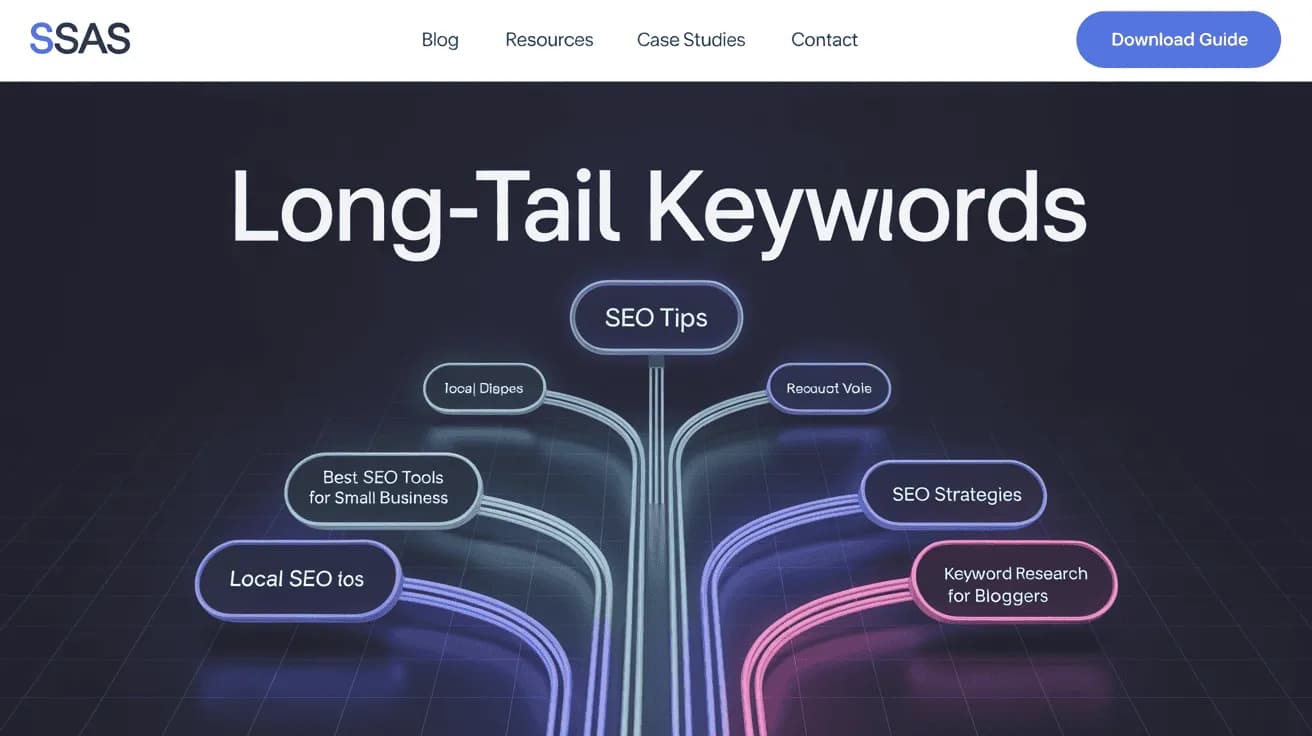
Here's a number that should change how you think about SEO: 91.8% of all Google searches are long-tail queries. Not the broad, single-word terms everyone fights over — the specific, multi-word phrases that most marketers ignore.
Here's a number that should change how you think about SEO: 91.8% of all Google searches are long-tail queries. Not the broad, single-word terms everyone fights over — the specific, multi-word phrases that most marketers ignore. The irony is that the keywords with the most competition drive the least qualified traffic, while the ones you can actually rank for are driving the majority of real purchase decisions.
If you've been pouring your budget into "best CRM software" or "marketing tools" and wondering why visitors bounce without converting, this guide will reframe your entire keyword strategy. Long-tail keywords aren't a consolation prize for websites that can't rank for head terms. They're the smarter play for almost everyone — and in 2026, they're more valuable than ever.
What Are Long-Tail Keywords?
A long-tail keyword is a highly specific search phrase that typically reflects a user who is further along in the decision-making process. They usually contain three or more words, though the real defining characteristic isn't length — it's low search volume relative to head terms and high specificity.
Ahrefs describes them well: in their U.S. database, there are just 31,000 keywords with more than 100,000 monthly searches, while there are 3.8 billion keywords with fewer than 10 monthly searches. The "tail" of the search demand curve isn't a footnote — it's almost the entire curve.
Classic examples of long-tail keywords:
- "long tail keywords" → head keyword (~1,900 searches/month)
- "how to find long tail keywords for a new blog" → long-tail (very specific, low volume)
- "best running shoes for women with flat feet" → long-tail (100–500 searches/month)
- "HVAC repair Denver same day" → long-tail (transactional, local intent)
- "contemporary art deco lounge chair for small apartment" → long-tail (highly specific commercial intent)
Notice how each long-tail example tells you exactly what the searcher wants, where they are in the buying cycle, and what kind of content would satisfy them. That precision is the point.
Key insight: Long-tail is not strictly about word count. A five-word keyword can have 200,000 monthly searches (making it a "head" term), while a three-word keyword can have 50 (making it genuinely long-tail). It's about specificity and volume relative to the topic.
Long-Tail vs Short-Tail Keywords: What's the Real Difference?
Most guides treat this as a simple volume trade-off. It's more nuanced than that. Here's how the three tiers actually compare:
Keyword Type | Example | Monthly Volume | Keyword Difficulty | Conversion Intent |
|---|---|---|---|---|
Short-tail (head) | "running shoes" | 100,000+ | 80–95 | Very low |
Mid-tail | "best running shoes for women" | 5,000–20,000 | 50–70 | Medium |
Long-tail | "best running shoes for women with flat feet" | 100–500 | 10–30 | High |
Zero-volume long-tail | "waterproof trail shoes for Morton's neuroma" | 0–10 | 0–5 | Very high |
The critical column isn't volume — it's conversion intent. A visitor who searches "running shoes" might be a journalist, a student doing research, someone checking a birthday gift idea, or an actual buyer. You have no idea. A visitor who searches "best running shoes for women with flat feet" has told you their gender, their use case, their problem, and their purchase readiness. That's a fundamentally different conversation.
Short-tail keywords have their place — they're essential for brand awareness and pillar content. But if your goal is qualified traffic that converts, long-tail keywords are where you should be spending most of your effort.
Why Long-Tail Keywords Drive More Qualified Traffic
Lower Competition, Higher Intent
The reason most websites ignore long-tail keywords is also the reason they're so valuable: big competitors don't bother with them. When a head keyword gets 100,000 searches per month, every major brand in your space is fighting for it. When a long-tail keyword gets 200 searches per month, you might face three or four real competitors — and you can beat them with a well-written, genuinely helpful page.
This is how newer websites and smaller businesses can compete. You're not trying to outrank Amazon for "shoes." You're trying to outrank two semi-relevant blog posts for "waterproof hiking boots for wide feet under $150."
Keyword difficulty scores reflect this clearly. Head terms typically score 80–95 on standard difficulty scales. Long-tail terms for the same topic often score 10–30, meaning a site with modest domain authority can rank within weeks rather than years.
Better Conversion Rates
This is where long-tail keywords genuinely separate themselves. Research by SEER Interactive analyzing over 1.5 million keyword-driven visits found that long-tail keywords had conversion rates 4.15 percentage points higher than short-tail terms on the same sites.
Yotpo's research puts it even more starkly: long-tail keywords typically convert at 2.5x the rate of head terms.
The logic is straightforward. Someone who searches "auto glass replacement Philadelphia" (a real example from SEER's research) has already decided they need the service, they know their location, and they just need to find a provider. They went from search to appointment — skipping the awareness and consideration phases entirely. That kind of search can't happen with a vague head term.
71% of marketers now prioritize long-tail keywords specifically for their ability to generate qualified leads, according to Circulate Digital's research. The shift away from chasing raw traffic volume toward attracting users who actually convert is one of the most significant strategic changes in SEO over the past five years.
How to Find Long-Tail Keywords (7 Methods)
1. Google Search Suggestions and People Also Ask
The simplest place to start is Google itself. Type your seed keyword into the search bar and look at two things:
- Autocomplete suggestions — These appear as you type. They're based on real queries people have searched. "Keyword research for small" will surface completions like "keyword research for small business," "keyword research for small blogs," and "keyword research for small ecommerce sites."
- People Also Ask boxes — These are pure gold for long-tail discovery. Each question in the PAA box is a real long-tail query, and each one you click expands to reveal more.
Also check the "Searches related to..." section at the bottom of the results page. These related searches are semantically connected long-tail terms that Google considers relevant to your topic.
This method costs nothing and takes five minutes. Do it for every seed keyword before reaching for a paid tool.
2. Google Search Console Data
Your Google Search Console is one of the most underused long-tail keyword sources available. It shows you every query that your site has already appeared in search results for — including hundreds of long-tail phrases you may not even know you're ranking for.
Go to Search Results → Queries and filter for queries you're ranking in positions 5–20. These are long-tail terms where you're close to the first page and a bit of content optimization could push you into the top three. This is often faster than targeting entirely new keywords because Google has already associated your content with these queries.
Sort by impressions to find the highest-opportunity terms, then look at which pages are capturing them — and whether those pages could be better optimized.
3. Answer The Public / AlsoAsked
Tools like AnswerThePublic and AlsoAsked mine Google's question data to surface long-tail keyword clusters organized by question type (who, what, when, where, why, how).
For a seed keyword like "keyword research," these tools will return hundreds of specific questions people are actually asking:
- "How to do keyword research for a new website"
- "What is keyword difficulty in SEO"
- "When should you update keyword research"
- "Why are long-tail keywords important for SEO"
Each of these is a ready-made long-tail keyword with clear search intent. For keyword research for SEO, this approach often reveals entire content clusters you hadn't considered.
4. Keyword Research Tools (Ahrefs, Semrush, Allable)
Purpose-built keyword tools give you search volume, keyword difficulty, and intent signals at scale — which is essential once you move beyond the exploratory phase.
The key filters when looking for long-tail opportunities:
- Word count: 3+ words
- Keyword difficulty: Under 30
- Search volume: 50–1,000 (varies by niche)
- Intent filter: Informational or Transactional (depending on your goal)
In Semrush's Keyword Magic Tool, the "Questions" filter surfaces long-tail queries by default since question-based searches are inherently specific. In Ahrefs, filtering the Keywords Explorer by KD under 20 and volume under 1,000 will show you a long list of genuinely accessible opportunities.
Allable's keyword research tool takes this further by combining keyword discovery with AI-powered intent classification and competitor gap analysis — so you can see not just which long-tail terms exist, but which ones your competitors are ranking for that you're not. This is especially useful for identifying quick wins in your existing content.
5. Reddit, Quora, and Niche Forums
Online communities are where people ask unfiltered questions in their own language. The phrasing they use is often exactly how they'd phrase a Google search — which means it's a direct window into real long-tail queries.
Search Reddit for your topic and look at:
- Question threads with high upvote counts
- Recurring questions in community FAQs
- Comment threads where people describe their specific problem
Quora works similarly. A question like "What's the best way to do keyword research if you're a one-person startup with no budget?" is itself a long-tail keyword cluster waiting to be written about.
The language people use in forums is often different from the SEO-optimized language brands use — and that difference is exactly where long-tail opportunities hide.
6. Competitor Keyword Gaps
Your competitors are already doing keyword research. Instead of starting from scratch, find the long-tail terms they're ranking for that you're not — and build better content for those terms.
This is competitor keyword research in its most practical form. In most keyword tools, a "keyword gap" report shows you terms where competitors appear in the top 10 and you're either not ranking or ranking below position 20. These are proven topics (someone is already getting traffic from them) where you have room to compete.
Focus on long-tail terms where your competitors are ranking with thin content — a short blog post that doesn't fully answer the query, or a product page trying to rank for an informational keyword. Those are your best entry points.
7. Your Own Site Search Data
If your website has an internal search function, the search terms your visitors use are a direct signal of what they're looking for but not finding. This is long-tail keyword data that's unique to your audience.
In Google Analytics 4, you can see internal search queries under Events → search (or via Search Reports if you've configured site search tracking). Common patterns to look for:
- Specific product variants people search for that you don't have pages for
- Questions that suggest content gaps
- Location-modified searches that indicate local intent
This data is especially valuable for e-commerce sites and content publishers with large catalogs. If 200 people a month search your site for "how to set up email automation for Shopify beginners," that's a content piece that practically writes itself.
How to Choose the Best Long-Tail Keywords for Your Strategy
Not all long-tail keywords are worth pursuing. Here's how to filter for the ones that will move the needle:
1. Match keyword intent to your content type
- Informational intent ("how to find long-tail keywords") → blog post, guide
- Commercial intent ("best keyword research tools 2026") → comparison page, review
- Transactional intent ("buy SEO tool subscription") → product/landing page
2. Prioritize relevance over volume
A keyword with 100 monthly searches that's directly relevant to your product is worth more than a keyword with 1,000 searches that's only tangentially related. Qualified traffic beats volume traffic every time.
3. Check the SERP before committing
Search the keyword yourself. Look at what's ranking. If the top results are authoritative, well-researched 3,000-word guides from high-DR domains, you'll need significant effort to compete. If the top results are thin, old, or off-topic — that's your opportunity.
4. Think in clusters, not individual keywords
Rather than targeting one long-tail keyword per page, cluster related terms that share the same search intent onto a single piece of content. A page about "how to find long-tail keywords" can naturally incorporate "long-tail keyword research," "long tail keywords examples," and "how to do keyword research" without feeling forced. This is more efficient and signals topical authority to Google.
5. Set a realistic KD threshold
For newer sites (under 2 years, modest backlink profile), aim for KD under 20. For established sites with strong domain authority, you can target up to KD 40–50. Going after KD 70+ long-tail keywords rarely makes sense — at that point, you'd be better served building foundational content first.
How to Use Long-Tail Keywords in Your Content
Once you've identified your target keywords, placement matters. Here's the practical guide:
In your title and H1: Use the primary long-tail keyword or a close variant. Don't stuff — write for the reader first, and let the keyword fit naturally.
In the first 100 words: Google gives extra weight to keywords that appear early. Work your primary term into the intro paragraph naturally.
In subheadings (H2/H3): Use secondary long-tail keywords as section headers. A question-format H2 like "How do long-tail keywords affect conversion rates?" signals to Google that you're answering a specific query.
In the body text: Distribute secondary and related keywords throughout the article. Vary the phrasing — "long tail keywords," "long-tail search terms," "specific search phrases" — rather than repeating the exact keyword every 100 words.
In meta descriptions: Include your primary keyword in the meta description. While meta descriptions don't directly influence rankings, they improve click-through rates when the searcher's query is bolded in the snippet.
In image alt text: If you include images or charts, use descriptive alt text that naturally incorporates relevant terms.
In internal links: When linking to related content, use descriptive anchor text that includes long-tail terms. This tells both readers and Google what the linked page is about. For example, linking to your AI SEO guide with the anchor "AI SEO" is more useful than "click here."
One thing to avoid: keyword density targets. Writing naturally with the reader in mind will produce appropriate keyword frequency automatically. Trying to hit "2% keyword density" produces robotic, unreadable content.
Long-Tail Keywords: Real Examples by Industry
To make this concrete, here's how long-tail keyword strategy plays out across different niches:
E-commerce (footwear):
- Head: "sneakers"
- Mid-tail: "women's running sneakers"
- Long-tail: "women's zero-drop running shoes for wide feet size 9"
- The long-tail version tells you exactly what product page to build and what features to highlight.
SaaS / Software:
- Head: "CRM software"
- Mid-tail: "CRM for small business"
- Long-tail: "CRM for freelance graphic designers under $50/month"
- A landing page targeting this exact query will convert dramatically better than a generic CRM homepage.
Local services:
- Head: "plumber"
- Mid-tail: "plumber Chicago"
- Long-tail: "emergency pipe repair Chicago north side 24 hours"
- The conversion intent is unmistakable. Someone searching this is calling within minutes of landing.
Content / Publishing:
- Head: "SEO tips"
- Mid-tail: "SEO tips for beginners"
- Long-tail: "SEO tips for Shopify product pages with no technical background"
- This level of specificity builds a loyal audience because you're speaking directly to their exact situation.
B2B / Marketing tools:
- Head: "marketing automation"
- Mid-tail: "marketing automation software"
- Long-tail: "marketing automation software for agencies with 5 clients"
- A blog post or landing page targeting this gets fewer visits but dramatically higher demo request rates.
FAQ
How many words does a long-tail keyword need to have?
There's no strict word count requirement. The real definition is about specificity and low search volume relative to the head keyword. A three-word keyword can be long-tail if it's highly specific; a five-word keyword can be a "head" term if it gets 50,000 searches per month.
Are long-tail keywords easier to rank for?
Usually, yes — but not always. Long-tail keywords typically have lower keyword difficulty scores because fewer authoritative sites are competing for them. However, some long-tail queries are dominated by strong domains. Always check the actual SERP before targeting a keyword.
How many long-tail keywords should I target per page?
Focus on one primary long-tail keyword per page, then cluster 3–10 semantically related long-tail terms that share the same search intent. One page, one intent — but multiple related expressions of that intent.
Do long-tail keywords still work with AI-generated search results?
Yes — and arguably more so. AI Overviews and generative search results tend to pull from content that answers specific questions comprehensively. A well-structured page targeting a specific long-tail query is more likely to appear in an AI-generated answer than a generic page targeting a broad topic.
How do I find long-tail keywords for free?
Start with Google Autocomplete, People Also Ask, and the "Searches related to..." section. Use Google Search Console for your existing site data. AnswerThePublic has a free tier. These three sources alone can fill a content calendar for months.
Start Finding Long-Tail Keywords Today
Long-tail keywords aren't the backup plan — they're the smart plan. The data is consistent: 91.8% of searches are long-tail, conversion rates are 2.5x higher than head terms, and the competition is a fraction of what you'd face going after volume keywords.
The seven methods in this guide give you a systematic way to build a keyword portfolio that's realistic to rank for and valuable to convert. Start with Google's own data (Autocomplete, PAA, Search Console), expand with a dedicated tool, and layer in competitor gap analysis to find the opportunities others are missing.
If you want to do this at scale — across multiple pages, products, or service areas — Allable's keyword research tool combines AI-powered discovery with intent analysis and competitor gap detection, so you can build your long-tail strategy without spending hours in spreadsheets.
For a deeper look at the foundational process, read our guide on keyword research for SEO and the best AI SEO tool options available for 2026.
The search demand curve doesn't lie: the tail is where the volume is. Time to start fishing there.
Ready to find long-tail keywords for your website? Try Allable AI — describe your goal and let AI do the research.