Content Strategy & Planning · Definition
What Is Content Brief?
A content brief is the specification a writer works from: the target keyword and intent, the angle, the structure, the sources, and what the page has to do. It…
A content brief is the specification a writer works from: the target keyword and intent, the angle, the structure, the sources, and what the page has to do. It is where a piece is won or lost, long before anyone writes a sentence.
Most underperforming content was not written badly — it was briefed badly, or not at all. A writer given a title and a word count will produce something readable that answers a question nobody asked, in a format the SERP does not reward. The brief is the point where research becomes instruction.
A working brief carries the primary keyword and its cluster, the intent read off the actual results page, the page type that intent demands, a specific angle that differentiates it from what already ranks, an H2-level outline, the questions to answer explicitly, the internal links to include, sources or data to cite, and the conversion goal. That last item is what stops a page from ranking beautifully and doing nothing for the business.
The angle deserves particular attention. If the brief only says "cover this topic", the writer will reproduce the consensus already on page 1, which gives Google no reason to prefer it. A brief that names what is missing from the current results — a real example, original data, a practitioner's opinion, a step nobody explains — is the difference between another entry and a better one.
The practical play is to make briefs the standard unit of handoff and keep them short enough to be read. One page, produced from the keyword research rather than from imagination, reused as the review checklist when the draft comes back. AI drafting has made this more important, not less: a model given a strong brief produces a usable draft, and a model given a title produces confident, generic filler.
Examples
- Primary keyword “content brief template”, intent informational-with-download, format: guide plus template — read directly off a page 1 dominated by template pages.
- Angle line: “every competing page lists what goes in a brief; none show a filled-in one from a real project — include ours.”
- A brief specifying three internal links, two data sources, and the FAQ questions from People Also Ask, so the draft comes back complete instead of half-finished.
Common questions
What should a content brief include?
Target keyword and cluster, search intent, page type, a differentiating angle, an H2 outline, questions to answer, internal links, sources to cite, and the conversion goal. Anything longer than a page tends not to get read.
Who writes the content brief?
Whoever did the keyword and SERP research — usually the SEO or content strategist, not the writer. The point of a brief is to hand over research the writer would otherwise have to redo.
Do I still need briefs if AI writes the draft?
More than before. The brief is the input that decides whether the draft is specific and differentiated or a fluent restatement of page 1. It also doubles as the review checklist for the output.
Allable briefs and drafts in the same pass
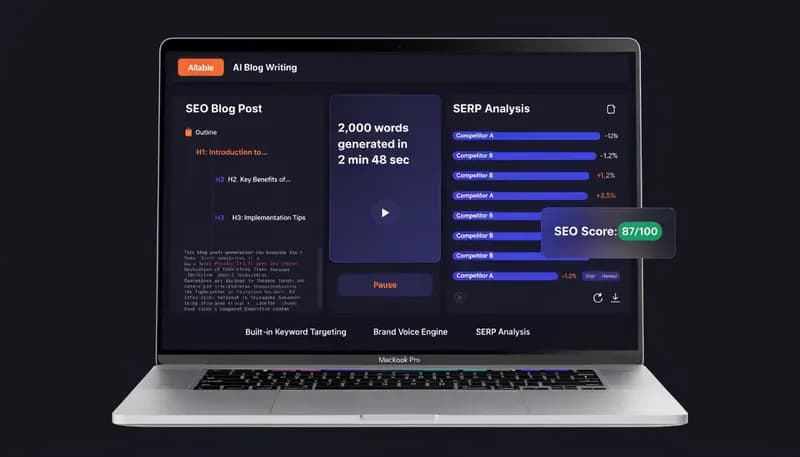
Allable's AI Writing Assistant builds the brief from live SERP research — intent, outline, questions, entities, internal links — then drafts against it, so the first version already fits the page it's competing with.
Also known as
Do it automatically
AI Blog Writing Tool
Put Content Brief to work — see how Allable handles it for you.
Related terms

Your competitors are already using AllAble. Are you?
The marketers pulling ahead aren't working harder. They're just working with one tool that does everything — that tool is AllAble. Try it yourself!