Lead Generation Content Marketing: Why the Asset That Converts Is Rarely the One You Gate
 Written by Martin H.
You publish for months and the pipeline stays flat. Every asset you ship asks for a download exactly when a stranger decides whether to trust you. What would change if your best asset needed no form at all?
Your most downloaded asset is probably your least useful one. The formats that pull the most registrations are the formats that predict a purchase decision least reliably. You are counting downloads and calling it demand. Meanwhile the reader who decides your next deal has never filled in a form for you. Not once. So the asset you are proudest of probably never reached the person who signs.
What Content-Led Lead Generation Actually Is (and Is Not)
Lead generation content marketing is the practice of publishing something useful enough that a stranger chooses to identify themselves to you.
Notice what that leaves out. Nothing says the identification has to happen through a form, and nothing says your asset has to sit behind one.
The version you probably run is a taxonomy: write an ebook, run a webinar, gate the useful part, count the leads. Every large vendor in your category already published that list, and they reach more of your buyers with it than you do. Build on that frame and you spend the quarter arguing over a definition you cannot win.
The version worth your budget is a selection problem. You have maybe six assets you could build this quarter. Which one earns permission to continue the conversation with a specific person on the buying committee? That question has an answer you can defend in a planning meeting. A taxonomy never needs defending, because it never decides anything.
Strip it back and content-led lead generation does three jobs for you. It gets found by a person with a problem and no supplier. It survives being read by people who will never speak to your sales team. It gives that reader something to carry into a room you are not in.
If an asset does none of those three, it is a content marketing habit. Hitting a calendar is not the same thing as building a content marketing strategy, and your boss can tell the difference when the pipeline number lands.
The Four Asset Types That Earn a Pipeline Entry
I have watched a team celebrate four hundred downloads on a format that could never produce a meeting. I have also watched a two page security brief unlock a deal stuck for six weeks. Both were well made. The difference was fit with the person reading, and that is a decision you make before you write a word.
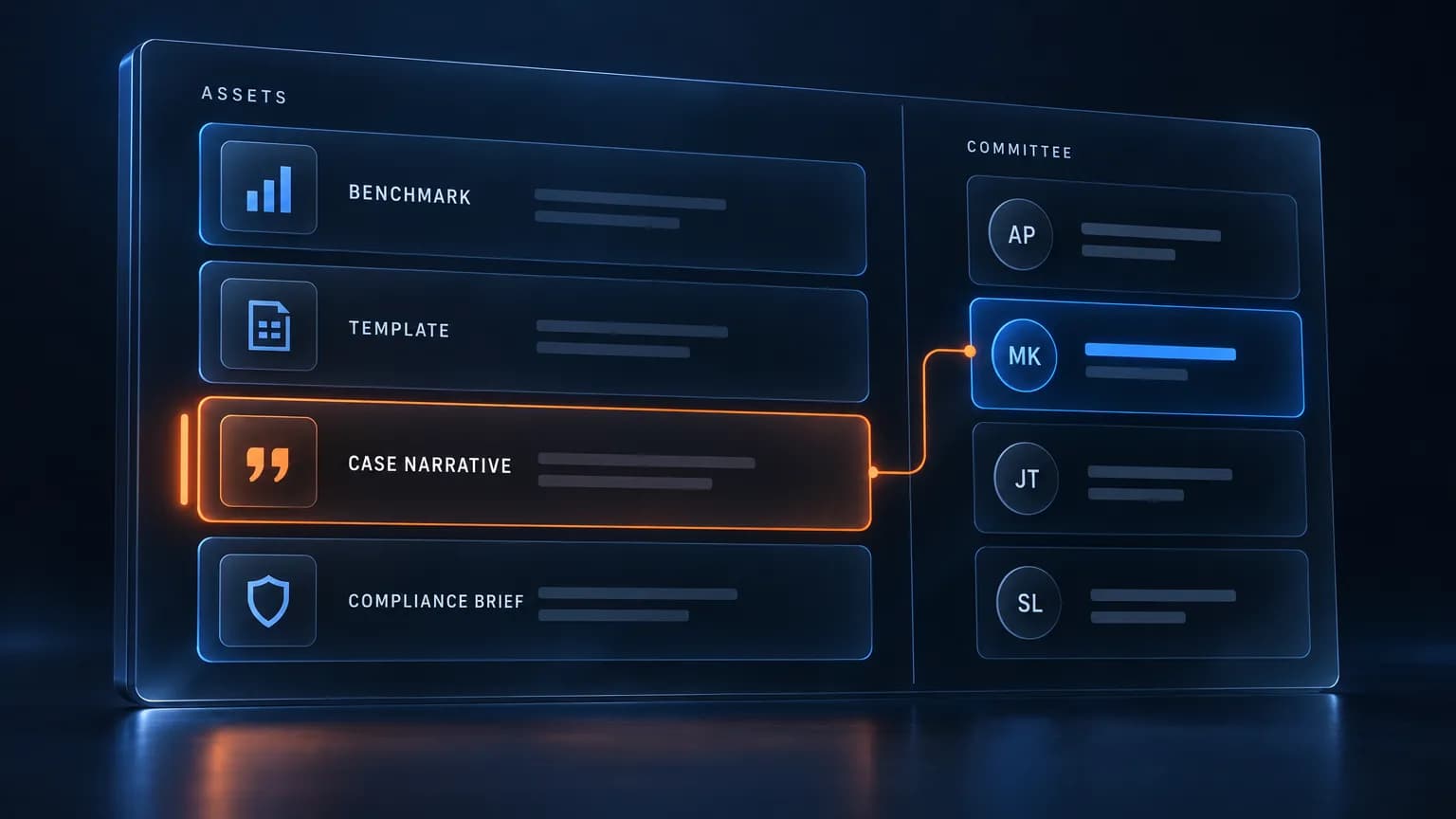
Four types of lead generation content earn their place in your library, and each one earns something different.
Asset type | What it earns | Who it selects for |
|---|---|---|
Benchmark or teardown built on your own data | A reply with a question attached, because the reader wants the method | Technical evaluator, plus the economic buyer who needs a defensible number |
Working template or playbook | A forward inside the company, often unedited | End user, the person who will actually run it |
Peer case narrative with named numbers | An argument the reader can repeat in a room you are not in | Economic buyer, and the procurement lead who has to justify the shortlist |
Risk and compliance brief | A cleared path, not a lead | Procurement and legal |
The benchmark is the one almost nobody builds, because it costs original work. You need your own data, and the nerve to publish a number that makes your category look worse than the marketing copy does. It is the only asset here that a technical evaluator forwards with the comment "read this".
The template earns less attention and more movement. Nobody ever said a spreadsheet template changed their view of a category. They do say they sent it to the person who owns the process, and that person now runs your logic every Monday morning. That beats a download.
Where the case narrative does its best work is your sales team's field knowledge. Named numbers, a real deadline, the moment the project nearly died. Write it for the economic buyer and be honest about the part that went badly, because procurement will ask and a story with no wounds reads as a press release.
The compliance brief rarely looks like marketing. That is why it works. Procurement and legal do not want your pitch. They want the answer to the question blocking the signature. Hand them two clean pages and you have done more for the deal than any campaign will.
If you can build only one this quarter, pick by the objection that has cost you the most revenue. Deals dying in security review call for the brief. Deals dying on price justification call for the benchmark.
None of these four is an ebook. The stages of your lead generation funnels tell you where an asset sits in the journey. They do not tell you who it is for, and the person is what decides whether it earns anything.

Why Gated Downloads Flatten the Conversion Curve
NetLine examined eight million first party registrations for its 2025 content report. Ebooks now account for 53% of all registrations, and ebook registrants were 12% less likely to signal a purchase decision within twelve months. Playbooks went the other direction, at 115% more likely. If you budget by download count, you are funding the format that predicts worst.
Two more findings explain why the curve flattens. Only 34% of registrants expect a purchase decision inside twelve months, and that figure fell three points year on year. The gap between requesting an asset and opening it widened from 31 to 39 hours. Your lead is not reading the ebook at the moment the form submits. Often they never open it.
TrustRadius supplies the reason in its 2026 buying study. Vendor marketing collateral sits last among the sources buyers actually consult, behind peer conversations, reviews and product demos. 47% of buyers say they trust online sources less than they did a year ago, up from 39%. A gated PDF is vendor marketing collateral by definition. You did not create a lead. You created a file in a folder nobody opens.
One more cost rarely gets named. An asset that only exists behind a form cannot be read, quoted or summarized by the assistants your buyer asks first, which is why AI lead generation work starts from such a thin picture of you. The argument your reader would have cited stayed locked in a file.
Form fills are not going away, and I am not telling you to delete every gate. Some assets cost real money to produce and some buyers expect a trade. What I am telling you is that the fill stops being the interesting event. The interesting event is a reader who carries your argument somewhere you cannot see.
Designing an Asset Backwards From the Buying Committee
Start with the room, not the format.
Edelman and LinkedIn surveyed close to two thousand professionals for their 2025 thought leadership report. The finding I keep returning to is about the people you never meet. 71% of hidden buyers, meaning the finance, legal, procurement and operations people who influence a purchase without being the main user, have minimal or no contact with a sales team. 63% of them still spend more than an hour a week reading thought leadership. 79% say they are more likely to support a proposal from a company that publishes strong content.
So the reader who decides your deal reads for an hour a week and will not fill in a form. They also vote in a meeting you are not allowed to attend.
Design backwards from that. Name the committee member whose objection kills your deals most often, then ask what they would have to read to stop objecting. Write that, and only that.
Write the objection down first, in the words that person would actually use, and then choose the format that carries it. Teams that start with the format spend their review meeting arguing about whether you should make a video.
If the answer is a security questionnaire, write the brief that makes the questionnaire boring. If the answer is a number their finance lead will accept, build the benchmark that produces it. If the answer is a story about a company like theirs that survived the switch, write the case with the hard parts left in.
The same report contains a harder number. More than 40% of B2B deals fail on internal disagreement inside the buying group, not on competition. You are not losing to a rival with a better product. You are losing to a meeting where nobody had your argument in front of them. That is a content problem, and content problems are the ones you can fix this quarter.

Telling a Content Lead From a Content Reader
A download is an event. A reply is a signal. Those are not the same thing, and confusing them is why content teams keep getting blamed for a pipeline you never had a chance to influence.
If you want to know whether an asset worked, look for one of five things. A question that quotes a specific line from it. A request for the underlying data. An introduction forwarded to a colleague you have never spoken to. A meeting request that names the asset. Someone mentioning it in a room you hear about three weeks later. Each of those arrives with a name attached, and none of them needs a form.
That is the difference between a content reader and a content lead. The reader consumes. The lead acts. Your job is to make acting cheap.
I put one question on every asset review now. What is the smallest action this asset should produce? If the answer is "download", the asset is decoration. If the answer is "send this to my finance lead", the asset has a job and you can measure whether it did it.
Then change the report. Put replies, named forwards and meeting requests on the page your leadership reads, and put downloads in the appendix. That single move changes which assets get funded next quarter.
Give it a quarter before you judge the result. An ungated asset works through people rather than through a form, so the reply usually arrives after the reader has seen the thing twice and mentioned it once in a meeting you were not in.
If outbound lead generation is where most of your pipeline starts, the mechanics differ in ways this article does not cover. I am not arguing with that model. This one runs on a different engine, and borrowing its scoreboard is how a good content program gets judged a bad one.
Where This Fits in the Demand Program
Content sits upstream of everything you report. The demand generation vs lead generation distinction is the useful frame here: demand work changes what your market believes, and lead work captures the people who already believe it. One asset can do both, but only if you decide which job it has before you write the first sentence.
Run the cycle once a quarter and keep it tight. Pick the committee member who stalls your deals. Build the one asset that answers them. Publish it where they can read it without asking anyone's permission. Measure the replies. Then take the next objection and repeat.
Do that four times and your content marketing for lead generation answers four real objections instead of four theoretical personas. Modest output, and your sales team starts forwarding it without being asked.
Lead Generation Agency or In House
A good lead generation agency can run this cycle for you. A retained agency sits in five other buying rooms and hears the objections you can only guess at, which is the input this method needs. What I would not outsource is the decision about which committee member you write for. That knowledge lives in your own lost deals.
In house, your constraint is editorial nerve rather than capacity. Someone has to publish a benchmark with no form in front of it and defend that call for two quarters before the first reply lands.
Frequently Asked Questions
What is a lead generation landing page, and where does it fit here?
A lead generation landing page is one page built to trade something specific for contact details. In this model it sits at the end of the chain, not the start. You send a reader there after the asset has earned their attention, not as the price of entry.
Do lead generation tools fix an asset that nobody replies to?
No. Lead generation tools manage the people who already reached you, and most of them do that well. None of them can manufacture a reason for a stranger to care. Fix the selection first, then automate the plumbing.
How do we know an ungated asset is working?
Count replies, requests for the data, forwards and meeting requests that name the asset. Every one of those shows up in your inbox or your CRM with a name attached. Download counts also show up, and they have been flattering you for years.

Start With the Free Trial
Allable is where I write, publish and measure assets like these in one workspace, with the performance data attached to the same project. Start your 7 day trial and put your first ungated asset in front of the committee before the week ends.