Marketing Agency Reporting: What a Book of Clients Costs to Report On
 Written by Martin H.

The last week of every month is the week your agency stops doing client work. Those hours sit on no invoice and nobody has priced them. What does your whole book cost to report on, and is that report what keeps the client?
Almost every page about marketing agency reporting is really about the software that formats it. The vendors publish the hours, then convert them into a case for buying their tool. What none of them costs is the thing you actually spend: a block of billable days, every month, on a document that appears on no invoice. On the hours assumption I use further down, fifteen clients at four hours each is 62% of one person's billable year, and most owners have never run that number on their own book. Which leaves the question the hours alone cannot answer: which clients on your book should never have been receiving that artifact in the first place?
The Three Jobs a Report Does
A report has three jobs, and they are not equally easy. Most agency reports only do the first one.
First, it proves the work happened. Screenshots, numbers, a list of what shipped. Every reporting tool handles this, and it is the cheapest of the three jobs to produce.
Second comes the variance explanation. Something moved against the plan, or refused to move at all, and the client needs to know why. That reason usually lives in a conversation, a product launch that slipped, or a competitor who cut prices in March. A connector cannot generate it.
The third job sets up the next decision. Continue, change scope, spend more here and less there. A report that does not end in a decision is a receipt.
Skipping the first job is rare. Skipping the second and third is the norm, and it is what turns a report into a document the client stops opening. A report that proves activity and says nothing about why the month looked the way it did is a summary of things your client could read in their own analytics, and they know it.
The third job is the one that pays. I have watched a client renew a retainer after a bad month, and I have watched one leave after a good one. The numbers were never the difference. What differed was whether the report explained what the agency would do next.
What a Book of Clients Actually Costs
The published figures on reporting time disagree by a factor of four. That spread is the first sign nobody is measuring this properly.
AgencyAnalytics publishes a band of 1.5 to 4 hours per client to produce a marketing report. A Databox survey found 49.25% of teams spending 1 to 3 hours preparing for each client meeting, with the same share reporting monthly. An AgencyAnalytics survey figure, carried by Tidal Arc in October, puts the average at 11.2 hours per client per month.
Those measure three different things. One is a report, one is a meeting, one is a month of a relationship. So pick a number, defend it, and show what happens when you are wrong. I use 4 hours per client per month, the top of the more conservative published band. If your team is faster, the model gets cheaper and the argument does not change.
The second input is what an hour actually costs you. Take an account manager at $85,000 fully loaded with 1,800 available working hours a year. That comes to $47 an hour, which is not the number you want. Haus Advisors' 2026 utilization benchmarks put firm-wide billable utilization at roughly 65%, with production staff at 75% to 85%. At 65%, the same salary buys 1,170 billable hours, so a consumed billable hour costs you $73. Monthly capacity per person at that rate is 97.5 billable hours.
What follows is a model with its assumptions written down, so you can swap in your own numbers and re-run it. It is not a measurement of your shop.
Clients on the book | Reporting hours per month | Loaded cost per month at $73/hour | Share of one person's billable capacity | Loaded cost per year |
|---|---|---|---|---|
8 | 32 | $2,336 | 33% | $28,032 |
15 | 60 | $4,380 | 62% | $52,560 |
30 | 120 | $8,760 | 123% | $105,120 |
Model assumptions: 4 hours per client per month, $85,000 fully loaded cost per account manager, 1,800 available hours per year, 65% billable utilization, no rework allowance, no tooling cost, and no time spent chasing platform access or waiting for a data source to settle. The crossover test further down adds one more: 50% gross margin on retained work.

Read the middle row again. Fifteen clients consume 62% of one person's billable year. You did not hire that person to write reports, and you cannot bill those 60 hours to anyone, because reporting sits inside the retainer as something the client never sees priced.
The sensitivity matters more than the point estimate. At 1.5 hours per client, 30 clients cost $3,285 a month, or 46% of one person. At 11.2 hours, the same book costs $24,528 a month, which is 3.4 full-time people doing nothing but reporting. That is the range the published figures genuinely describe, and it explains why owners underestimate it. We estimate from the report we remember building, not from the month that went sideways.
The Standardization Decision
Standardization is where an agency either buys back capacity or builds a factory nobody wants to read.
Three things can be templated without making the report worse. The structure, meaning the order in which a client learns what happened, why it happened, and what comes next. The metric set, meaning the numbers that appear every month regardless of performance. And the visual grammar, meaning the same chart types, color roles, and reading direction every time. All three save hours, because nobody has to make a hundred small decisions at 6pm on the second working day.
A marketing dashboard is the natural home for structure and visual grammar, and that is genuinely most of the saving. Your marketing KPIs decision fixes the metric set, and once it is fixed it should not move because a client asked a new question last Tuesday.
Two things cannot be templated. The variance explanation is the first, and it fails the moment you try, because the reason a number moved belongs to that client's month and nobody else's. The recommendation is the second. A template can remind you to write one. It cannot write one a client would act on.
White labeling is the same decision wearing a different coat. If another agency's brand goes on your report, your white label SEO reports still have to carry your explanation and your recommendation. Otherwise the buyer is paying for a skin with no thinking underneath it.
The test I use is simple. If a paragraph would survive being pasted into another client's report word for word, it is template output and it belongs in the templated layer. If it would be wrong in any other client's month, that is the part you are actually being paid for.
Two Client Types, Two Artifacts
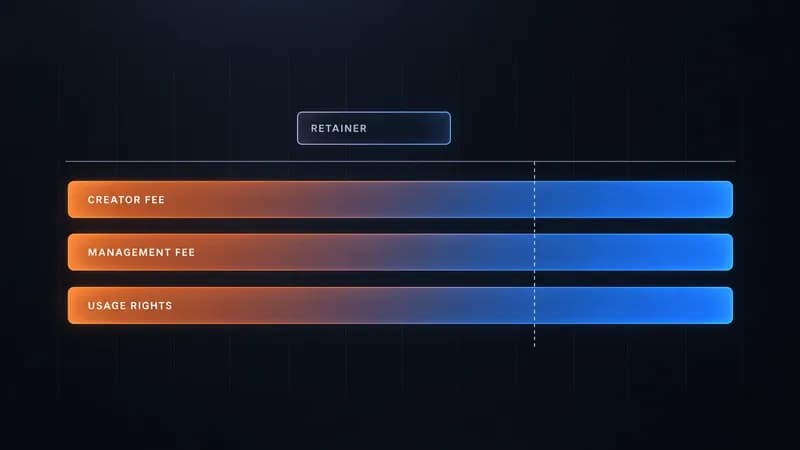
The most common reporting mistake is sending the same artifact to a retainer client and a project client.

Dimension | Retainer client | Project client |
|---|---|---|
What the artifact has to do | Defend the monthly fee and show what next month buys | Show that this scope closed properly and what the next scope is worth |
Cadence | Monthly, on a fixed date the client can plan around | At milestones and once at closeout |
Reader | The person who signed the retainer, plus anyone who can cancel it | Whoever approves the next project, often a different person |
Failure mode | A report that only proves activity, so the fee starts to look like a cost | No closeout document, so the next scope goes out to three agencies |
Cost of getting it wrong | Slow churn and a renewal conversation you lose late | No repeat purchase and no evidence you created the result |
The two contract types behave differently in the data. A 2026 churn report from Focus Digital puts retainer-based clients at 1.6% monthly churn, 18% a year, on a 56-month average lifespan. Project-based clients sit at 4.2% a month, 42% a year, on 24 months. Project churn is structurally more than twice the retainer rate. First Page Sage's September 2026 retention table points in the same direction with different numbers, showing PPC and paid media clients retaining 22.5% at twelve months against 55.4% for full-service digital. The two datasets do not agree on the level, so do not average them. They agree on the direction.
Why does that matter for the report? Because the artifact is the only recurring contact you have with a project client. A retainer client argues with you every month, and the argument is the relationship. A project client gets milestones, an invoice, and then silence. If the closeout document does not exist, the next scope goes out to bid and you find out about it in the same week it is already lost.
Retainer pricing is still the dominant commercial form. A 2026 Influencer Marketing Hub survey, carried by Agency Dashboard, puts 78% of digital agencies on retainer-based pricing as their primary model, up from 64% in 2023. That is why the monthly narrative gets all the design attention, and why the closeout document is the one that quietly goes missing.
Reporting as a Retention Instrument
The renewal gets decided by the nine reports that came before the renewal call.
The perception gap here is unusually wide. Setup's Marketing Relationship Survey, which covers more than 400 brand and agency professionals, found delivery dissatisfaction is the top reason clients end a relationship, cited by 48% of clients and up 14 points year on year. Agencies rank the same reason seventh. The same survey reports 40% of clients saying they will switch partners within six months.
Notice what the survey is measuring. Delivery, not results. Your report is the document where delivery becomes visible to the client, which makes it the cheapest lever you have on whether they stay.
The economics of closing that gap are not subtle. The Bain retention figures, as carried in Agiled's agency operations writing, say a 5% lift in retention raises profit by 25% to 95%, and that selling to an existing client is 60% to 70% likely against 5% to 20% for a new prospect. You do not need the top of that range for the argument to hold. You need the report to carry the explanation rather than the screenshots.
For the narrower question of what one client should receive and how often, the section-by-section answer lives in SEO client reporting. This article stays on the money.
What to Charge For and What to Absorb
There are two defensible answers and one indefensible one.
Baked in means reporting sits inside the retainer and never appears on an invoice. It works while the hours are small relative to the margin, and it fails once the book grows past the point where those hours are visible on a timesheet. If fifteen clients eat 62% of an account manager's billable year, baked in is not a pricing decision anymore. It is an unmeasured subsidy.
A line item means reporting has its own price, either as a named component inside the retainer or as a separate monthly fee. It is the honest form when a client wants extra depth, a custom metric set, or a call to walk through the numbers. It also puts the ad hoc requests on the record, which is the real point.
Here is the crossover test. Take a $2,000 monthly retainer at 50% gross margin, which leaves $1,000 to cover delivery. Four hours of reporting at $73 costs $292, or 29% of that margin. At 1.5 hours it costs $110, or 11%. So below 10% of account margin, absorb it and stop counting. Between 10% and 20%, standardize and get the hours down. Above 20%, either charge for it or shrink what the client receives, because you are funding the report out of the work.
The indefensible answer is the one most agencies arrive at by accident. Reporting is nominally included, the client sends a question every week, and each question gets answered as a small piece of free analysis. Ad hoc analysis requests are reporting in disguise, and they are the cleanest scope creep pattern in this business. A client asking why a number dropped is asking for the second job of the report. If that job is not in the artifact, it arrives as an email instead. Ten of those emails a month is a report you are building twice.
Where Marketing Agency Reporting Breaks
Four failure patterns cover most of it.
There is no standard, so every report is a small project. Hours do not compound across clients, and nobody can tell you what a report costs, because every one of them is different.
One person knows how to build it. This is the pattern that hurts most. That person is usually senior, usually busy, and one resignation away from taking the whole reporting capability out of the building with them.
The report is unreadable to the person receiving it. A dashboard built for the analyst gets forwarded to a CEO who has ninety seconds and no context. The metric set is technically correct and the narrative is missing.
The metric set changes every quarter. Each change resets the comparison, kills the trend line, and gives the client a reason to ask what happened to the numbers you reported in March.
All four sit inside marketing operations rather than inside marketing strategy, so a strategy review rarely fixes them. They get fixed by deciding what the standard is, who owns the build, and what a client is allowed to change without a scope conversation.
The Report Is a Commercial Decision Before It Is a Design One
The hours are already being spent. The only open question is whether you know what they cost and what they are buying you.
Run the arithmetic on your own book this week. Client count, honest hours per client per month, loaded cost per billable hour. The number will be higher than you expect, because the model above excludes rework, tooling, and the hours spent waiting for a platform to settle its data.
Then make the two decisions the number forces. Which clients get the monthly narrative and which get the closeout document. What is included in the fee and what gets a price.
The agencies I have watched get marketing agency reporting right did not buy better software. They decided what the report was for, priced the hours honestly, and stopped sending the same artifact to two kinds of client. The ones that did not are still sending a PDF on the third working day, still absorbing every question as free analysis, and still wondering why a client with good results left anyway.
Frequently Asked Questions
What should a marketing agency report include?
It has to prove the work, explain the variance, and set up the next decision. Those are three jobs, and most reports only complete the first. If a client reads your report and cannot answer what happens next, the artifact is incomplete no matter how many metrics it holds.
How often should an agency send client reports?
Monthly for retainer clients, on a fixed date, because the cadence is part of what the fee buys. For project clients, at milestones and once at closeout, because there is no monthly relationship to maintain and the closeout document is what carries the next scope. Match the cadence to when the client actually makes decisions, not to when your billing cycle closes.
Should agencies charge separately for reporting?
Only if the hours justify it, and the test is margin rather than principle. If reporting consumes under 10% of an account's gross margin, absorbing it costs less than the conversation. Above 20%, you are funding the report out of delivery work, and a named line or a reduced scope is the honest fix. Between those two numbers, standardize first.

Put the reporting hours back into client work
If the model above describes your month, the cheapest way to test a different approach is to run one real client report inside a single workspace instead of four dashboards and a spreadsheet. Seven days, full access, and one client's numbers to work with.